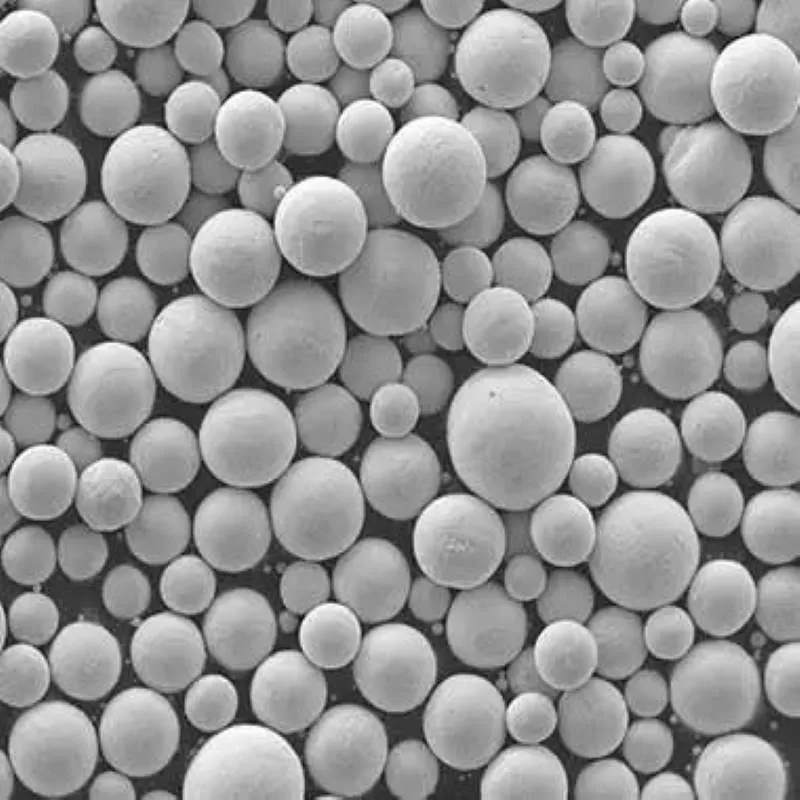
Spherical ASTM A500 Steel Powder, grade B
Product Code : SP-CSTI-532-CU
We provide Spherical ASTM A500 Steel Powder, grade B,Spherical ASTM A500 Steel Powder, grade B is suitable for laser/electron beam augmentation, hot isostatic pressing, laser cladding, hot/cold spraying, and so on. The particles can be irregular and spherical. The particle distribution can reach the nanometer scale.,Spherical Particle Size,0-15μm,,15-45um,15-53μm, 20-63um,45-105um,45-150μm , 50-150um,75-150μm,or customized,Product purity and oxygen content can be customized according to requirements.
Please contact us if you need customized services. We will contact you with the price and availability in 24 hours.
ASTM A500 Steel Spherical Powder, grade B, round structural tubing Product Information
-:-
For detailed product information, please contact sales.
-:
ASTM A500 Steel Spherical Powder, grade B, round structural tubing Synonyms
-:-
For detailed product information, please contact sales.
-:
-:-
For detailed product information, please contact sales.
-:
Spherical ASTM A500 Steel Powder, grade B characteristics
-:-
For detailed product information, please contact sales.
-:
Spherical ASTM A500 Steel Powder, grade B Particle Size
-:-
For detailed product information, please contact sales.
-:
-:-
-:-
0-15μm ,5-25μm, 15-45μm, 15-53μm,20-63um, 45-75μm, 45-105μm, 45-150μm ,75-150μm.
(Various granularities can be customized according to customer requirements)
-:-
For detailed product information, please contact sales.
-:
Spherical ASTM A500 Steel Powder, grade B Applicable processes
-:-
For detailed product information, please contact sales.
-:
Laser/electron beam additive manufacturing (SLM/EBM, 3D printing)
Direct laser deposition (DLD)
Used in thermal spray (TSA)
Powder hot isostatic pressing (HIP)
Metal injection molding (MIM)
Powder metallurgy (PM)
Laser cladding (LC), etc.
-:-
For detailed product information, please contact sales.
-:
Spherical ASTM A500 Steel Powder, grade B Chemical Composition
-:-
For detailed product information, please contact sales.
-:
-:-
For detailed product information, please contact sales.
-:
ASTM A500 Steel, grade B, round structural tubing Product Information
-:-
For detailed product information, please contact sales.
-:
# **Product Technical Datasheet: ASTM A500 Grade C - Round Structural Steel Tubing**
## **1. Product Overview**
**ASTM A500 Grade C, Round** is a **high-strength cold-formed welded and seamless carbon steel structural tubing** designed for **demanding structural applications** requiring maximum load capacity and superior mechanical properties. As the highest strength grade within the ASTM A500 specification for structural tubing, Grade C provides exceptional strength-to-weight ratio and structural efficiency, making it ideal for critical applications in construction, infrastructure, and industrial structures where material optimization and performance are paramount.
## **2. Governing International Standard**
- **Primary Standard:** **ASTM A500/A500M** - Standard Specification for Cold-Formed Welded and Seamless Carbon Steel Structural Tubing in Rounds and Shapes
- **Related Standards:**
- **AISC 360** - Specification for Structural Steel Buildings (recognizes A500 Grade C)
- **EN 10210** - Hot-finished structural hollow sections (S355J2H equivalent)
- **EN 10219** - Cold-formed welded structural hollow sections
- **CSA G40.20/G40.21** - Canadian structural steel standards
- **JIS G 3466** - Carbon steel tubes for general structure
## **3. Chemical Composition**
The composition is optimized for maximum strength while maintaining adequate weldability and toughness:
| Element | Maximum (%) | Typical Range (%) | Metallurgical Function |
|---------|-------------|-------------------|------------------------|
| **Carbon (C)** | 0.23 | 0.18-0.21 | Strength control with weldability balance |
| **Manganese (Mn)** | 1.35 | 0.90-1.20 | Primary solid solution strengthener |
| **Phosphorus (P)** | 0.035 | 0.020-0.030 | Impurity control for toughness |
| **Sulfur (S)** | 0.035 | 0.015-0.025 | Impurity control, inclusion shape control |
| **Copper (Cu)** | 0.20 min* | 0.18-0.25 | Atmospheric corrosion resistance (when specified) |
| **Silicon (Si)** | - | 0.15-0.30 | Deoxidizer, strength contributor |
| **Vanadium (V)** | Optional | ≤0.10 | Microalloying for grain refinement |
*Note: Copper requirement is optional for enhanced atmospheric corrosion resistance.
**Key Chemical Features:**
- **Higher Manganese:** Enhanced solid solution strengthening compared to lower grades
- **Controlled Carbon:** Balanced for strength without excessive weldability penalty
- **Carbon Equivalent:** Typically CE ≤ 0.45 (IIW formula)
- **Microalloying Potential:** Optional vanadium for grain refinement
## **4. Physical & Mechanical Properties**
### **Minimum Mechanical Properties (Per ASTM A500):**
- **Tensile Strength:** 62 ksi min (427 MPa min)
- **Yield Strength (0.2% Offset):** 50 ksi min (345 MPa min)
- **Elongation in 2" (50 mm):** 21% min
- **Yield-to-Tensile Ratio:** Typically 0.75-0.82
### **Typical Achieved Properties:**
- **Tensile Strength:** 65-75 ksi (448-517 MPa)
- **Yield Strength:** 52-58 ksi (359-400 MPa)
- **Hardness:** 80-95 HRB
- **Modulus of Elasticity:** 29,000 ksi (200 GPa)
- **Shear Modulus:** 11,200 ksi (77 GPa)
### **Geometric Properties & Sizes:**
- **Outside Diameters:** 0.375" to 20" (9.5 mm to 508 mm)
- **Wall Thicknesses:** 0.028" to 0.625" (0.7 mm to 15.9 mm)
- **Standard Schedules:** HSS (Hollow Structural Sections) designations
- **Section Properties:**
- **Area:** A = π(D² - d²)/4
- **Moment of Inertia:** I = π(D⁴ - d⁴)/64
- **Section Modulus:** S = π(D⁴ - d⁴)/(32D)
- **Radius of Gyration:** r = √(D² + d²)/4
### **Physical Constants:**
- **Density:** 0.284 lb/in³ (7.85 g/cm³)
- **Poisson's Ratio:** 0.29
- **Coefficient of Thermal Expansion:** 6.5×10⁻⁶/°F (11.7×10⁻⁶/°C)
- **Thermal Conductivity:** 50-52 W/m·K
- **Specific Heat:** 0.11 BTU/lb·°F (460 J/kg·K)
## **5. Manufacturing Processes**
### **Welded Tubing Production (Most Common):**
1. **Strip Preparation:** Hot-rolled or cold-rolled steel coil to precise thickness
2. **Forming:** Progressive roll forming to circular cross-section
3. **Welding:** High-frequency electric resistance welding (HF-ERW) with in-line heat treatment
4. **Sizing:** Cold reduction through sizing stands
5. **Cutting:** Flying cut-off to specified lengths
6. **Testing & Inspection:** Comprehensive quality verification
### **Seamless Tubing Production:**
1. **Billet Preparation:** Continuously cast steel rounds
2. **Piercing:** Rotary piercing at elevated temperature
3. **Elongation:** Mandrel mill or plug mill processing
4. **Sizing & Reducing:** To final dimensions
5. **Heat Treatment:** Normalizing or quenching & tempering as required
6. **Finishing:** Straightening, cutting, testing
### **Quality Control Features:**
- **Weld Quality:** Non-destructive testing (ultrasonic, eddy current)
- **Dimensional Control:** Laser measurement systems
- **Surface Quality:** Automated visual inspection
- **Batch Traceability:** Complete heat-to-product tracking
## **6. Key Characteristics & Performance Advantages**
### **Structural Superiority:**
1. **Maximum Strength:** 50 ksi minimum yield strength provides 28% increase over Grade B
2. **Optimal Strength-to-Weight Ratio:** Enables lighter, more efficient structures
3. **Excellent Stiffness:** High modulus of elasticity for deflection control
4. **Uniform Properties:** Isotropic behavior in all radial directions
5. **Superior Torsional Resistance:** Highest among structural shapes
### **Fabrication & Construction Benefits:**
1. **Design Efficiency:** Reduces member sizes and connection complexity
2. **Material Savings:** Lower weight for equivalent load capacity
3. **Space Optimization:** Smaller cross-sections for given loads
4. **Connection Advantages:** Concentrated load transfer at nodes
5. **Aesthetic Quality:** Clean, continuous appearance for architectural exposure
### **Performance Characteristics:**
1. **Fatigue Resistance:** Good performance under cyclic loading
2. **Impact Toughness:** Adequate for most structural applications
3. **Weldability:** Good with proper procedures despite higher strength
4. **Formability:** Maintains adequate ductility for moderate bending
## **7. Design Considerations & Structural Properties**
### **AISC Design Values (LRFD):**
- **Flexural Strength:** φMn = 0.90FyZ
- **Compressive Strength:** φPn = 0.85FcrAg
- **Shear Strength:** φVn = 0.90(0.6Fy)Aw
- **Tensile Strength:** φPn = 0.90FyAg
### **Local Buckling Limits:**
- **Wall Slenderness:** D/t ratios per AISC Specification Chapter B
- **Compactness Criteria:** For developing plastic moment capacity
- **Width-Thickness Ratios:** Governed by material yield strength
### **Connection Design:**
- **Welded Connections:** Full penetration preferred for maximum strength
- **Bolted Connections:** Consider shear lag and block shear
- **Direct Bearing:** Effective for concentrated loads
- **Moment Connections:** Rigid or semi-rigid configurations
## **8. Typical Applications**
### **High-Rise & Commercial Construction:**
- **Long-Span Trusses:** Chord and web members in roof and floor systems
- **Heavy-Duty Columns:** Supporting significant gravity and lateral loads
- **Transfer Structures:** Girder and truss systems for column transfers
- **Braced Frames:** Diagonal bracing in seismic and wind systems
### **Industrial Structures:**
- **Heavy Crane Runways:** Support structures for overhead cranes
- **Industrial Mezzanines:** Multi-level platforms with heavy loads
- **Process Support Structures:** Equipment supports in manufacturing
- **Material Handling Systems:** Conveyor supports and racking systems
### **Infrastructure Projects:**
- **Long-Span Bridges:** Arch ribs and truss members
- **Transmission Towers:** Legs and bracing in electrical structures
- **Heavy Sign Structures:** Large highway and commercial signs
- **Offshore Platforms:** Secondary structural members
### **Specialized Applications:**
- **Seismic-Resistant Structures:** Special moment frames and braced frames
- **Sports Facilities:** Long-span roof structures for arenas
- **Convention Centers:** Large column-free spaces
- **Aviation Facilities:** Hangars and terminal structures
## **9. Fabrication & Welding Guidelines**
### **Cutting & Preparation:**
- **Saw Cutting:** Cold saws for precision square cuts
- **Plasma Cutting:** For complex shapes and bevel preparation
- **Laser Cutting:** High-precision for mass production
- **End Preparation:** Machined ends for critical connections
### **Forming Operations:**
- **Cold Bending:** Minimum bend radius typically 3× OD
- **Mandrel Bending:** For tight radii and ovality control
- **Flaring & Swaging:** For mechanical connections
- **Notching & Coping:** For intersecting member connections
### **Welding Procedures:**
- **Preheat Requirements:** 150-250°F (65-120°C) for thicknesses > 0.75"
- **Filler Metals:** E70XX electrodes or ER70S-6 wire
- **Heat Input Control:** 20-40 kJ/in to maintain HAZ properties
- **Post-Weld Treatment:** Stress relief for thick sections or restrained joints
## **10. Connection Details**
### **Common Connection Types:**
1. **Direct Welding:** Butt welds, fillet welds, partial penetration welds
2. **Gusset Plate Connections:** Bolted or welded gusset plates
3. **Through-Bolt Connections:** With internal stiffeners
4. **Base Plate Connections:** For column-to-foundation connections
5. **Moment Connections:** With reinforcing rings or diaphragms
### **Design Considerations:**
- **Shear Lag:** Account for in tension members with eccentric connections
- **Block Shear:** Critical for bolted connections
- **Local Strengthening:** Internal stiffeners for concentrated loads
- **Fatigue Details:** Careful detailing for cyclic loading applications
## **11. Corrosion Protection**
### **Coating Options:**
- **Hot-Dip Galvanizing:** ASTM A123 compliance, excellent durability
- **Paint Systems:** Multi-coat systems per SSPC specifications
- **Powder Coating:** For architectural and clean environments
- **Weathering Steel:** Alternative material selection (ASTM A847)
### **Surface Preparation:**
- **Abrasive Blasting:** SSPC-SP10/NACE No. 2 (Near-White Metal)
- **Chemical Treatment:** Phosphating or chromating for paint adhesion
- **Surface Profile:** 1.5-3.0 mils for optimal coating performance
## **12. Quality Control & Testing**
### **Mandatory Testing:**
- **Chemical Analysis:** For each heat of steel
- **Tensile Testing:** At least one per heat for welded, more for seamless
- **Flattening Test:** For welded tubing to verify weld quality
- **Reverse Bend Test:** Alternative weld quality test
- **Hydrostatic or Electric Test:** For verification of soundness
### **Optional Testing:**
- **Charpy V-Notch:** For low-temperature applications
- **Hardness Testing:** Verification of mechanical properties
- **Dimensional Inspection:** OD, wall, ovality, straightness
- **Ultrasonic Testing:** For critical applications
## **13. Comparison with Other A500 Grades**
| Property | Grade A | Grade B | **Grade C** | Grade D |
|----------|---------|---------|-------------|---------|
| **Yield Strength** | 39 ksi | 46 ksi | **50 ksi** | 36 ksi |
| **Tensile Strength** | 45 ksi | 58 ksi | **62 ksi** | 58 ksi |
| **Elongation** | 25% | 23% | **21%** | 23% |
| **Typical Use** | General | Intermediate | **Maximum Strength** | Seamless Preference |
| **Cost Factor** | Low | Moderate | **High** | Highest |
## **14. Economic Considerations**
### **Cost-Benefit Analysis:**
- **Material Premium:** 10-20% over Grade B, 25-35% over Grade A
- **Design Savings:** Reduced member sizes and connection costs
- **Foundation Savings:** Lower gravity loads
- **Transportation Savings:** Lighter shipments
- **Erection Efficiency:** Smaller, lighter components
### **Value Engineering Opportunities:**
1. **Member Optimization:** Smaller sections for equivalent strength
2. **Connection Simplification:** Reduced connection complexity
3. **Space Recovery:** More usable floor area
4. **Aesthetic Enhancement:** Sleeker structural appearance
## **15. Limitations & Special Considerations**
### **Technical Limitations:**
- **Weldability Challenges:** Higher CE requires careful procedure control
- **Formability Limits:** Reduced compared to lower strength grades
- **Notch Sensitivity:** Potential at cut edges and openings
- **Minimum Thickness:** Practical limits for manufacturing
### **Design Limitations:**
- **Local Buckling:** More critical with higher strength materials
- **Connection Design:** Requires careful detailing for full strength utilization
- **Fatigue Applications:** May require special detailing
- **Impact Requirements:** May need supplemental testing
## **16. Sustainability & Environmental**
### **Environmental Benefits:**
- **Material Efficiency:** Higher strength reduces material consumption
- **Recyclability:** 100% recyclable with existing infrastructure
- **Energy Efficiency:** Lower embodied energy per unit strength
- **Long Service Life:** Durable with proper corrosion protection
### **Life Cycle Assessment:**
- **Resource Conservation:** Less raw material extraction
- **Transportation Efficiency:** Lower shipping weight
- **Construction Waste:** Reduced scrap generation
- **End-of-Life Recovery:** High scrap value
## **17. Global Standards & Equivalents**
### **International Correlations:**
- **Europe:** EN 10210 S355J2H (similar strength and application)
- **Canada:** CSA G40.21 50W (direct equivalent)
- **Australia:** AS 1163 C450L0 (similar properties)
- **Japan:** JIS G 3466 STK500 (comparable specification)
### **Market Acceptance:**
- **Code Recognition:** Included in all major building codes
- **Industry Experience:** Extensive track record in demanding applications
- **Manufacturer Support:** Available from leading producers worldwide
- **Technical Resources:** Comprehensive design guidance available
## **18. Technical Recommendations**
### **When to Specify Grade C:**
1. **High-Load Applications:** Where member size reduction is beneficial
2. **Long-Span Structures:** Where deflection control is critical
3. **Weight-Sensitive Designs:** Where dead load reduction is valuable
4. **Aesthetic Applications:** Where smaller sections are architecturally desirable
5. **Cost Optimization:** Where total project cost benefits justify material premium
### **Design Best Practices:**
1. **Utilize Full Strength:** Design connections to develop member capacity
2. **Consider Stability:** Address local and global buckling phenomena
3. **Optimize Connections:** Design for constructability and efficiency
4. **Verify Fabrication:** Ensure capability before specification
## **19. Summary**
**ASTM A500 Grade C Round Structural Tubing** represents the **premium high-strength option** for structural applications requiring **maximum load capacity and material efficiency**. With its **50 ksi minimum yield strength** and **62 ksi tensile strength**, it provides the **highest strength-to-weight ratio** among standard structural tubing grades, enabling innovative designs and cost-effective solutions for demanding structural challenges.
The round cross-section offers **unique advantages in torsional resistance, uniform strength distribution, and aesthetic appeal**, making Grade C tubing particularly suitable for **exposed structural elements, long-span systems, and applications where member size optimization is critical**. While requiring more careful attention to welding procedures and connection detailing than lower strength grades, its **performance benefits often justify the additional engineering effort**.
For engineers and designers seeking to **push the boundaries of structural efficiency**, minimize material usage, or create **elegant structural solutions** that maximize both performance and aesthetics, **ASTM A500 Grade C Round Tubing provides a technically advanced material solution** that delivers measurable value through enhanced structural performance, reduced construction costs, and superior long-term durability in demanding applications.
-:-
For detailed product information, please contact sales.
-:
ASTM A500 Steel, grade B, round structural tubing Specification
Dimensions
Size:
Diameter 20-1000 mm Length <5901 mm
Size:We can customized as required
Standard:
Per your request or drawing
We can customized as required
Properties(Theoretical)
Chemical Composition
-:-
For detailed product information, please contact sales.
-:
ASTM A500 Steel, grade B, round structural tubing Properties
-:-
For detailed product information, please contact sales.
-:
Spherical ASTM A500 Steel Powder, grade B Particle Size Description
-:-
For detailed product information, please contact sales.
-:
Applications of Spherical ASTM A500 Steel Powder, grade B
-:-
For detailed product information, please contact sales.
-:
-:-
For detailed product information, please contact sales.
-:
Applications of ASTM A500 Steel Spherical Powder, grade B, round structural tubing
-:-
For detailed product information, please contact sales.
-:
Chemical Identifiers ASTM A500 Steel Spherical Powder, grade B, round structural tubing
-:-
For detailed product information, please contact sales.
-:
Packing of ASTM A500 Steel Spherical Powder, grade B, round structural tubing
-:-
For detailed product information, please contact sales.
-:
Standard Packing:
-:-
For detailed product information, please contact sales.
-:
Typical bulk packaging includes palletized plastic 5 gallon/25 kg. pails, fiber and Steel Spherical Powder drums to 1 ton super sacks in full container (FCL) or truck load (T/L) quantities. Research and sample quantities and hygroscopic, oxidizing or other air sensitive materials may be packaged under argon or vacuum. Solutions are packaged in polypropylene, plastic or glass jars up to palletized 2372 gallon liquid totes Special package is available on request. E FORUs’ is carefully handled to minimize damage during storage and transportation and to preserve the quality of our products in their original condition