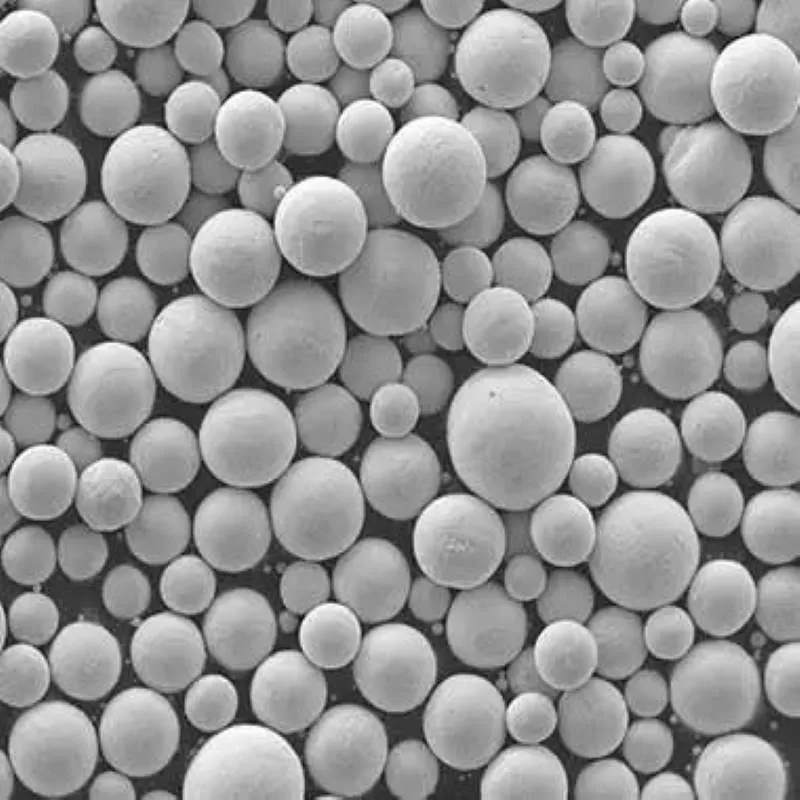
Spherical ASTM A699 Steel Powder, class 3
Product Code : SP-CSTI-569-CU
We provide Spherical ASTM A699 Steel Powder, class 3,Spherical ASTM A699 Steel Powder, class 3 is suitable for laser/electron beam augmentation, hot isostatic pressing, laser cladding, hot/cold spraying, and so on. The particles can be irregular and spherical. The particle distribution can reach the nanometer scale.,Spherical Particle Size,0-15μm,,15-45um,15-53μm, 20-63um,45-105um,45-150μm , 50-150um,75-150μm,or customized,Product purity and oxygen content can be customized according to requirements.
Please contact us if you need customized services. We will contact you with the price and availability in 24 hours.
ASTM A699 Steel Spherical Powder, class 3 Product Information
-:-
For detailed product information, please contact sales.
-:
ASTM A699 Steel Spherical Powder, class 3 Synonyms
-:-
For detailed product information, please contact sales.
-:
-:-
For detailed product information, please contact sales.
-:
Spherical ASTM A699 Steel Powder, class 3 characteristics
-:-
For detailed product information, please contact sales.
-:
Spherical ASTM A699 Steel Powder, class 3 Particle Size
-:-
For detailed product information, please contact sales.
-:
-:-
-:-
0-15μm ,5-25μm, 15-45μm, 15-53μm,20-63um, 45-75μm, 45-105μm, 45-150μm ,75-150μm.
(Various granularities can be customized according to customer requirements)
-:-
For detailed product information, please contact sales.
-:
Spherical ASTM A699 Steel Powder, class 3 Applicable processes
-:-
For detailed product information, please contact sales.
-:
Laser/electron beam additive manufacturing (SLM/EBM, 3D printing)
Direct laser deposition (DLD)
Used in thermal spray (TSA)
Powder hot isostatic pressing (HIP)
Metal injection molding (MIM)
Powder metallurgy (PM)
Laser cladding (LC), etc.
-:-
For detailed product information, please contact sales.
-:
Spherical ASTM A699 Steel Powder, class 3 Chemical Composition
-:-
For detailed product information, please contact sales.
-:
-:-
For detailed product information, please contact sales.
-:
ASTM A699 Steel, class 3 Product Information
-:-
For detailed product information, please contact sales.
-:
# Technical Data Sheet: ASTM A699 Steel, Class 3
**Ultra-High Strength, Cold-Worked, High-Carbon Spring Steel**
---
## 1. PRODUCT OVERVIEW
**Standard Designation:** ASTM A699/A699M
**Full Title:** *Standard Specification for Steel, Carbon, Cold-Worked, for Springs and Other Applications*
**Classification:** Class 3
**International Standard:** ASTM International (American Society for Testing and Materials)
**Material Type:** Cold-worked, very high-carbon steel wire and rod
**Primary Processing:** Extreme cold working (maximum strain hardening) without subsequent heat treatment
**Key Distinction:** Highest strength grade in the A699 specification, achieving maximum tensile strength through severe cold deformation of high-carbon steel
---
## 2. MATERIAL CHARACTERISTICS & MANUFACTURING
### 2.1 Manufacturing Process
ASTM A699 Class 3 undergoes the most **severe cold deformation process** in the specification, pushing strain hardening to its practical limits:
**Production Sequence:**
1. **Starting Material:** Hot-rolled very high-carbon steel rod (0.85-1.05% C)
2. **Patenting/Spheroidizing:** Essential pre-treatment for microstructure conditioning
3. **Extreme Cold Reduction:** 60-85% area reduction through multiple drawing passes
4. **Interstage Treatments:** Stress relief or patenting between severe reductions
5. **Final Processing:** Controlled straightening, minimal stress relief (if any)
6. **Property Achievement:** Exclusively through cold work deformation
### 2.2 Metallurgical Principles
**Maximum Strain Hardening:**
- Ultimate dislocation density (10¹³-10¹⁴ cm⁻²)
- Subgrain formation with high-angle boundaries
- Extreme texture development and grain alignment
- Maximum achievable residual stresses
**Microstructural Features:**
- **Phase Structure:** Cold-worked ferrite with aligned cementite lamellae/particles
- **Grain Morphology:** Extreme elongation (aspect ratios >20:1)
- **Texture Components:** Dominant <110> + secondary <111> fiber texture
- **Carbide Alignment:** Perfect alignment of cementite in drawing direction
---
## 3. CHEMICAL COMPOSITION
### 3.1 Base Composition Requirements
| Element | Composition Range (% by weight, maximum unless specified) | Metallurgical Rationale |
|---------|-----------------------------------------------------------|--------------------------|
| **Carbon (C)** | 0.85 - 1.05 | Maximum carbon for ultimate strength potential |
| **Manganese (Mn)** | 0.60 - 0.90 | Optimized for maximum strain hardening |
| **Phosphorus (P)** | 0.040 max | Extremely tight control for retained ductility |
| **Sulfur (S)** | 0.050 max | Controlled, may be optimized for specific needs |
| **Silicon (Si)** | 0.15 - 0.35 | Deoxidizer, minimal solid solution strengthening |
| **Copper (Cu)** | 0.20 max (when specified) | Optional for specialized corrosion resistance |
### 3.2 Composition Optimization for Class 3
**Carbon Strategy:**
- **Typical Target:** 0.90-1.00% for optimal performance
- **Lower Range (0.85-0.90%):** Better balance of strength and limited ductility
- **Upper Range (1.00-1.05%):** Maximum strength, minimum ductility
**Critical Element Control:**
- **Chromium (Cr):** ≤0.20% (strictly controlled)
- **Nickel (Ni):** ≤0.20% (typically ≤0.12%)
- **Molybdenum (Mo):** ≤0.08% (trace amounts only)
- **Vanadium (V):** ≤0.05% (occasional microalloying)
- **Total Residuals:** Typically ≤0.55% maximum
### 3.3 Specialized Variants
1. **Standard Class 3:** Maximum strength general applications
2. **Controlled Ductility Class 3:** Optimized for critical forming operations
3. **Ultra-Clean Class 3:** Reduced inclusion content for fatigue applications
4. **Precision Class 3:** Tighter dimensional and property tolerances
---
## 4. MECHANICAL PROPERTIES
### 4.1 Minimum Required Properties (ASTM A699)
| Property | Minimum Requirement | Test Standard | Class 3 Specifics |
|----------|---------------------|---------------|-------------------|
| **Tensile Strength** | 1500 MPa (217 ksi) minimum | ASTM A370 | Highest in specification |
| **Yield Strength (0.2% offset)** | Not specified; typically 88-95% of tensile | ASTM A370 | Extremely high yield ratio |
| **Elongation in 10×Diameter** | 3% minimum | ASTM A370 | Severely reduced but controlled |
| **Reduction of Area** | 20% minimum | ASTM A370 | Critical minimum for functionality |
| **Torsional Tests** | As specified | Special procedures | Often required for validation |
### 4.2 Typical Property Ranges (Class 3)
| Property | Typical Range | Performance Characteristics |
|----------|---------------|----------------------------|
| **Tensile Strength** | 1500-1900 MPa (217-276 ksi) | Industry maximum for cold-worked carbon steel |
| **Yield Strength** | 1350-1750 MPa (196-254 ksi) | Yield ratio typically 0.90-0.95 |
| **Modulus of Elasticity** | 200-205 GPa (29,000-29,700 ksi) | Consistent with steel fundamentals |
| **Shear Modulus** | 78-80 GPa (11,300-11,600 ksi) | Critical for spring applications |
| **Elongation (Longitudinal)** | 3-5% | Minimum maintained for functionality |
| **Reduction of Area** | 20-30% | Indicates retained fracture resistance |
| **Hardness** | 42-50 HRC | Approaching practical limits for cold work |
### 4.3 Specialized Mechanical Properties
**Fatigue Performance:**
- **Rotating Bending Fatigue Limit:** 550-650 MPa (10⁷ cycles, polished)
- **Fatigue Ratio:** 0.35-0.40 × tensile strength
- **Surface Condition Sensitivity:** Extremely high
- **Shot Peening Benefit:** 40-60% fatigue life improvement
**Torsional Characteristics:**
- **Torsional Strength:** 900-1100 MPa
- **Torsional Modulus:** 77-79 GPa
- **Torsional Ductility:** 10-20 twists before failure (diameter dependent)
**Anisotropy & Directionality:**
- **Longitudinal vs. Transverse Strength:** 15-25% difference
- **Transverse Ductility:** Significantly reduced (≤2% elongation)
- **Impact Properties:** Highly directional; longitudinal only meaningful
---
## 5. PHYSICAL PROPERTIES
| Property | Value | Conditions & Technical Notes |
|----------|-------|-----------------------------|
| **Density** | 7.85 g/cm³ (0.284 lb/in³) | Unaffected by cold work |
| **Modulus of Elasticity (E)** | 200-205 GPa (29,000-29,700 ksi) | Minor increase with severe cold work |
| **Shear Modulus (G)** | 77-80 GPa (11,200-11,600 ksi) | Critical for spring design calculations |
| **Poisson's Ratio** | 0.285-0.295 | Slight directional variation |
| **Coefficient of Thermal Expansion** | 11.5 × 10⁻⁶/°C (6.4 × 10⁻⁶/°F) | 20-100°C range |
| **Thermal Conductivity** | 45 W/(m·K) | At 100°C; reduces with carbon content |
| **Specific Heat** | 0.46 kJ/(kg·K) | At 20°C |
| **Electrical Resistivity** | 0.20 μΩ·m | At 20°C; increases significantly with cold work |
| **Magnetic Properties** | Strongly ferromagnetic | Useful for certain applications |
| **Thermal Stability Limit** | 180°C (355°F) | Lower than Class 1 & 2 due to higher stored energy |
---
## 6. FABRICATION CHARACTERISTICS
### 6.1 Forming & Shaping Limitations
**Extreme Limitations Due to Maximum Strength:**
- **Cold Bending:** Minimum radius 12-15× thickness/diameter
- **Hot Working:** Absolutely prohibited
- **Straightening:** Extremely limited, high risk of cracking
- **Coiling:** Only with specialized equipment and expertise
**Spring Manufacturing Constraints:**
- **Minimum Coil Diameter:** 8-10× wire diameter
- **Spring Index Range:** 5-15 for practical manufacturing
- **Set Operations:** Controlled stress relief often required
- **Surface Treatment:** Essential for performance optimization
### 6.2 Machinability
**Rating:** Very Poor (25-35% relative to B1112 steel)
**Machining Guidelines for Class 3:**
| Operation | Recommended Parameters | Critical Considerations |
|-----------|------------------------|-------------------------|
| **Turning** | 20-40 m/min, conservative feeds | Carbide only, sharp edges essential |
| **Drilling** | Very low speed, peck drilling | Carbide drills, maximum rigidity |
| **Milling** | 25-50 m/min, light cuts | Carbide end mills, climb milling |
| **Grinding** | Primary finishing method | Aluminum oxide or CBN, light passes |
| **Threading** | Single-point preferred | Carbide tools, ample coolant |
### 6.3 Heat Treatment Restrictions
**Absolute Maximum Temperature:** 250°C (480°F)
**Permissible Thermal Exposures:**
- **Stress Relief:** 180-220°C for 30-45 minutes maximum
- **Coating Processes:** ≤150°C for limited durations
- **Service Temperature:** Continuous ≤130°C, peak ≤180°C
- **Critical Limit:** 250°C for any significant duration
**Consequences of Overheating:**
- **200-250°C:** Initial property degradation (5-15%)
- **250-300°C:** Significant strength reduction (20-40%)
- **300-350°C:** Major property loss (40-70%)
- **>350°C:** Complete loss of cold-worked properties
### 6.4 Surface Treatments
**Essential for Performance:**
1. **Shot Peening:** Mandatory for fatigue applications
2. **Electroplating:** Limited options due to hydrogen embrittlement risk
3. **Phosphating:** Recommended for corrosion protection
4. **Special Coatings:** PVD, DLC possible with temperature control
5. **Passivation:** Chemical treatments for specific applications
---
## 7. PRIMARY APPLICATIONS
### 7.1 Maximum Performance Spring Applications
| Application Category | Specific Components | Why Class 3 is Essential |
|----------------------|---------------------|--------------------------|
| **High-Performance Automotive** | Racing valve springs, extreme suspension springs | Maximum stress capability |
| **Aerospace Critical** | Landing gear components, flight control springs | Ultimate strength-to-weight ratio |
| **Industrial Extreme** | Heavy press springs, safety-critical valve springs | Reliability under maximum loads |
| **Defense Systems** | Weapon system components, armored vehicle springs | Maximum performance in limited space |
### 7.2 Specialized High-Stress Components
- **Ultra-High Strength Fasteners:** Special bolts, pins for critical applications
- **Cutting & Wear Components:** Industrial blades, wear parts requiring maximum hardness
- **Precision Mechanisms:** High-stress instrument components
- **Safety-Critical Devices:** Emergency release mechanisms, safety system components
### 7.3 Advanced Engineering Applications
- **Medical Implants:** Non-corrosive, high-strength components
- **Scientific Instruments:** High-stress measurement devices
- **Robotics & Automation:** Maximum performance actuator components
- **Energy Systems:** Critical components in power generation
### 7.4 Specialized Industrial Applications
- **Oil & Gas:** Downhole tool components, high-pressure valves
- **Mining:** Extreme wear components, high-stress machinery parts
- **Heavy Manufacturing:** Press tools, forming die components
- **Transportation:** Critical safety system components
---
## 8. COMPARATIVE ANALYSIS
### 8.1 Within ASTM A699 Family
| Property | Class 2 | **Class 3** |
|----------|---------|-------------|
| **Carbon Range** | 0.70-0.90% | **0.85-1.05%** |
| **Min Tensile Strength** | 1400 MPa | **1500 MPa** |
| **Typical Hardness** | 40-47 HRC | **42-50 HRC** |
| **Cold Reduction** | 50-70% | **60-85%** |
| **Min Elongation** | 4% | **3%** |
| **Min Reduction of Area** | 25% | **20%** |
| **Relative Cost** | 1.08-1.15 | **1.15-1.30** |
| **Primary Application** | High-stress springs | **Maximum strength applications** |
### 8.2 Comparison with Alternative Ultra-High-Strength Materials
| Aspect | ASTM A699 Class 3 | ASTM A228 (Music Wire) | High-Carbon Oil-Tempered |
|--------|-------------------|------------------------|--------------------------|
| **Strength Level** | 1500-1900 MPa | 2000-3000 MPa (drawn) | 1600-1900 MPa (tempered) |
| **Production Method** | Cold working only | Specialized cold drawing | Heat treatment required |
| **Property Uniformity** | Excellent | Excellent | Good |
| **Temperature Sensitivity** | High | Very High | Moderate |
| **Cost Factor** | High | Very High | Moderate-High |
| **Application Scope** | Broad | Limited (small diameters) | Broad |
### 8.3 International Comparison
| Standard | Equivalent Grade | Strength Comparison |
|----------|------------------|---------------------|
| **EN 10270-1** | SH (Highest grade) | Similar strength concept |
| **JIS G 4801** | SWP-V | Similar ultra-high strength |
| **ISO 8458-2** | Class D | International classification |
| **GB/T 4357** | Grade E | Chinese highest grade |
---
## 9. DESIGN CONSIDERATIONS
### 9.1 Spring Design for Class 3
**Critical Design Parameters:**
- **Maximum Shear Stress:** ≤0.40 × tensile strength (conservative)
- **Spring Rate Calculation:** Use lower bound shear modulus
- **Initial Set Allowance:** Design for 8-12% initial set
- **Fatigue Design:** Use ≤0.30 × tensile as alternating stress
**Surface & Treatment Requirements:**
- **Surface Finish:** Polished or super-finished essential
- **Shot Peening:** Mandatory design consideration
- **Coating Limitations:** Consider thermal restrictions
- **Stress Concentration:** Absolute minimization required
### 9.2 Directional Property Management
**Design Strategies:**
- **Load Alignment:** Critical alignment with drawing direction
- **Multi-axial Stresses:** Conservative safety factors required
- **Notch Sensitivity:** Extremely high; smooth transitions essential
- **Shear Design:** Most favorable loading condition
### 9.3 Temperature Management
**Service Temperature Guidelines:**
- **Optimal Range:** -30°C to +120°C (-22°F to +250°F)
- **Maximum Short-Term:** 180°C (355°F)
- **Property Stability:** Good below 130°C (265°F)
- **Thermal Cycling:** Limited capability; minimize cycles
---
## 10. QUALITY ASSURANCE & TESTING
### 10.1 Standard Testing Requirements
| Test | Frequency | Specimen Requirements | Acceptance Criteria |
|------|-----------|------------------------|---------------------|
| **Chemical Analysis** | Each heat | Complete melt analysis | Meets Class 3 composition |
| **Tensile Test** | Each production lot | Full cross-section specimens | Min 1500 MPa, 3% elongation |
| **Hardness Verification** | Statistical + each lot | Multiple locations | 42-50 HRC typical range |
| **Surface Inspection** | 100% visual + magnification | Entire surface | Free from all defects |
| **Dimensional Verification** | Each coil/lot | Complete dimensional check | Within tight tolerances |
### 10.2 Specialized Testing for Class 3
- **Torsion Testing:** Mandatory for many applications
- **Bend Testing:** Limited bend capability verification
- **Fatigue Testing:** Often required for critical applications
- **Decarburization Check:** Maximum 1.0% of diameter or 0.15mm
- **Non-destructive Testing:** 100% ultrasonic or eddy current
- **Metallographic Examination:** Microstructure verification
### 10.3 Certification Requirements
- **Comprehensive MTC:** Full chemical and mechanical data
- **Complete Traceability:** Heat to finished product
- **Process Certification:** Verification of controlled processes
- **Special Certifications:** Available for critical applications
---
## 11. ORDERING INFORMATION
### 11.1 Specification Format
```
Material: ASTM A699, Class 3
Form: [Specify: wire, rod, special shape]
Dimensions: [Exact dimensions with tolerances]
Condition: Cold worked, as drawn
Surface Finish: [Specify: bright, coated, treated]
Special Requirements: [Testing, certification, packaging]
Quantity: [Exact requirements]
Application Information: [For processing guidance]
```
### 11.2 Available Forms & Specifications
| Form | Size Range | Tolerance Class |
|------|------------|-----------------|
| **Round Wire** | 0.8-15.0 mm diameter | Precision: ±0.02mm, Commercial: ±0.05mm |
| **Flat Wire** | 0.3-6.0 mm thick, 1-40 mm wide | Thickness ±0.02mm, Width ±0.05mm |
| **Rods** | 5-40 mm diameter | Diameter ±0.05mm, Straightness 0.3mm/m |
| **Special Shapes** | Custom available | Per drawing specifications |
### 11.3 Surface Condition Options
1. **Bright Drawn:** Standard finish
2. **Polished:** For maximum fatigue performance
3. **Coated:** Limited options due to temperature constraints
4. **Treated:** Phosphated or similar for corrosion resistance
5. **Custom:** Available for specific applications
---
## 12. TECHNICAL SUPPORT & RESOURCES
### 12.1 Design & Engineering Support
- **Advanced Spring Design:** Specialized software and expertise
- **Application Engineering:** Deep technical support available
- **Failure Analysis:** Comprehensive investigation services
- **Testing & Validation:** Full laboratory services
### 12.2 Industry References
- **ASTM Standards:** Complete specification library
- **Spring Design Manuals:** Advanced design guidelines
- **Technical Papers:** Research on ultra-high-strength materials
- **Case Studies:** Application-specific performance data
---
## 13. FABRICATION BEST PRACTICES
### 13.1 Handling & Storage
- **Special Handling:** Required for this high-strength material
- **Storage Conditions:** Controlled environment essential
- **Identification:** Complete traceability maintenance
- **Shelf Life Management:** Regular inspection recommended
### 13.2 Manufacturing Controls
1. **Process Validation:** All processes must be validated
2. **Temperature Monitoring:** Continuous monitoring essential
3. **Tooling Management:** Specialized tooling and maintenance
4. **Quality Documentation:** Complete process records
### 13.3 Spring Fabrication Specifics
- **Specialized Equipment:** Required for successful processing
- **Process Controls:** Tight control of all parameters
- **Post-Processing:** Essential treatments and inspections
- **Final Validation:** Comprehensive testing of finished components
---
## SUMMARY
**ASTM A699 Class 3** represents the **ultimate in cold-worked, high-carbon steel strength**, achieving the maximum tensile properties possible through severe cold deformation. This material pushes the boundaries of strain hardening to provide exceptional strength for the most demanding applications.
**Key Advantages:**
1. **Maximum Strength:** 1500+ MPa tensile strength without heat treatment
2. **Property Consistency:** Excellent uniformity through controlled processing
3. **High Performance:** Capable of extreme service conditions
4. **No Heat Treatment Distortion:** Eliminates quenching distortion issues
5. **Advanced Applications:** Enables designs not possible with other materials
**Critical Limitations:**
1. **Extreme Forming Restrictions:** Very limited post-production formability
2. **Severe Anisotropy:** Maximum directional property variation
3. **Temperature Sensitivity:** Lowest thermal stability in the specification
4. **Fabrication Challenges:** Requires specialized expertise and equipment
**Optimal Application Scenarios:**
- Applications requiring absolute maximum strength from carbon steel
- Critical components where cold working is the final operation
- Designs limited by space or weight requiring maximum strength
- Applications where heat treatment distortion cannot be tolerated
**Selection Considerations:**
1. Verify that Class 3 properties are truly necessary vs. Class 2
2. Ensure design accommodates material limitations
3. Consider total lifecycle costs including specialized fabrication
4. Validate application requirements against material capabilities
5. Engage with material specialists early in design process
**Final Recommendation:** ASTM A699 Class 3 is recommended only for applications where its exceptional properties are absolutely essential and where appropriate design, fabrication, and quality control expertise is available. This material represents a specialized solution for extreme performance requirements.
---
**CRITICAL CONSIDERATIONS:**
1. This material represents the practical limit of cold-worked carbon steel
2. Design must fully accommodate all material limitations
3. Fabrication requires specialized knowledge and equipment
4. Quality control is absolutely essential
5. Consultation with material experts is mandatory
**DISCLAIMER:** This technical information is provided for general guidance. For specific applications, consult the latest edition of ASTM A699/A699M, relevant design codes, and qualified engineering professionals. Material properties may vary by manufacturer and production batch. Always review certified mill test reports for critical applications. Performance validation through testing is strongly recommended.
-:-
For detailed product information, please contact sales.
-:
ASTM A699 Steel, class 3 Specification
Dimensions
Size:
Diameter 20-1000 mm Length <5955 mm
Size:We can customized as required
Standard:
Per your request or drawing
We can customized as required
Properties(Theoretical)
Chemical Composition
-:-
For detailed product information, please contact sales.
-:
ASTM A699 Steel, class 3 Properties
-:-
For detailed product information, please contact sales.
-:
Spherical ASTM A699 Steel Powder, class 3 Particle Size Description
-:-
For detailed product information, please contact sales.
-:
Applications of Spherical ASTM A699 Steel Powder, class 3
-:-
For detailed product information, please contact sales.
-:
-:-
For detailed product information, please contact sales.
-:
Applications of ASTM A699 Steel Spherical Powder, class 3
-:-
For detailed product information, please contact sales.
-:
Chemical Identifiers ASTM A699 Steel Spherical Powder, class 3
-:-
For detailed product information, please contact sales.
-:
Packing of ASTM A699 Steel Spherical Powder, class 3
-:-
For detailed product information, please contact sales.
-:
Standard Packing:
-:-
For detailed product information, please contact sales.
-:
Typical bulk packaging includes palletized plastic 5 gallon/25 kg. pails, fiber and Steel Spherical Powder drums to 1 ton super sacks in full container (FCL) or truck load (T/L) quantities. Research and sample quantities and hygroscopic, oxidizing or other air sensitive materials may be packaged under argon or vacuum. Solutions are packaged in polypropylene, plastic or glass jars up to palletized 2426 gallon liquid totes Special package is available on request. E FORUs’ is carefully handled to minimize damage during storage and transportation and to preserve the quality of our products in their original condition