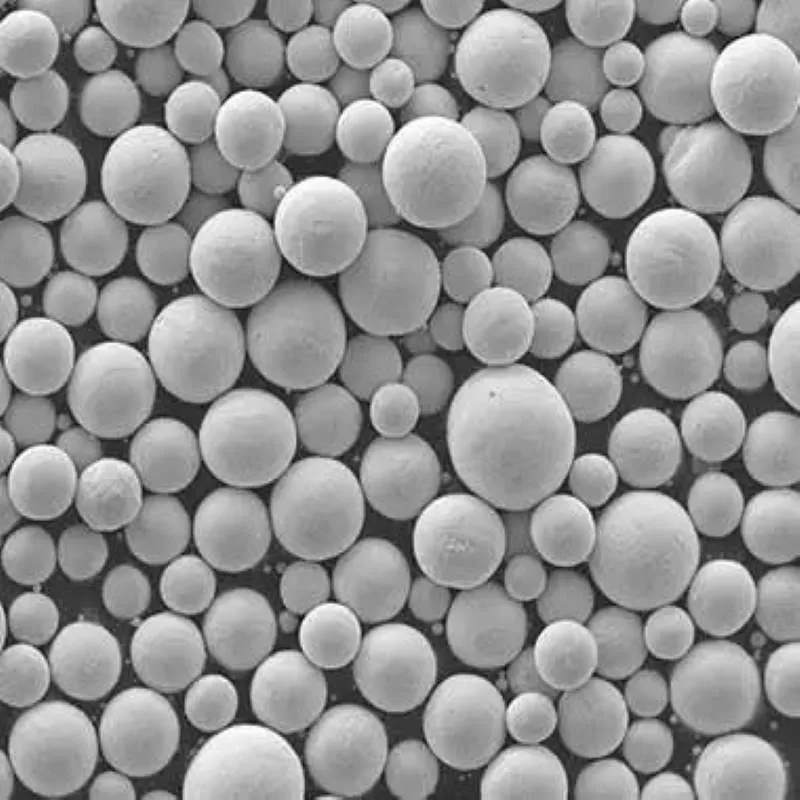
AISI 1018 Steel Spherical Powder, cold drawn Product Information
-:-
For detailed product information, please contact sales.
-:
AISI 1018 Steel Spherical Powder, cold drawn Synonyms
-:-
For detailed product information, please contact sales.
-:
-:-
For detailed product information, please contact sales.
-:
Spherical AISI 1018 Steel Powder characteristics
-:-
For detailed product information, please contact sales.
-:
Spherical AISI 1018 Steel Powder Particle Size
-:-
For detailed product information, please contact sales.
-:
-:-
-:-
0-15μm ,5-25μm, 15-45μm, 15-53μm,20-63um, 45-75μm, 45-105μm, 45-150μm ,75-150μm.
(Various granularities can be customized according to customer requirements)
-:-
For detailed product information, please contact sales.
-:
Spherical AISI 1018 Steel Powder Applicable processes
-:-
For detailed product information, please contact sales.
-:
Laser/electron beam additive manufacturing (SLM/EBM, 3D printing)
Direct laser deposition (DLD)
Used in thermal spray (TSA)
Powder hot isostatic pressing (HIP)
Metal injection molding (MIM)
Powder metallurgy (PM)
Laser cladding (LC), etc.
-:-
For detailed product information, please contact sales.
-:
Spherical AISI 1018 Steel Powder Chemical Composition
-:-
For detailed product information, please contact sales.
-:
-:-
For detailed product information, please contact sales.
-:
AISI 1018 Steel, cold drawn Product Information
-:-
For detailed product information, please contact sales.
-:
# Product Datasheet: AISI 1018 Cold Drawn Steel
## 1. PRODUCT OVERVIEW
**AISI 1018 Cold Drawn Steel** is one of the most widely used and versatile low-carbon steel grades in manufacturing, known for its excellent balance of strength, ductility, machinability, and cost-effectiveness. Through the cold drawing process, this material achieves superior dimensional accuracy, enhanced mechanical properties, and a bright, smooth surface finish that makes it ideal for precision components requiring minimal post-processing. AISI 1018's slightly higher manganese content compared to 1015 and 1017 grades provides improved hardenability and strength while maintaining excellent weldability and formability characteristics.
The cold drawing operation imparts significant work hardening that increases yield strength by 40-60% compared to hot-rolled material, making it particularly suitable for applications where both precision and mechanical performance are required. This grade has become an industry standard for general-purpose manufacturing across multiple sectors due to its predictable performance, consistent quality, and excellent response to various fabrication processes.
---
### 2. KEY SPECIFICATIONS & INTERNATIONAL STANDARDS
| **Parameter** | **Specification** |
|---------------|-------------------|
| **AISI/SAE Grade** | 1018 |
| **UNS Designation** | G10180 |
| **Primary Standards** | **ASTM A108** - Standard Specification for Steel Bar, Carbon and Alloy, Cold-Finished
**ASTM A29/A29M** - Steel Bars, Carbon and Alloy, Hot-Wrought and Cold-Finished
**ASTM A576** - Steel Bars, Carbon, Hot-Wrought, Special Quality (when specified) |
| **ISO Standards** | ISO 683-18: Heat-treatable steels, alloy steels and free-cutting steels |
| **Common Product Forms** | Cold drawn rounds, hexagons, squares, flats; wire; special shapes |
| **Surface Finish** | Bright cold-drawn finish (typically 1.6-3.2 μm Ra) |
| **Dimensional Tolerances** | ASTM A108 commercial tolerances; precision tolerances available |
**International Equivalents:**
- **EN (Europe):** 1.0402 (C22) per EN 10083-2 (closest equivalent)
- **DIN (Germany):** C22, CK22, Cm22 (cold drawn)
- **JIS (Japan):** S20C, SWRCH20K
- **GB (China):** 20# (冷拉钢)
- **India (IS):** C20
- **France (AFNOR):** XC18
- **Russia:** ГОСТ 20
---
### 3. CHEMICAL COMPOSITION (% BY WEIGHT)
| **Element** | **Standard Range** | **Typical Analysis** | **Effect on Material Properties** |
|-------------|-------------------|----------------------|-----------------------------------|
| **Carbon (C)** | **0.15 - 0.20%** | 0.18% | Provides fundamental strength and hardness; optimal balance for machinability |
| **Manganese (Mn)** | **0.60 - 0.90%** | 0.75% | **Key feature:** Higher than 1015/1017; enhances hardenability and strength |
| **Phosphorus (P)** | **≤ 0.040% max** | 0.020% | Controlled residual; improves machinability but reduces ductility at higher levels |
| **Sulfur (S)** | **≤ 0.050% max** | 0.025% | Enhances machinability; forms manganese sulfides for chip breaking |
| **Silicon (Si)** | **0.10 - 0.20%** (typical) | 0.15% | Deoxidizer; contributes to strength through solid solution strengthening |
| **Copper (Cu)** | ≤ 0.20% (optional) | 0.10% | Optional for improved atmospheric corrosion resistance |
| **Iron (Fe)** | Balance | Balance | Base element |
**Key Composition Characteristics:**
- **Carbon Equivalent (CE):** CE = C + (Mn/6) ≈ 0.25-0.35, indicating **good weldability** with proper procedures
- **Manganese Advantage:** Higher manganese (0.60-0.90%) distinguishes 1018 from lower grades and enhances hardenability
- **Optimal Carbon Range:** 0.15-0.20% provides excellent balance of strength and machinability
- **Machinability Optimization:** Controlled sulfur and phosphorus levels enhance machining performance
---
### 4. PHYSICAL & MECHANICAL PROPERTIES (COLD-DRAWN CONDITION)
#### 4.1 Mechanical Properties (Typical for Cold-Drawn Bars)
| **Property** | **Guaranteed Minimum** | **Typical Range** | **Test Method** | **Notes** |
|--------------|------------------------|-------------------|-----------------|-----------|
| **Tensile Strength** | 480 MPa (70 ksi) | **500-600 MPa** (73-87 ksi) | ASTM A370 | Approximately 20-25% higher than hot-rolled |
| **Yield Strength (0.2% offset)** | 400 MPa (58 ksi) | **420-520 MPa** (61-75 ksi) | ASTM A370 | Significant increase from work hardening (40-60%) |
| **Elongation in 50 mm** | 15% | **16-24%** | ASTM A370 | Maintains reasonable ductility despite cold work |
| **Reduction of Area** | 40% | **44-54%** | ASTM A370 | Good formability indicator |
| **Hardness (Brinell)** | - | **140-170 HB** | ASTM E10 | Higher than most low-carbon cold-drawn steels |
| **Hardness (Rockwell B)** | - | **80-95 HRB** | ASTM E18 | Commonly specified range |
| **Modulus of Elasticity** | - | **200 GPa** (29,000 ksi) | - | Unaffected by cold working |
| **Shear Strength** | - | **340-410 MPa** (49-59 ksi) | - | Approximately 0.68 × tensile strength |
| **Fatigue Strength** (Rotating beam, 10⁷ cycles) | - | **230-280 MPa** (33-41 ksi) | - | Polished specimens, good for dynamic applications |
| **Machinability Rating** | - | **78-85%** (vs. 1212 as 100%) | - | Excellent for a non-free-machining grade |
| **Endurance Limit** | - | **200-240 MPa** (29-35 ksi) | - | For polished surfaces in bending |
#### 4.2 Physical Properties
| **Property** | **Value** | **Conditions** |
|--------------|-----------|----------------|
| **Density** | **7.85 g/cm³** (0.284 lb/in³) | At 20°C |
| **Melting Point** | **1480-1520°C** (2696-2768°F) | - |
| **Thermal Conductivity** | **48.9 W/m·K** | At 100°C |
| **Electrical Resistivity** | **0.173 μΩ·m** | At 20°C |
| **Coefficient of Thermal Expansion** | **11.4 × 10⁻⁶/°C** | 20-100°C range |
| **Specific Heat Capacity** | **483 J/kg·K** | At 20°C |
| **Magnetic Properties** | **Ferromagnetic** | Up to Curie temperature (770°C) |
#### 4.3 Cold Drawing Process Effects
- **Work Hardening:** Increases yield strength by 40-60% compared to hot-rolled
- **Surface Quality:** Bright, scale-free finish (Ra 1.6-3.2 μm typical)
- **Dimensional Accuracy:** Tight tolerances (±0.05-0.13 mm for common diameters)
- **Grain Structure:** Elongated grains in drawing direction
- **Residual Stress:** Surface compressive stresses from drawing process
- **Straightness:** Excellent (≤2 mm/m typical)
- **Consistency:** Uniform properties throughout bar length
---
### 5. MATERIAL CHARACTERISTICS & PERFORMANCE
#### 5.1 Manufacturing Characteristics
- **Machinability:** **Excellent** - produces consistent chips with excellent tool life
- **Weldability:** **Good** - most common welding methods applicable; preheat recommended for thicker sections
- **Formability:** **Moderate** - suitable for bending but less than hot-rolled; may require annealing for severe deformation
- **Hardenability:** **Moderate** - responds well to case hardening (carburizing); limited through-hardening capability
- **Surface Treatability:** **Excellent substrate** for plating, painting, and various surface treatments
- **Consistency:** Uniform properties due to controlled drawing process and consistent chemistry
#### 5.2 Heat Treatment Response
- **Stress Relieving:** 540-650°C (1000-1200°F) for 1 hour/inch - Reduces residual stresses
- **Annealing:** 870-925°C (1600-1700°F), slow cool - Restores maximum ductility
- **Normalizing:** 900-950°C (1650-1740°F), air cool - Refines grain structure
- **Carburizing:** 900-925°C (1650-1700°F) - Excellent candidate for case hardening
- **Through-Hardening:** Limited but better than lower-carbon grades due to manganese content
#### 5.3 Special Attributes
- **Case Hardening Response:** One of the best low-carbon steels for carburizing
- **Consistency:** Industry standard with predictable performance
- **Availability:** Widely stocked in numerous sizes and forms
- **Cost-Performance Ratio:** Excellent value for general manufacturing
- **Versatility:** Suitable for wide range of fabrication methods
---
### 6. TYPICAL APPLICATIONS
#### 6.1 Automotive Components (Extensive Use)
- **Engine Components:** Valve guides, tappets, push rods, rocker arms
- **Transmission Parts:** Gear blanks, synchronizer hubs, shift forks, shafts
- **Steering & Suspension:** Tie rod ends, ball studs, linkage pins, bushings
- **Brake Systems:** Caliper pins, adjuster mechanisms, parking brake components
- **Fasteners:** High-strength bolts, studs, specialized pins
#### 6.2 Machinery & Equipment (Primary Application)
- **Shafts & Axles:** Drive shafts, counter shafts, pump shafts (medium to heavy duty)
- **Bearing Components:** Races, cages, bushings (often after heat treatment)
- **Hydraulic/Pneumatic:** Cylinder rods, piston rods, valve components
- **Gear Components:** Small to medium gear blanks for carburizing
- **Tooling:** Jigs, fixtures, arbors, mandrels, wear plates
#### 6.3 Industrial Manufacturing (Widespread Use)
- **Fastener Manufacturing:** High-quality bolt and screw blanks
- **CNC Machining:** Precision turned parts, fittings, couplings, connectors
- **Material Handling:** Conveyor components, rollers, guide rails, sprockets
- **Agricultural Equipment:** Implement parts, linkage components, shafts, gears
- **Textile Machinery:** Spindle components, guide pins, tension rods
#### 6.4 Consumer & Commercial Products
- **Appliance Components:** Motor shafts, gear mechanisms, drive components
- **Power Tools:** Drill chucks, spindle components, transmission parts
- **Hardware:** High-strength pins, hinges, locking mechanisms, brackets
- **Sporting Equipment:** Bicycle components, exercise machine parts, firearms components
- **Furniture:** Mechanism components, adjustment systems, structural parts
#### 6.5 Special Applications
- **Medical Equipment:** Non-implant components requiring precision and reliability
- **Instrumentation:** Precision shafts, measurement device components
- **Robotics:** Joint components, actuator parts, guide elements, gears
- **Aerospace Ground Support:** Non-flight-critical components and tooling
- **Defense:** Components for firearms, optical mounts, equipment parts
---
### 7. PROCESSING RECOMMENDATIONS
#### 7.1 Machining Parameters (Optimized for AISI 1018)
| **Operation** | **Speed (m/min)** | **Feed (mm/rev)** | **Depth of Cut (mm)** | **Tool Recommendations** |
|---------------|-------------------|-------------------|----------------------|--------------------------|
| **Turning** | 120-180 | 0.15-0.35 | 1.5-3.5 | Carbide inserts with positive rake (CNMG, DNMG) |
| **Drilling** | 25-35 | 0.10-0.25 | Full diameter | HSS or carbide drills, peck drilling for deep holes |
| **Milling** | 100-160 | 0.08-0.18 per tooth | 1.5-3.0 | Carbide end mills (4-flute for finishing) |
| **Tapping** | 8-12 | Pitch determined | - | HSS spiral-point or spiral-flute taps |
| **Threading** | 30-50 | Pitch determined | Multiple passes | Carbide threading inserts |
| **Grinding** | 25-35 m/sec | 0.005-0.020 mm/pass | 0.01-0.10 mm | Aluminum oxide wheels (46-60 grit) |
**Coolant Recommendations:** Soluble oil (5-8%) for general machining; synthetic coolants for high-speed or production operations.
#### 7.2 Welding Guidelines
- **Preheat:** Recommended for sections >12 mm (100-150°C)
- **Interpass Temperature:** Maintain below 200°C (400°F)
- **Filler Metals:** ER70S-3, ER70S-6 for GMAW; E7018 for SMAW
- **Shielding Gas:** 75% Ar/25% CO₂ for GMAW (most applications)
- **Post-Weld Heat Treatment:** Stress relieving recommended for critical applications
- **Welding Processes:** GMAW, GTAW, SMAW, FCAW all suitable with proper procedures
- **Special Note:** Higher manganese requires more care than lower-carbon grades
#### 7.3 Forming Operations
- **Cold Bending:** Minimum radius = 1.5-2.0 × material thickness (across grain)
- **Springback Allowance:** Account for 3-6° springback in bending operations
- **Annealing:** Recommended for severe deformation or multiple bending operations
- **Hot Forming:** Excellent for complex shapes or tight radii
- **Forging Temperature:** 1150-1260°C (2100-2300°F) for hot forging
- **Punching/Blanking:** Good with proper die clearance (8-12% of thickness)
---
### 8. HEAT TREATMENT OPTIONS
#### 8.1 Standard Heat Treatments
| **Treatment** | **Temperature** | **Time** | **Cooling** | **Resulting Properties** | **Applications** |
|---------------|-----------------|----------|-------------|--------------------------|------------------|
| **Full Annealing** | 870-925°C | 1 hr/inch | Furnace cool | HRB 70-80, maximum ductility | Severe cold forming |
| **Process Annealing** | 650-700°C | 1-2 hrs | Air cool | Partial softening, stress relief | Intermediate processing |
| **Normalizing** | 900-950°C | 1 hr/inch | Air cool | HRB 80-90, uniform structure | General improvement |
| **Carburizing** | 900-925°C | 4-12 hrs | Quench & temper | Case: 58-63 HRC, Core: 25-35 HRC | Wear components |
| **Carbonitriding** | 850-870°C | 1-4 hrs | Quench | Case: 55-60 HRC, shallow case | Light wear applications |
| **Stress Relieving** | 550-650°C | 1 hr/inch | Air cool | Reduced residual stresses | After welding/machining |
#### 8.2 Case Hardening Characteristics (Excellent for AISI 1018)
- **Carburizing Depth:** 0.5-1.8 mm achievable with standard treatments
- **Case Hardness:** 58-63 HRC typical after proper quenching and tempering
- **Core Properties:** Maintains toughness (25-35 HRC) while providing hard surface
- **Distortion Control:** Moderate; proper fixturing and process control essential
- **Quenching Media:** Oil quenching typically used (fast oil for thicker sections)
- **Tempering:** 150-200°C after carburizing to relieve stresses and improve toughness
---
### 9. QUALITY STANDARDS & INSPECTION
#### 9.1 Standard Testing Requirements
- **Chemical Analysis:** Optical emission spectroscopy per ASTM E415
- **Mechanical Testing:** Tensile testing per ASTM A370, hardness per ASTM E10/E18
- **Dimensional Inspection:** Full compliance with ASTM A108 tolerances
- **Surface Inspection:** Visual examination for seams, pits, drawing marks, or defects
- **Microstructural Examination:** Grain size assessment per ASTM E112 (when specified)
- **Straightness Verification:** Typically ≤2 mm per meter
#### 9.2 Common Quality Certifications
- **Mill Test Certificate 3.1** per EN 10204 (Type 3.1 common for export)
- **Certificate of Conformity** to ASTM A108
- **Chemical Analysis Certificate** with full composition
- **RoHS/REACH Compliance Statement** (when required)
- **Material Traceability Documentation** with heat/lot numbers
- **Third-Party Inspection Certificates** (SGS, TÜV, Bureau Veritas, etc.)
#### 9.3 Industry-Specific Requirements
- **Automotive:** Often requires PPAP documentation, SPC data, and additional testing
- **Aerospace:** May require additional NDT, tighter documentation, and special certifications
- **Medical:** Cleanliness certifications, special handling, and extensive documentation
- **Defense:** Lot traceability, certified test reports, and government specifications
- **Nuclear:** Extraordinary documentation, testing, and quality system requirements
---
### 10. COMPARISON WITH SIMILAR GRADES
| **Property** | **AISI 1018 CD** | **AISI 1017 CD** | **AISI 1020 CD** | **AISI 1045 CD** |
|--------------|------------------|------------------|------------------|------------------|
| **Carbon %** | 0.15-0.20 | 0.15-0.20 | 0.18-0.23 | 0.43-0.50 |
| **Manganese %** | 0.60-0.90 | 0.30-0.60 | 0.30-0.60 | 0.60-0.90 |
| **Tensile (MPa)** | 500-600 | 480-580 | 520-620 | 620-720 |
| **Yield (MPa)** | 420-520 | 410-510 | 450-550 | 530-630 |
| **Elongation %** | 16-24 | 16-24 | 14-22 | 12-18 |
| **Hardness (HB)** | 140-170 | 135-165 | 145-175 | 170-210 |
| **Machinability** | 78-85% | 75-82% | 65-75% | 50-60% |
| **Case Hardening** | **Excellent** | Very Good | Good | Not typical |
| **Cost Factor** | 1.00 (baseline) | 0.98-1.02 | 1.03-1.07 | 1.15-1.25 |
---
### 11. STORAGE, HANDLING & SAFETY
#### 11.1 Storage Requirements
- **Environment:** Dry, ventilated storage (relative humidity < 60% recommended)
- **Temperature:** Ambient, avoid condensation and rapid temperature changes
- **Stacking:** Proper support every 1-1.5 meters to prevent bending and distortion
- **Protection:** Rust preventive oil, VCI packaging, or desiccant for long-term storage
- **Identification:** Clear marking of grade, heat number, dimensions, and supplier
- **Segregation:** Separate from other materials to prevent contamination
#### 11.2 Handling Guidelines
- **Lifting Equipment:** Proper spreader bars, C-hooks, or magnets for long lengths
- **Surface Protection:** Use padding or protective covers to prevent surface damage
- **Cutting Safety:** Implement proper guarding, coolant, and PPE for all cutting operations
- **Transportation:** Secure bundling with edge protection to prevent movement and damage
- **End Protection:** Use caps or protective wrapping for threaded or precision ends
#### 11.3 Safety Considerations
- **Machining Safety:** Use appropriate guards, local exhaust ventilation, and personal protective equipment
- **Welding Safety:** Ensure adequate ventilation, respiratory protection, and fire safety measures
- **Material Handling:** Follow proper lifting techniques, use mechanical aids for heavy material
- **Storage Safety:** Secure stacking to prevent collapse, ensure clear aisles and access
- **Waste Management:** Proper disposal of machining chips, cutting fluids, and other waste
- **Training:** Ensure all personnel are trained in proper handling and safety procedures
---
### 12. TECHNICAL & ECONOMIC CONSIDERATIONS
#### 12.1 Advantages of AISI 1018 Cold Drawn
1. **Optimal Balance:** Excellent combination of strength, ductility, and machinability
2. **Case Hardening Excellence:** One of the best low-carbon steels for carburizing
3. **Dimensional Accuracy:** Tight tolerances reduce machining requirements and cost
4. **Surface Quality:** Bright finish often eliminates need for additional surface preparation
5. **Consistency:** Industry standard with predictable, reliable performance
6. **Availability:** Widely stocked in numerous sizes, forms, and conditions
7. **Cost-Effectiveness:** Excellent value for general manufacturing applications
8. **Versatility:** Suitable for wide range of fabrication and finishing processes
#### 12.2 Design Considerations
- **Anisotropy:** Account for directional properties resulting from cold drawing
- **Stress Relief:** Consider stress relieving for complex machined parts to prevent distortion
- **Springback:** Allow for springback in forming and bending operations
- **Case Hardening:** Design for case hardening when wear resistance is needed
- **Tolerances:** Specify appropriate tolerances based on application requirements
- **Safety Factors:** Use appropriate safety factors for dynamic or critical applications
#### 12.3 Procurement Guidelines
1. **Specification:** Clearly state "AISI 1018 Cold Drawn" with reference to ASTM A108
2. **Dimensions:** Specify exact sizes, tolerances, straightness, and surface requirements
3. **Quantity:** Consider minimum order quantities, lead times, and inventory requirements
4. **Certification:** Required documentation level based on application criticality
5. **Testing:** Any additional testing requirements beyond standard
6. **Packaging:** Special requirements for protection, identification, and handling
7. **Traceability:** Heat/lot traceability requirements for quality assurance
---
### 13. ENVIRONMENTAL & SUSTAINABILITY ASPECTS
#### 13.1 Environmental Considerations
- **Recyclability:** 100% recyclable with established infrastructure and markets
- **Energy Content:** Moderate compared to alloy steels and non-ferrous materials
- **Manufacturing Impact:** Cold drawing is relatively energy-efficient compared to extensive machining
- **Waste Generation:** Minimal material waste compared to machining from larger stock
- **Coating Compatibility:** Works well with environmentally friendly coatings and treatments
- **Life Cycle:** Long service life with proper maintenance and protection
#### 13.2 Sustainability Factors
- **Resource Efficiency:** Efficient use of material through precise sizing and minimal waste
- **Energy Efficiency:** Lower energy requirements for processing compared to alternatives
- **Transport Efficiency:** Dense material reduces transportation energy per unit strength
- **Maintenance:** Durable with standard maintenance practices
- **End-of-Life:** Easily recycled without degradation of material properties
- **Carbon Footprint:** Lower than many alternative materials for equivalent applications
#### 13.3 Compliance Considerations
- **RoHS Compliance:** Typically compliant with Restriction of Hazardous Substances
- **REACH Compliance:** Generally compliant with Registration, Evaluation, Authorisation and Restriction of Chemicals
- **Conflict Minerals:** Compliance with relevant regulations and reporting requirements
- **Environmental Management:** Supplier environmental management systems (ISO 14001)
- **Sustainability Reporting:** Increasing requirements for environmental and social reporting
---
**DISCLAIMER:** This technical datasheet provides general information about AISI 1018 cold drawn steel based on industry standards and typical manufacturing practices. Actual properties may vary between manufacturers, production batches, specific processing conditions, and material dimensions. For critical applications, conduct appropriate testing and consult with qualified engineering personnel. Always verify current specifications with suppliers and refer to the latest edition of relevant standards. The information contained herein is for guidance purposes only and should not replace specific engineering analysis for particular applications. Material selection should be made by qualified professionals with full understanding of application requirements, regulatory compliance, and safety considerations.
-:-
For detailed product information, please contact sales.
-:
AISI 1018 Steel, cold drawn Specification
Dimensions
Size:
Diameter 20-1000 mm Length <5429 mm
Size:We can customized as required
Standard:
Per your request or drawing
We can customized as required
Properties(Theoretical)
Chemical Composition
-:-
For detailed product information, please contact sales.
-:
AISI 1018 Steel, cold drawn Properties
-:-
For detailed product information, please contact sales.
-:
Spherical AISI 1018 Steel Powder Particle Size Description
-:-
For detailed product information, please contact sales.
-:
Applications of Spherical AISI 1018 Steel Powder
-:-
For detailed product information, please contact sales.
-:
-:-
For detailed product information, please contact sales.
-:
Applications of AISI 1018 Steel Spherical Powder, cold drawn
-:-
For detailed product information, please contact sales.
-:
Chemical Identifiers AISI 1018 Steel Spherical Powder, cold drawn
-:-
For detailed product information, please contact sales.
-:
Packing of AISI 1018 Steel Spherical Powder, cold drawn
-:-
For detailed product information, please contact sales.
-:
Standard Packing:
-:-
For detailed product information, please contact sales.
-:
Typical bulk packaging includes palletized plastic 5 gallon/25 kg. pails, fiber and Steel Spherical Powder drums to 1 ton super sacks in full container (FCL) or truck load (T/L) quantities. Research and sample quantities and hygroscopic, oxidizing or other air sensitive materials may be packaged under argon or vacuum. Solutions are packaged in polypropylene, plastic or glass jars up to palletized 1900 gallon liquid totes Special package is available on request. E FORUs’ is carefully handled to minimize damage during storage and transportation and to preserve the quality of our products in their original condition