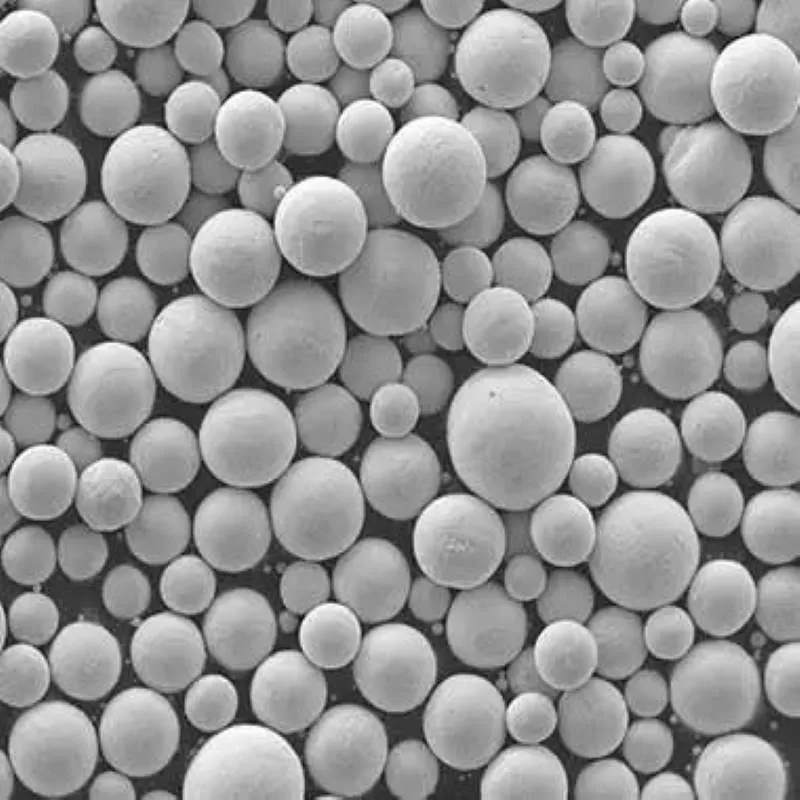
Spherical ASTM A353 Alloy Steel Powder
Product Code : SP-CSTI-596-CU
We provide Spherical ASTM A353 Alloy Steel Powder,Spherical ASTM A353 Alloy Steel Powder is suitable for laser/electron beam augmentation, hot isostatic pressing, laser cladding, hot/cold spraying, and so on. The particles can be irregular and spherical. The particle distribution can reach the nanometer scale.,Spherical Particle Size,0-15μm,,15-45um,15-53μm, 20-63um,45-105um,45-150μm , 50-150um,75-150μm,or customized,Product purity and oxygen content can be customized according to requirements.
Please contact us if you need customized services. We will contact you with the price and availability in 24 hours.
ASTM A353 Alloy Steel Spherical Powder Product Information
-:-
For detailed product information, please contact sales.
-:
ASTM A353 Alloy Steel Spherical Powder Synonyms
-:-
For detailed product information, please contact sales.
-:
-:-
For detailed product information, please contact sales.
-:
Spherical ASTM A353 Alloy Steel Powder characteristics
-:-
For detailed product information, please contact sales.
-:
Spherical ASTM A353 Alloy Steel Powder Particle Size
-:-
For detailed product information, please contact sales.
-:
-:-
-:-
0-15μm ,5-25μm, 15-45μm, 15-53μm,20-63um, 45-75μm, 45-105μm, 45-150μm ,75-150μm.
(Various granularities can be customized according to customer requirements)
-:-
For detailed product information, please contact sales.
-:
Spherical ASTM A353 Alloy Steel Powder Applicable processes
-:-
For detailed product information, please contact sales.
-:
Laser/electron beam additive manufacturing (SLM/EBM, 3D printing)
Direct laser deposition (DLD)
Used in thermal spray (TSA)
Powder hot isostatic pressing (HIP)
Metal injection molding (MIM)
Powder metallurgy (PM)
Laser cladding (LC), etc.
-:-
For detailed product information, please contact sales.
-:
Spherical ASTM A353 Alloy Steel Powder Chemical Composition
-:-
For detailed product information, please contact sales.
-:
-:-
For detailed product information, please contact sales.
-:
ASTM A353 Alloy Steel Product Information
-:-
For detailed product information, please contact sales.
-:
## **ASTM A353 9% Nickel Alloy Steel for Cryogenic Service**
### **1. Product Overview**
**ASTM A353** is a **nickel alloy steel plate** specifically designed for **welded pressure vessel construction for service at extremely low temperatures**. This specification covers **double-normalized and tempered 9% nickel steel plates** that provide exceptional toughness and strength at cryogenic temperatures down to **-320°F (-196°C)**, making it one of the most critical materials for liquefied natural gas (LNG) storage and transportation applications.
Unlike lower-nickel steels in the A203 series, ASTM A353 employs a **substantially higher nickel content (approximately 9%)** combined with a specific **double-normalizing and tempering heat treatment** to achieve a fine-grained microstructure with outstanding low-temperature fracture toughness. This grade represents the premier material choice for primary containment in cryogenic systems where safety and reliability are paramount.
### **2. Key International Standards & Specifications**
| Standard System | Equivalent Designation | Notes |
|-----------------|------------------------|-------|
| **ASTM/ASME** | **ASTM A353/A353M** / **SA-353** | Primary specification, ASME Boiler & Pressure Vessel Code Section VIII approved |
| **European (EN)** | **EN 10028-4: X8Ni9** | 9% nickel steel for cryogenic applications |
| **Japanese (JIS)** | **JIS G3127 SLA 9N 590** | 9% nickel steel for low temperature pressure vessels |
| **ISO** | **ISO 9328-4: 12Ni14** (similar application) | Steel for pressure purposes |
| **Chinese** | **GB 24511 N9** | 9% nickel steel plate |
| **Industry Equivalents:** INVAR alternatives for specific applications, though A353 remains standard for pressure vessels |
**Classification Society Approvals:** Mandatory for marine applications; fully approved by ABS, DNV, LR, BV, and all major societies with specific supplementary requirements for LNG containment.
### **3. Chemical Composition (% by Weight)**
| Element | ASTM A353 Requirements | Metallurgical Purpose |
|---------|------------------------|------------------------|
| **Carbon (C)** | **0.13% maximum** | Strictly limited for weldability and low-temperature toughness |
| **Manganese (Mn)** | **0.90% maximum** | Controlled to prevent excessive hardenability |
| **Phosphorus (P)** | **0.035% maximum** | Stringent control to prevent embrittlement |
| **Sulfur (S)** | **0.040% maximum** | Minimized for improved transverse properties |
| **Silicon (Si)** | **0.15-0.40%** | Deoxidizer, controlled range |
| **Nickel (Ni)** | **8.50-9.50%** | **Critical alloying element** - stabilizes austenite at cryogenic temperatures, enables martensitic transformation with tempering |
| **Chromium (Cr)** | **0.25% maximum** | Residual, kept low to avoid detrimental phases |
| **Molybdenum (Mo)** | **0.12% maximum** | Residual |
| **Copper (Cu)** | **0.35% maximum** | Residual |
| **Vanadium (V)** | **0.05% maximum** | Residual, kept minimal |
| **Impurities:** Strict control of trace elements (Sn, As, Sb) to prevent temper embrittlement |
**Key Metallurgical Features:**
- **Nickel-Martensite System:** Unique among cryogenic steels - transforms to martensite upon cooling but maintains toughness
- **Carbon Equivalent:** Very low, typically 0.25-0.35% (IIW formula)
- **Austenite Stabilization:** High nickel content retains some austenite at cryogenic temperatures
- **Purity Requirements:** Exceptionally clean steel with minimal inclusions
### **4. Mechanical & Physical Properties**
#### **4.1 Tensile Properties (Double Normalized & Tempered)**
| Property | Minimum Requirement | Typical Range | Test Standard |
|----------|---------------------|---------------|---------------|
| **Yield Strength (0.2% offset)** | **75 ksi (515 MPa)** | 80-95 ksi (550-655 MPa) | ASTM A370 |
| **Tensile Strength** | **100-120 ksi (690-825 MPa)** | 105-115 ksi (725-795 MPa) | ASTM A370 |
| **Elongation (in 2" gauge)** | **20%** minimum | 22-28% | ASTM A370 |
| **Reduction of Area** | Not specified | Typically 55-65% | ASTM A370 |
| **Yield-to-Tensile Ratio** | ≤ 0.90 typically | 0.75-0.85 | Important for design |
#### **4.2 Cryogenic Toughness Properties (Defining Characteristic)**
| Test Temperature | Charpy V-Notch Requirement | Typical Values | K₁c Values (Typical) |
|------------------|----------------------------|----------------|-----------------------|
| **-320°F (-196°C)** | **25 ft-lb (34 J) average** | 40-80 ft-lb (54-108 J) | 150-250 ksi√in |
| **-275°F (-170°C)** | **30 ft-lb (41 J) average** | 50-90 ft-lb (68-122 J) | 180-280 ksi√in |
| **-200°F (-129°C)** | **40 ft-lb (54 J) average** | 60-100 ft-lb (81-136 J) | 200-300 ksi√in |
**Note:** Single specimen cannot be less than 20 ft-lb (27 J) at -320°F
#### **4.3 Physical Properties at Cryogenic Temperatures**
| Property | Room Temperature | -196°C (-320°F) | Change |
|----------|-----------------|-----------------|--------|
| **Density** | 7.85 g/cm³ | 7.92 g/cm³ | +0.9% |
| **Modulus of Elasticity** | 29,000 ksi (200 GPa) | 31,000 ksi (214 GPa) | +7% |
| **Thermal Conductivity** | 45 W/m·K | 23 W/m·K | -49% |
| **Specific Heat** | 460 J/kg·K | 220 J/kg·K | -52% |
| **Coefficient of Thermal Expansion** | 11.5 × 10⁻⁶/°C | 8.5 × 10⁻⁶/°C | -26% |
| **Electrical Resistivity** | 0.22 μΩ·m | 0.12 μΩ·m | -45% |
#### **4.4 Hardness & Microhardness**
- **Typical Brinell Hardness:** 220-260 HB
- **Martensite Hardness:** 300-350 HV
- **Retained Austenite:** 5-15% (critical for toughness)
- **Microstructural Uniformity:** Essential through thickness
### **5. Heat Treatment Requirements (Critical Process)**
**Mandatory Heat Treatment Sequence:**
1. **First Normalizing:**
- Temperature: 1650-1725°F (900-940°C)
- Soak: Minimum 1 hour per inch
- Cooling: Air cool to below 300°F (150°C)
2. **Second Normalizing:**
- Temperature: 1425-1475°F (775-800°C) - below Ac1
- Soak: Minimum 1 hour per inch
- Cooling: Air cool
3. **Tempering:**
- Temperature: 1050-1150°F (565-620°C)
- Soak: 2+ hours per inch
- Cooling: Air cool or faster
**Microstructural Requirements:**
- **Grain Size:** ASTM 6 or finer
- **Microstructure:** Tempered nickel-martensite with 5-15% retained austenite
- **Inclusion Control:** Extremely stringent - ASTM E45 Method A, maximum severity 1.0
- **Phase Control:** No delta-ferrite or untempered martensite allowed
### **6. Product Applications**
#### **6.1 Primary Industries & Applications**
| Industry | Specific Applications | Service Temperature | Why A353 is Essential |
|----------|----------------------|---------------------|------------------------|
| **LNG Industry** | - LNG storage tank inner shells
- LNG carrier containment
- LNG processing equipment | -162°C (-260°F) | Only material with proven -196°C toughness for primary containment |
| **Industrial Gases** | - Liquid oxygen/nitrogen/argon storage
- Cryogenic transport vessels
- Air separation units | -196°C (-321°F) | Safety-critical applications requiring guaranteed toughness |
| **Aerospace** | - Rocket fuel storage (LOX, LH2)
- Cryogenic test facilities
- Space simulation chambers | -253°C (-423°F) and below | Reliability in extreme environments |
| **Research & Science** | - Superconducting magnet structures
- Particle accelerator components
- Low-temperature physics equipment | -269°C (-452°F) | Maintains properties at near-absolute zero |
| **Energy** | - Hydrogen liquefaction & storage
- Cryogenic energy storage systems
- Advanced power generation | -196°C to -253°C | Enables emerging energy technologies |
#### **6.2 Special Application Requirements**
- **LNG Containment:** Must withstand thermal cycling and sloshing loads
- **Space Applications:** Ultra-clean requirements for oxygen service
- **Medical Gases:** FDA compliance for medical liquid oxygen
- **Research:** Often requires magnetic permeability testing
### **7. Fabrication Characteristics**
#### **7.1 Weldability (Critical Consideration)**
**Weldability Rating:** **Excellent** (for a high-nickel alloy steel)
| Parameter | Requirements/Recommendations |
|-----------|------------------------------|
| **Carbon Equivalent** | 0.25-0.35% - very favorable |
| **Preheat Temperature** | None required (except for very thick sections) |
| **Interpass Temperature** | ≤ 300°F (150°C) |
| **Welding Processes** | GTAW (preferred), SMAW, GMAW, SAW |
| **Heat Input Control** | Strict limits: 10-35 kJ/inch |
| **Post-Weld Heat Treatment** | **Generally not required or permitted** (can destroy microstructure) |
#### **7.2 Welding Consumables**
- **AWS Classification:** AWS A5.14 ERNiMo-8 or equivalent
- **Nickel Matching:** Overmatching consumables (11-12% Ni typically)
- **Special Considerations:** Must maintain low carbon, ultra-clean
- **Procedural Requirements:** Extensive procedure qualification testing
#### **7.3 Forming & Machining**
| Operation | Special Requirements |
|-----------|----------------------|
| **Cold Forming** | **Excellent** - can be formed at room temperature |
| **Hot Forming** | Avoid if possible; requires full re-heat treatment |
| **Machining** | 40-50% of free-cutting steel
Requires sharp tools, positive rake, adequate cooling |
| **Cutting** | Plasma, laser, or waterjet preferred |
### **8. Comparative Analysis**
#### **8.1 vs. Other Cryogenic Steels**
| Property | A353 (9% Ni) | A203 Grade D (3.5% Ni) | A645 (5% Ni) | 304/316 Stainless |
|----------|--------------|------------------------|--------------|-------------------|
| **Minimum Test Temp** | -320°F (-196°C) | -150°F (-101°C) | -275°F (-170°C) | -452°F (-269°C) |
| **Yield Strength** | 75 ksi | 37 ksi | 65 ksi | 30 ksi |
| **Thermal Conductivity** | Low | Moderate | Low | Very Low |
| **Cost Factor** | 1.0x | 0.4x | 0.7x | 1.5-2.0x |
| **LNG Application** | **Primary Containment** | Secondary | Limited | Alternative |
| **Fabrication** | Complex HT | Standard | Complex HT | Standard |
#### **8.2 vs. Aluminum Alloys for Cryogenic Service**
| Aspect | ASTM A353 | 5083 Aluminum |
|--------|-----------|---------------|
| **Strength at -196°C** | Increases 20-30% | Increases 40-50% |
| **Toughness at -196°C** | Excellent | Excellent |
| **Thermal Expansion** | Lower | Higher (problematic) |
| **Weldability** | Complex | Good |
| **Industry Preference** | **LNG Primary** | LNG Secondary/Membrane |
| **Code Acceptance** | **Proven, established** | Established |
### **9. Technical Advantages**
#### **9.1 Key Benefits**
1. **Proven Cryogenic Performance:** Decades of successful LNG service
2. **Excellent Toughness:** Guaranteed at -320°F (-196°C)
3. **High Strength:** 75 ksi minimum yield strength
4. **Good Weldability:** Low carbon equivalent despite high strength
5. **Code Recognition:** Fully ASME and international code approved
#### **9.2 Unique Metallurgical Properties**
- **Retained Austenite:** Provides "crack-stopping" mechanism
- **Tempered Martensite:** Balanced strength and toughness
- **Microstructural Stability:** Maintains properties after welding (no PWHT)
- **Fracture Mechanics:** Excellent K₁c and CTOD values at cryogenic temperatures
### **10. Design Considerations**
#### **10.1 Optimal Application Areas**
- **Primary containment** for LNG and industrial gases
- **Critical cryogenic components** where failure is unacceptable
- **Applications** requiring both strength and toughness at -196°C
- **Structures** subject to thermal cycling
#### **10.2 Design Limitations**
- **Temperature上限:** Not for sustained service above 800°F (425°C)
- **Corrosion Resistance:** Similar to carbon steel - requires protection
- **Magnetic Properties:** Ferromagnetic (consider for certain applications)
- **Availability:** Limited to specialized mills with exacting controls
### **11. Quality Assurance (Extremely Rigorous)**
#### **11.1 Mandatory Testing**
1. **Chemical Analysis:** Multiple verifications including vacuum spark
2. **Tensile Testing:** Multiple orientations and locations
3. **Charpy Impact:** At -320°F with extensive sampling
4. **Ultrasonic Testing:** 100% scanning per ASTM A578 Level II minimum
5. **Hardness Testing:** Multiple locations including HAZ simulation
#### **11.2 Special Tests for A353**
- **Microstructural Examination:** Quantitative retained austenite measurement
- **Fracture Toughness Testing:** Often required (K₁c, CTOD)
- **Step Cooling Tests:** For temper embrittlement susceptibility
- **Cryogenic Tensile Tests:** For design validation
- **Weld Procedure Tests:** Extensive qualification including CTOD
### **12. Procurement & Specification**
#### **12.1 Essential Ordering Information**
When specifying ASTM A353:
- Full designation: ASTM A353/A353M
- Explicit requirement for double normalized and tempered condition
- Exact impact test requirements (-320°F mandatory)
- Supplementary testing requirements
- Certification level (EN 10204 3.2 typically required)
#### **12.2 Supply Chain Considerations**
- **Lead Time:** 16-24 weeks minimum
- **Mill Qualifications:** Very limited number of qualified mills worldwide
- **Testing Requirements:** Extensive, adds to lead time and cost
- **Traceability:** Complete "cradle-to-grave" documentation required
### **13. Case Studies**
#### **13.1 LNG Carrier Fleet**
**Application:** Moss-type spherical LNG tank construction
**Scale:** Over 200 vessels built since 1970s
**Performance:**
- Zero material-related failures in service
- Withstands sloshing loads and thermal cycling
- 40+ year design life proven
- Standard for large-capacity LNG transport
#### **13.2 Base-Load LNG Terminal**
**Location:** Various global locations
**Application:** Full-containment LNG storage tanks
**Results:**
- Multiple 180,000 m³ tanks in service
- Withstands seismic events in some installations
- Maintenance costs lower than alternatives
- Industry standard for large-scale storage
### **14. Industry Trends & Future Outlook**
#### **14.1 Growing Applications**
- **LNG Expansion:** Global trade growth driving demand
- **Hydrogen Economy:** Liquid hydrogen infrastructure development
- **Space Exploration:** Commercial space and satellite applications
- **Scientific Research:** Next-generation physics experiments
#### **14.2 Technical Developments**
- **Improved Steelmaking:** Enhanced cleanliness and homogeneity
- **Advanced NDT:** Better detection of minute imperfections
- **Welding Technology:** Automated and robotic welding improvements
- **Digital Qualification:** Simulation of cryogenic performance
### **15. Conclusion**
**ASTM A353** represents the **gold standard for 9% nickel cryogenic steel**, offering **unmatched combination of strength and toughness at temperatures down to -320°F (-196°C)**. Its technical attributes make it uniquely suited for:
**Primary Strengths:**
1. **Guaranteed Cryogenic Toughness:** 25 ft-lb minimum at -320°F
2. **High Strength:** 75 ksi minimum yield strength
3. **Proven Reliability:** Decades of flawless performance in LNG service
4. **Code Compliance:** Fully approved by all major international codes
5. **Industry Standard:** Established as the material of choice for LNG primary containment
**Critical Application Scenarios:**
- LNG storage and transport primary containment
- Critical cryogenic pressure vessels
- Applications where safety is non-negotiable
- Structures requiring demonstrated -196°C performance
**Essential Success Factors:**
- Rigorous quality control throughout manufacturing
- Exact adherence to heat treatment specifications
- Specialized welding procedures and consumables
- Comprehensive testing and documentation
ASTM A353 fills a **vital and irreplaceable role** in the cryogenic materials spectrum, providing a **proven, reliable solution** for applications where failure is not an option. While representing a **premium material with significant cost and lead time implications**, its performance in enabling the global LNG industry demonstrates its **essential value** for critical cryogenic applications.
For engineers designing **primary containment systems for LNG, industrial gases, or other cryogenic applications**, A353 offers a **time-tested, code-approved material solution** with an unparalleled track record of safety and reliability. Its continued specification for the world's most demanding cryogenic applications ensures its position as a **cornerstone material** for the evolving global energy infrastructure and advancing scientific frontiers.
-:-
For detailed product information, please contact sales.
-:
ASTM A353 Alloy Steel Specification
Dimensions
Size:
Diameter 20-1000 mm Length <5987 mm
Size:We can customized as required
Standard:
Per your request or drawing
We can customized as required
Properties(Theoretical)
Chemical Composition
-:-
For detailed product information, please contact sales.
-:
ASTM A353 Alloy Steel Properties
-:-
For detailed product information, please contact sales.
-:
Spherical ASTM A353 Alloy Steel Powder Particle Size Description
-:-
For detailed product information, please contact sales.
-:
Applications of Spherical ASTM A353 Alloy Steel Powder
-:-
For detailed product information, please contact sales.
-:
-:-
For detailed product information, please contact sales.
-:
Applications of ASTM A353 Alloy Steel Spherical Powder
-:-
For detailed product information, please contact sales.
-:
Chemical Identifiers ASTM A353 Alloy Steel Spherical Powder
-:-
For detailed product information, please contact sales.
-:
Packing of ASTM A353 Alloy Steel Spherical Powder
-:-
For detailed product information, please contact sales.
-:
Standard Packing:
-:-
For detailed product information, please contact sales.
-:
Typical bulk packaging includes palletized plastic 5 gallon/25 kg. pails, fiber and Steel Spherical Powder drums to 1 ton super sacks in full container (FCL) or truck load (T/L) quantities. Research and sample quantities and hygroscopic, oxidizing or other air sensitive materials may be packaged under argon or vacuum. Solutions are packaged in polypropylene, plastic or glass jars up to palletized 2458 gallon liquid totes Special package is available on request. E FORUs’ is carefully handled to minimize damage during storage and transportation and to preserve the quality of our products in their original condition