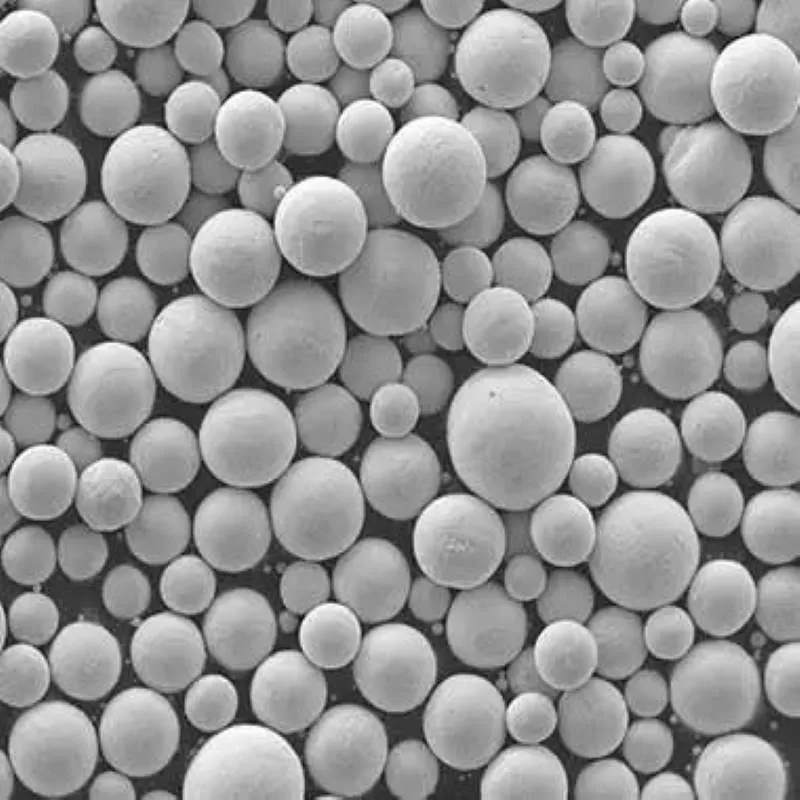
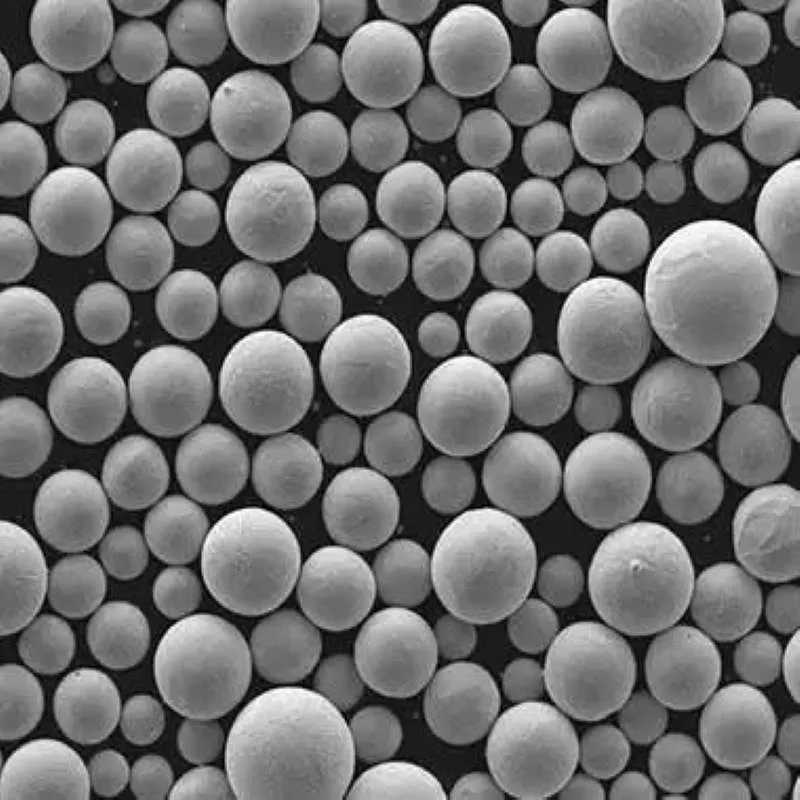
Spherical ASTM A387 Alloy Steel Powder, Grade 21, Class 1
Product Code : SP-CSTI-602-CU
We provide Spherical ASTM A387 Alloy Steel Powder, Grade 21, Class 1,Spherical ASTM A387 Alloy Steel Powder, Grade 21, Class 1 is suitable for laser/electron beam augmentation, hot isostatic pressing, laser cladding, hot/cold spraying, and so on. The particles can be irregular and spherical. The particle distribution can reach the nanometer scale.,Spherical Particle Size,0-15μm,,15-45um,15-53μm, 20-63um,45-105um,45-150μm , 50-150um,75-150μm,or customized,Product purity and oxygen content can be customized according to requirements.
Please contact us if you need customized services. We will contact you with the price and availability in 24 hours.
ASTM A387 Alloy Steel Spherical Powder, Grade 21, Class 1 Product Information
-:-
For detailed product information, please contact sales.
-:
ASTM A387 Alloy Steel Spherical Powder, Grade 21, Class 1 Synonyms
-:-
For detailed product information, please contact sales.
-:
-:-
For detailed product information, please contact sales.
-:
Spherical ASTM A387 Alloy Steel Powder, Grade 21, Class 1 characteristics
-:-
For detailed product information, please contact sales.
-:
Spherical ASTM A387 Alloy Steel Powder, Grade 21, Class 1 Particle Size
-:-
For detailed product information, please contact sales.
-:
-:-
-:-
0-15μm ,5-25μm, 15-45μm, 15-53μm,20-63um, 45-75μm, 45-105μm, 45-150μm ,75-150μm.
(Various granularities can be customized according to customer requirements)
-:-
For detailed product information, please contact sales.
-:
Spherical ASTM A387 Alloy Steel Powder, Grade 21, Class 1 Applicable processes
-:-
For detailed product information, please contact sales.
-:
Laser/electron beam additive manufacturing (SLM/EBM, 3D printing)
Direct laser deposition (DLD)
Used in thermal spray (TSA)
Powder hot isostatic pressing (HIP)
Metal injection molding (MIM)
Powder metallurgy (PM)
Laser cladding (LC), etc.
-:-
For detailed product information, please contact sales.
-:
Spherical ASTM A387 Alloy Steel Powder, Grade 21, Class 1 Chemical Composition
-:-
For detailed product information, please contact sales.
-:
-:-
For detailed product information, please contact sales.
-:
ASTM A387 Alloy Steel, Grade 21, Class 1 Product Information
-:-
For detailed product information, please contact sales.
-:
# **ASTM A387 Grade 21 Class 1 - 3% Chromium-1% Molybdenum Alloy Steel Plate for High-Temperature Hydrogen Service**
## **1. Product Overview**
**ASTM A387 Grade 21 Class 1** is a **3% chromium-1% molybdenum alloy steel plate** supplied in the **annealed condition** for high-temperature pressure vessel applications, particularly those involving hydrogen service at temperatures up to **1100°F (593°C)**. As part of the ASTM A387 specification for pressure vessel plates, Grade 21 offers significantly enhanced oxidation resistance and hydrogen attack resistance compared to lower chromium grades, while maintaining good weldability and fabricability. The Class 1 designation indicates the material is delivered in a soft, fully annealed state, optimized for extensive forming operations and requiring final normalizing and tempering heat treatment after fabrication.
This intermediate chromium-molybdenum alloy represents a critical material choice for refinery hydroprocessing equipment, high-temperature hydrogen reformers, and other applications where both elevated temperature strength and resistance to hydrogen embrittlement are essential. Its 3% chromium content provides substantially better oxidation and sulfidation resistance than Grades 11 and 12, while remaining more economical than the 5-9% chromium grades.
## **2. Key International Standards & Specifications**
| Standard System | Equivalent Designation | Notes |
|-----------------|------------------------|-------|
| **ASTM/ASME** | **ASTM A387/A387M Grade 21 Class 1** / **SA-387 Grade 21 Class 1** | Primary specification, ASME Boiler & Pressure Vessel Code Section I & VIII Div 1 & 2 |
| **European (EN)** | **EN 10028-2: 10CrMo9-10** | European equivalent for elevated temperature service |
| **Japanese (JIS)** | **JIS G4109 SCMV 3** | Japanese chromium-molybdenum steel designation |
| **German (DIN)** | **1.7380** | 10CrMo9-10 designation |
| **ISO** | **ISO 9328-2** | Steel plates for pressure purposes |
| **Chinese** | **GB 713 12Cr2Mo1R** | Chinese pressure vessel steel equivalent |
| **Unified Numbering System** | **UNS K31545** | Standard material designation |
| **API** | **API 934** | Materials for high-pressure hydrogen service |
**Classification Society Approvals:** Fully approved by ABS, DNV, LR, BV, ClassNK, and other major societies with specific requirements for hydrogen service applications.
## **3. Chemical Composition (% by Weight)**
| Element | ASTM A387 Grade 21 Class 1 Requirements | Metallurgical Purpose |
|---------|------------------------------------------|------------------------|
| **Carbon (C)** | **0.05-0.15%** | Carefully balanced for weldability and creep strength |
| **Manganese (Mn)** | **0.30-0.60%** | Controlled to enhance hardenability without excessive strength |
| **Phosphorus (P)** | **0.025% maximum** | Extremely low to prevent temper embrittlement |
| **Sulfur (S)** | **0.025% maximum** | Stringent control for hydrogen-induced cracking resistance |
| **Silicon (Si)** | **0.50% maximum** | Deoxidizer; contributes to oxidation resistance |
| **Chromium (Cr)** | **2.80-3.25%** | **Critical alloying element** - provides oxidation/sulfidation resistance and solid solution strengthening |
| **Molybdenum (Mo)** | **0.90-1.10%** | **Essential alloying element** - enhances creep strength and hydrogen attack resistance |
| **Nickel (Ni)** | **0.40% maximum** (residual) | Kept low to control cost and microstructure |
| **Copper (Cu)** | **0.20% maximum** (residual) | Residual element control |
| **Vanadium (V)** | **0.03% maximum** (residual) | Minimized to prevent excessive precipitation hardening |
| **Tramp Elements** | Sn, As, Sb <0.015% each | Strict control for temper embrittlement resistance |
**Key Metallurgical Features:**
- **Carbon Equivalent (CE):** 0.45-0.55% (IIW formula)
- **J-Factor:** <120 (J = (Si+Mn)×(P+Sn)×10⁴) for temper embrittlement control
- **X-Factor:** <15 (X = (10P + 5Sb + 4Sn + As)×10⁻²) for step-cooling embrittlement
- **Annealed Microstructure:** Fully soft ferrite-pearlite for maximum formability
- **Hardenability:** Moderate to high; suitable for thick sections up to 8 inches
## **4. Mechanical & Physical Properties**
### **4.1 Tensile Properties (Annealed Condition - As Supplied)**
| Property | Minimum Requirement | Typical Range | Test Standard |
|----------|---------------------|---------------|---------------|
| **Yield Strength (0.2% offset)** | **30 ksi (205 MPa)** | 32-40 ksi (220-275 MPa) | ASTM A370 |
| **Tensile Strength** | **60-85 ksi (415-585 MPa)** | 65-75 ksi (450-515 MPa) | ASTM A370 |
| **Elongation (in 2" / 50mm gauge)** | **30%** minimum | 32-38% | ASTM A370 |
| **Reduction of Area** | Not specified | Typically 60-70% | ASTM A370 |
**Note:** These properties represent the soft, annealed condition. Final design properties are achieved after fabrication and normalizing/tempering heat treatment.
### **4.2 Properties After Final Heat Treatment (Typical)**
| Property | After Normalizing & Tempering |
|----------|-------------------------------|
| **Yield Strength** | 45-55 ksi (310-380 MPa) |
| **Tensile Strength** | 75-90 ksi (515-620 MPa) |
| **Elongation** | 20-25% |
| **Hardness** | 180-220 HB |
### **4.3 Elevated Temperature Properties (After Final HT)**
| Temperature | Yield Strength Retention | Tensile Strength Retention | Creep-Rupture Strength (100,000 hr) |
|-------------|--------------------------|----------------------------|-------------------------------------|
| **900°F (482°C)** | ~80% of RT value | ~85% of RT value | 10-12 ksi (69-83 MPa) |
| **1000°F (538°C)** | ~70% of RT value | ~75% of RT value | 6-8 ksi (41-55 MPa) |
| **1100°F (593°C)** | ~60% of RT value | ~65% of RT value | 3-4 ksi (21-28 MPa) |
### **4.4 Hydrogen Service Properties (Per Nelson Curves)**
| Temperature | Maximum Allowable Hydrogen Partial Pressure |
|-------------|---------------------------------------------|
| **700°F (371°C)** | 1200 psi (8.3 MPa) |
| **800°F (427°C)** | 600 psi (4.1 MPa) |
| **900°F (482°C)** | 300 psi (2.1 MPa) |
| **1000°F (538°C)** | 150 psi (1.0 MPa) |
*Note: Consult latest ASME Section II Part D Nelson curves for design values*
### **4.5 Physical Properties**
| Property | Value | Conditions |
|----------|-------|------------|
| **Density** | 7.86 g/cm³ (0.284 lb/in³) | Room temperature |
| **Modulus of Elasticity** | 29,500 ksi (203 GPa) | 20°C (68°F) |
| **Coefficient of Thermal Expansion** | 10.8 × 10⁻⁶/°C | 20-100°C (68-212°F) |
| **Thermal Conductivity** | 38 W/m·K | 20°C (68°F) |
| **Specific Heat Capacity** | 460 J/kg·K | 20°C (68°F) |
| **Electrical Resistivity** | 0.28 μΩ·m | 20°C (68°F) |
### **4.6 Hardness Characteristics**
- **As-Supplied (Annealed):** 140-180 HB
- **After Final HT:** 180-220 HB
- **Maximum for Sour Service:** 22 HRC (237 HB) per NACE
- **Through-Thickness Uniformity:** Excellent due to annealing
## **5. Heat Treatment Requirements**
### **5.1 As-Supplied Condition: Annealed**
- **Annealing Temperature:** 1550-1650°F (845-900°C)
- **Soaking Time:** 1-2 hours per inch
- **Cooling:** Furnace cool to below 800°F (427°C), then air cool
- **Purpose:** Produce soft, formable microstructure
### **5.2 Final Heat Treatment (After Fabrication)**
1. **Normalizing:**
- Temperature: 1700-1800°F (925-980°C)
- Soak: 1 hour per inch minimum
- Cooling: Air cool
2. **Tempering:**
- Temperature: 1250-1400°F (675-760°C)
- Soak: 1-2 hours per inch
- Cooling: Air cool or faster
### **5.3 Post-Weld Heat Treatment (PWHT)**
- **Mandatory:** For all welded pressure-retaining components
- **Temperature:** 1250-1400°F (675-760°C)
- **Time:** 1 hour per inch minimum
- **Purpose:** Stress relief and tempering of weld HAZ
## **6. Product Applications**
### **6.1 Primary Industries & Applications**
| Industry | Specific Applications | Service Conditions | Selection Rationale |
|----------|----------------------|-------------------|---------------------|
| **Petroleum Refining** | - Hydrocracking reactors
- Hydrotreating reactors
- Reformer vessels | 700-950°F (371-510°C), high H₂ pressure | Excellent hydrogen attack resistance |
| **Chemical Processing** | - Methanol synthesis
- Ammonia converters
- Syngas reactors | 700-900°F (371-482°C), various pressures | Good high-temperature strength |
| **Power Generation** | - High-pressure boilers
- Steam headers
- Advanced USC components | 900-1050°F (482-566°C) | Oxidation and creep resistance |
| **Oil & Gas** | - Gas sweetening units
- Sulfur recovery
- High-pressure separators | 600-850°F (316-454°C), sour service | Sulfidation resistance |
### **6.2 Special Application Advantages**
- **Hydrogen Service:** Superior to lower chromium grades per Nelson curves
- **Sulfidation Resistance:** 3% Cr provides good protection in sulfur environments
- **Oxidation Resistance:** Effective to 1100°F (593°C)
- **Creep Strength:** Good long-term strength at elevated temperatures
## **7. Fabrication Characteristics**
### **7.1 Weldability**
**Weldability Rating:** **Good** (with strict procedural controls)
| Parameter | Requirements/Recommendations |
|-----------|------------------------------|
| **Carbon Equivalent** | 0.50-0.60% |
| **Preheat Temperature** | 300-400°F (149-204°C) minimum |
| **Interpass Temperature** | 400-600°F (204-316°C) |
| **Recommended Processes** | SMAW (E9018-B3), GTAW, SAW |
| **Heat Input Control** | Moderate control required |
| **PWHT** | **Mandatory** after welding |
### **7.2 Welding Consumables**
- **AWS Classification:** AWS A5.5 E9018-B3 or equivalent
- **Composition Matching:** Essential for service performance
- **Hydrogen Control:** Ultra-low hydrogen practices mandatory
- **Procedure Qualification:** Extensive testing required
### **7.3 Forming & Machining (Annealed Condition)**
- **Cold Forming:** **Excellent** - soft condition ideal for complex forming
- **Hot Forming:** 1650-1800°F (899-982°C) with re-heat treatment
- **Machining:** Good in annealed condition
- **Cutting:** All standard methods suitable
## **8. Comparative Analysis**
### **8.1 Within A387 Series Comparison**
| Property | **Grade 21 Class 1** | Grade 11 Class 1 | Grade 22 Class 1 |
|----------|----------------------|------------------|------------------|
| **Chromium Content** | 2.80-3.25% | 1.00-1.50% | 2.00-2.50% |
| **Molybdenum Content** | 0.90-1.10% | 0.45-0.65% | 0.90-1.10% |
| **Hydrogen Resistance** | **Excellent** | Good | Very Good |
| **Temperature Limit** | 1100°F (593°C) | 1000°F (538°C) | 1200°F (649°C) |
| **Cost Factor** | 1.2-1.4x | 1.0x | 1.1-1.3x |
### **8.2 Versus Competing Alloys for Hydrogen Service**
| Material | Max H₂ Pressure (900°F) | Cost vs. Gr 21 | Typical Use |
|----------|-------------------------|----------------|-------------|
| **A387 Gr 21** | 300 psi | Baseline | General hydroprocessing |
| A387 Gr 11 | 150 psi | 0.8-0.9x | Lower severity |
| A387 Gr 22 | 400 psi | 1.0-1.2x | Higher temperature |
| 2.25Cr-1Mo-0.25V | 500 psi | 1.5-2.0x | Advanced hydroprocessing |
## **9. Technical Advantages**
### **9.1 Key Benefits**
1. **Superior Hydrogen Resistance:** Excellent performance per Nelson curves
2. **Enhanced Oxidation Resistance:** 3% Cr provides good high-temperature protection
3. **Good Creep Strength:** Suitable for long-term high-temperature service
4. **Fabrication Flexibility:** Annealed condition enables complex forming
5. **Proven Performance:** Decades of successful refinery applications
### **9.2 Special Metallurgical Properties**
- **Microstructural Stability:** Resists degradation in hydrogen service
- **Temper Embrittlement Resistance:** Controlled chemistry minimizes susceptibility
- **Weld Joint Integrity:** Proper procedures yield joints matching base metal
- **Through-Thickness Properties:** Uniform due to annealing process
## **10. Design Considerations**
### **10.1 Temperature-Pressure Limitations**
- **Maximum Design Temperature:** 1100°F (593°C) continuous
- **Hydrogen Service:** Follow ASME Nelson curves strictly
- **Minimum Temperature:** -20°F (-29°C) without impact testing
- **Cyclic Service:** Requires detailed fatigue analysis
### **10.2 Corrosion Considerations**
- **Oxidation:** Good to 1100°F (593°C) in air/steam
- **Sulfidation:** Good resistance to 800°F (427°C)
- **Hydrogen Attack:** Excellent within Nelson curve limits
- **Polythionic Acid SCC:** Requires proper shutdown procedures
## **11. Quality Assurance & Testing**
### **11.1 Mandatory Testing**
1. **Chemical Analysis:** Complete heat and product analysis
2. **Tensile Testing:** One test per plate or 50 tons
3. **Hardness Testing:** Multiple locations for consistency
### **11.2 Special Tests for Critical Applications**
- **Charpy Impact Testing:** At service and PWHT conditions
- **Ultrasonic Testing:** 100% per ASTM A578 for thick plates
- **Step-Cooling Tests:** For temper embrittlement evaluation
- **Hydrogen Compatibility Tests:** For severe service applications
## **12. Procurement & Specification**
### **12.1 Essential Ordering Information**
When specifying ASTM A387 Grade 21 Class 1:
- Full designation: ASTM A387/A387M Grade 21 Class 1
- Plate dimensions and tolerances
- Testing requirements (impact, UT, step-cooling, etc.)
- Certification requirements (EN 10204 3.2 typically)
- Final heat treatment parameters if known
### **12.2 Availability & Lead Times**
- **Thickness Range:** 0.5 to 8 inches (12 to 200 mm)
- **Standard Sizes:** Up to 150" width available
- **Lead Time:** 10-16 weeks for standard orders
- **Mill Sources:** Limited specialized producers
## **13. Case Studies**
### **13.1 Hydrocracking Reactor - Modern Refinery**
**Application:** 80,000 BPD hydrocracker reactor
**Design Conditions:** 4" wall thickness, 2500 psi at 850°F, H₂ partial pressure 1200 psi
**Grade 21 Class 1 Performance:**
- Exceeded Nelson curve requirements with margin
- Successful fabrication of complex dished heads in annealed condition
- 20+ years of continuous operation
- Minimal inspection findings during turnarounds
### **13.2 Hydrogen Reformer - Petrochemical Complex**
**Application:** Hydrogen production reformer vessel
**Conditions:** 3" thickness, 400 psi at 1100°F, reforming gas environment
**Results:**
- Adequate oxidation resistance at high temperature
- Good resistance to metal dusting conditions
- Cost-effective vs. higher chromium alloys
- Met all ASME Section VIII requirements
## **14. Industry Trends**
### **14.1 Current Applications**
- **Clean Fuel Production:** Ultra-low sulfur diesel units
- **Hydrogen Economy:** Hydrogen production and purification
- **Refinery Upgrades:** Capacity expansions and severity increases
- **Advanced Power:** High-efficiency combined cycle plants
### **14.2 Technical Developments**
- **Improved Cleanliness:** Lower sulfur and phosphorus for better properties
- **Advanced Heat Treatment:** More precise temperature control
- **Welding Automation:** Increased use of automated GTAW and SAW
- **Digital Documentation:** Complete material traceability systems
## **15. Conclusion**
**ASTM A387 Grade 21 Class 1** represents a **critical intermediate chromium-molybdenum alloy** for **high-temperature hydrogen service applications** requiring extensive fabrication in a soft, formable condition. Its technical attributes provide:
**Primary Advantages:**
1. **Excellent Hydrogen Resistance:** Superior performance in hydroprocessing environments
2. **Enhanced Temperature Capability:** Suitable for service up to 1100°F
3. **Superior Fabricability:** Annealed condition enables complex forming operations
4. **Proven Reliability:** Decades of successful refinery applications
5. **Code Compliance:** Fully ASME and international code approved
**Optimal Application Scenarios:**
- Hydroprocessing reactors with high hydrogen partial pressures
- Components requiring extensive cold forming operations
- High-temperature hydrogen service up to 1100°F
- Applications where post-fabrication heat treatment is planned
**Critical Success Factors:**
- Strict adherence to Nelson curve limitations
- Proper welding procedure development and qualification
- Mandatory PWHT after welding operations
- Careful control of fabrication processes
**Class 1 vs. Class 2 Selection Guide:**
- **Choose Class 1 when:** Extensive forming required, complex geometries needed, final heat treatment available
- **Choose Class 2 when:** Minimal forming required, ready-to-use condition needed, field heat treatment limited
**Material Selection Considerations:**
- **Choose Grade 21 when:** Hydrogen partial pressures exceed Grade 11 capabilities, temperatures approach 1000°F
- **Consider lower alloys when:** Service conditions less severe, cost sensitivity high
- **Consider higher alloys when:** Higher temperatures (>1100°F) or severe sulfidation expected
ASTM A387 Grade 21 Class 1 continues to be a **workhorse material for refinery hydroprocessing equipment**, offering a **balanced solution** that combines adequate high-temperature hydrogen resistance with reasonable fabricability and cost. Its ability to be supplied in a **fully annealed condition** makes it particularly valuable for fabricators needing to create complex vessel geometries that would be difficult or impossible with normalized and tempered material.
For engineers designing **high-pressure hydrogen service equipment** operating in the 800-1100°F range, **Grade 21 Class 1 provides a technically sound, code-approved material selection** with an extensive track record of reliable performance. While representing a **premium material choice** compared to lower chromium grades, its performance in enabling modern clean fuel production demonstrates its **essential value** for critical refinery applications where hydrogen attack resistance cannot be compromised.
-:-
For detailed product information, please contact sales.
-:
ASTM A387 Alloy Steel, Grade 21, Class 1 Specification
Dimensions
Size:
Diameter 20-1000 mm Length <5995 mm
Size:We can customized as required
Standard:
Per your request or drawing
We can customized as required
Properties(Theoretical)
Chemical Composition
-:-
For detailed product information, please contact sales.
-:
ASTM A387 Alloy Steel, Grade 21, Class 1 Properties
-:-
For detailed product information, please contact sales.
-:
Spherical ASTM A387 Alloy Steel Powder, Grade 21, Class 1 Particle Size Description
-:-
For detailed product information, please contact sales.
-:
Applications of Spherical ASTM A387 Alloy Steel Powder, Grade 21, Class 1
-:-
For detailed product information, please contact sales.
-:
-:-
For detailed product information, please contact sales.
-:
Applications of ASTM A387 Alloy Steel Spherical Powder, Grade 21, Class 1
-:-
For detailed product information, please contact sales.
-:
Chemical Identifiers ASTM A387 Alloy Steel Spherical Powder, Grade 21, Class 1
-:-
For detailed product information, please contact sales.
-:
Packing of ASTM A387 Alloy Steel Spherical Powder, Grade 21, Class 1
-:-
For detailed product information, please contact sales.
-:
Standard Packing:
-:-
For detailed product information, please contact sales.
-:
Typical bulk packaging includes palletized plastic 5 gallon/25 kg. pails, fiber and Steel Spherical Powder drums to 1 ton super sacks in full container (FCL) or truck load (T/L) quantities. Research and sample quantities and hygroscopic, oxidizing or other air sensitive materials may be packaged under argon or vacuum. Solutions are packaged in polypropylene, plastic or glass jars up to palletized 2466 gallon liquid totes Special package is available on request. E FORUs’ is carefully handled to minimize damage during storage and transportation and to preserve the quality of our products in their original condition