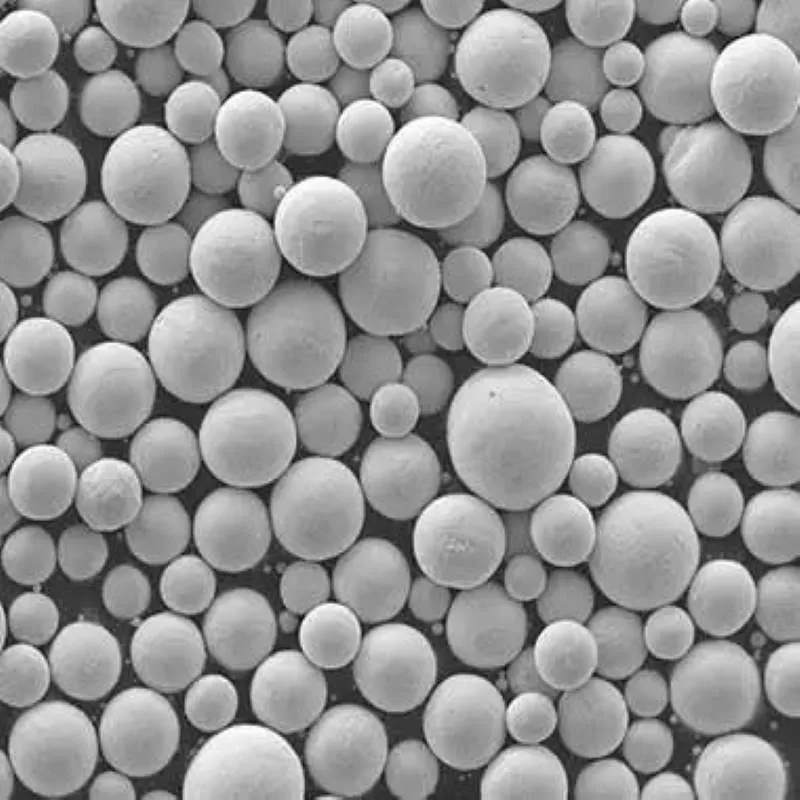
Spherical ASTM A517 Low Alloy Steel Powder, Grade A
Product Code : SP-CSTI-629-CU
We provide Spherical ASTM A517 Low Alloy Steel Powder, Grade A,Spherical ASTM A517 Low Alloy Steel Powder, Grade A is suitable for laser/electron beam augmentation, hot isostatic pressing, laser cladding, hot/cold spraying, and so on. The particles can be irregular and spherical. The particle distribution can reach the nanometer scale.,Spherical Particle Size,0-15μm,,15-45um,15-53μm, 20-63um,45-105um,45-150μm , 50-150um,75-150μm,or customized,Product purity and oxygen content can be customized according to requirements.
Please contact us if you need customized services. We will contact you with the price and availability in 24 hours.
ASTM A517 Low Alloy Steel Spherical Powder, Grade A Product Information
-:-
For detailed product information, please contact sales.
-:
ASTM A517 Low Alloy Steel Spherical Powder, Grade A Synonyms
-:-
For detailed product information, please contact sales.
-:
-:-
For detailed product information, please contact sales.
-:
Spherical ASTM A517 Low Alloy Steel Powder, Grade A characteristics
-:-
For detailed product information, please contact sales.
-:
Spherical ASTM A517 Low Alloy Steel Powder, Grade A Particle Size
-:-
For detailed product information, please contact sales.
-:
-:-
-:-
0-15μm ,5-25μm, 15-45μm, 15-53μm,20-63um, 45-75μm, 45-105μm, 45-150μm ,75-150μm.
(Various granularities can be customized according to customer requirements)
-:-
For detailed product information, please contact sales.
-:
Spherical ASTM A517 Low Alloy Steel Powder, Grade A Applicable processes
-:-
For detailed product information, please contact sales.
-:
Laser/electron beam additive manufacturing (SLM/EBM, 3D printing)
Direct laser deposition (DLD)
Used in thermal spray (TSA)
Powder hot isostatic pressing (HIP)
Metal injection molding (MIM)
Powder metallurgy (PM)
Laser cladding (LC), etc.
-:-
For detailed product information, please contact sales.
-:
Spherical ASTM A517 Low Alloy Steel Powder, Grade A Chemical Composition
-:-
For detailed product information, please contact sales.
-:
-:-
For detailed product information, please contact sales.
-:
ASTM A517 Low Alloy Steel, Grade A Product Information
-:-
For detailed product information, please contact sales.
-:
# **Product Introduction: ASTM A517 Grade A Quenched & Tempered High-Strength Alloy Steel Plate**
**ASTM A517 Grade A** is a premium **high-strength, quenched and tempered (Q&T) low-alloy steel plate** designed for applications requiring exceptional yield strength combined with good toughness and weldability. As part of the A517 specification (commonly known as "T-1" type steels), Grade A offers a minimum yield strength of **100 ksi (690 MPa)** and is specifically formulated with **boron-enhanced chemistry** to achieve maximum hardenability and through-thickness properties. This grade represents the foundation of the 100 ksi yield strength structural steel family, optimized for welded construction in demanding structural and mechanical applications where weight reduction and high load capacity are critical.
---
## **1. Key International Standards & Specifications**
* **Primary Standard:** **ASTM A517/A517M** - Standard Specification for Pressure Vessel Plates, Alloy Steel, High-Strength, Quenched and Tempered
* **Alternative Designation:** **ASTM A514 Grade A** - Essentially identical specification (A514 for structural, A517 for pressure vessels)
* **Common Name:** **"T-1 Steel"** - Industry terminology for this family of steels
* **ASME Code Adoption:** **SA-517 Grade A** in ASME Boiler and Pressure Vessel Code, Section II, Part A
* **Military Specifications:** **MIL-S-23284** (equivalent)
* **International Equivalents:**
* **EN 10025-6:** S690Q, S690QL (similar strength class, different chemistry approach)
* **ISO 4950-3:** High yield strength flat steel products - Quenched and tempered steels
* **JIS G3124:** SHT690 (Japanese high tensile strength steel for welded structures)
* **GB/T 16270:** Q690D/E (Chinese high strength structural steels, 690 MPa yield)
* **DIN 17102:** STE 690 (German high-strength structural steel)
---
## **2. Chemical Composition (Weight %)**
| Element | Composition Range (%) | Metallurgical Function |
|---------|----------------------|------------------------|
| Carbon (C) | 0.10-0.20 | Primary hardenability element, controlled for weldability |
| Manganese (Mn) | 0.60-1.00 | Enhances hardenability and strength |
| Phosphorus (P) | 0.035 max | Impurity control (toughness preservation) |
| Sulfur (S) | 0.040 max | Impurity control (improved weldability and ductility) |
| Silicon (Si) | 0.15-0.35 | Deoxidizer, solid solution strengthening |
| Chromium (Cr) | 0.40-0.65 | Enhances hardenability, corrosion/oxidation resistance |
| Molybdenum (Mo) | 0.15-0.25 | Provides high-temperature strength, reduces temper embrittlement |
| Vanadium (V) | 0.03-0.08 | Grain refinement, precipitation strengthening |
| **Boron (B)** | **0.001-0.005** | **Critical:** Dramatically increases hardenability at minimal levels |
| Nickel (Ni) | Not specified | Typically low (<0.40%) unless specially added |
| Copper (Cu) | Not specified | Typically <0.35% unless specified for corrosion |
### **Carbon Equivalent Calculations:**
- **IIW Formula:** CE = C + Mn/6 + (Cr+Mo+V)/5 + (Ni+Cu)/15 ≈ **0.45-0.60**
- **Pcm Formula:** C + Si/30 + (Mn+Cu+Cr)/20 + Ni/60 + Mo/15 + V/10 + 5B ≈ **0.20-0.30**
- **Weldability Classification:** Good with proper procedures (moderate Pcm for 100 ksi strength)
### **Key Composition Features:**
1. **Boron Addition:** Enables 100 ksi yield strength with lean alloying (cost-effective)
2. **Balanced Alloying:** Cr-Mo-V combination optimized for Q&T response
3. **Clean Steel Practice:** Low sulfur and phosphorus for enhanced toughness
4. **Controlled Carbon:** Maximum 0.20% for weldability at high strength level
### **Boron Metallurgy:**
- **Mechanism:** Boron segregates to austenite grain boundaries, retarding ferrite formation
- **Effect:** Dramatically increases hardenability without increasing carbon equivalent
- **Benefit:** Achieves martensitic structure in thick sections with minimal alloying
- **Control:** Precise boron addition essential (0.001-0.005% range)
---
## **3. Mechanical & Physical Properties**
### **Minimum Mechanical Properties (Up to 2.5 in / 63.5 mm thick):**
- **Tensile Strength:** **760-895 MPa** (110,000-130,000 psi)
- **Yield Strength (0.2% offset):** **690 MPa minimum** (100,000 psi minimum)
- **Elongation in 2 in. (50 mm):** **16% minimum**
- **Reduction of Area:** Typically 40-55%
- **Hardness Range:** 235-293 HB (Brinell)
### **Impact Toughness Requirements:**
- **Charpy V-Notch Testing:** Mandatory
- **Standard Test Temperature:** **-18°C (0°F)** or as specified
- **Minimum Absorbed Energy:** **34 J (25 ft-lb)** minimum average
- **Individual Specimens:** Typically no single value < 27 J (20 ft-lb)
### **Thickness-Dependent Properties:**
| Thickness Range | Minimum Yield Strength | Minimum Tensile Strength | Notes |
|-----------------|------------------------|--------------------------|-------|
| ≤ 1.5 in (38 mm) | 690 MPa (100 ksi) | 760 MPa (110 ksi) | Full properties |
| 1.5-2.5 in (38-63.5 mm) | 690 MPa (100 ksi) | 760 MPa (110 ksi) | Maintains properties |
| 2.5-4.0 in (63.5-102 mm) | 620 MPa (90 ksi) | 690 MPa (100 ksi) | Reduced properties |
| > 4.0 in (>102 mm) | Consult manufacturer | Consult manufacturer | Special processing required |
### **Physical Properties:**
| Property | Value | Conditions |
|----------|-------|------------|
| Density | 7.85 g/cm³ (0.284 lb/in³) | Room temperature |
| Modulus of Elasticity | 200 GPa (29×10⁶ psi) | Room temperature |
| Shear Modulus | 77 GPa (11.2×10⁶ psi) | Room temperature |
| Poisson's Ratio | 0.29 | - |
| Coefficient of Thermal Expansion | 11.8×10⁻⁶/°C | 20-100°C |
| Thermal Conductivity | 42-46 W/m·K | 100°C |
| Specific Heat | 460 J/kg·K | 100°C |
| Electrical Resistivity | 0.25-0.30 μΩ·m | Room temperature |
---
## **4. Heat Treatment & Microstructure**
### **Mandatory Heat Treatment Sequence:**
1. **Austenitizing:** 900-955°C (1650-1750°F) - Complete transformation
2. **Quenching:** Accelerated cooling (water or polymer quench)
3. **Tempering:** 595-690°C (1100-1275°F) - Develops tempered martensite
4. **Cooling:** Air cool after tempering
### **Critical Processing Parameters:**
- **Austenitizing Temperature:** Precise control essential for grain size
- **Quenching Rate:** Must exceed critical cooling rate for full martensite
- **Tempering Temperature:** Determines final strength-toughness balance
- **Time at Temperature:** Sufficient for complete transformation
### **Resulting Microstructure:**
- **Primary Phase:** Tempered martensite (lath martensite structure)
- **Carbide Distribution:** Fine, dispersed alloy carbides (M₂C, M₇C₃, MC types)
- **Grain Size:** ASTM 7 or finer (≤15 μm prior austenite grain size)
- **Prior Austenite Grain:** Controlled through processing and microalloying
### **Through-Thickness Properties:**
- **Hardenability:** Excellent due to boron addition
- **Property Uniformity:** Maintains ≥90% of surface properties in properly processed material
- **Section Sensitivity:** Minimal up to 2.5 in thickness
---
## **5. Key Characteristics & Advantages**
### **Exceptional Strength-to-Weight Ratio:**
- **High Strength:** 100 ksi yield enables 50-60% weight reduction vs. A36 steel
- **Stiffness Maintenance:** Same modulus as lower strength steels
- **Design Efficiency:** Allows more efficient structural designs
### **Excellent Toughness for Strength Level:**
- **Good Low-Temperature Toughness:** Maintains properties to -18°C (0°F) standard
- **Fracture Resistance:** High Charpy values prevent brittle fracture
- **Fatigue Resistance:** Superior to many lower-strength steels
### **Weldability (Relative to Strength Level):**
- **Good Weldability:** For a 100 ksi yield strength steel
- **Preheat Required:** But manageable with proper procedures
- **HAZ Properties:** Maintains good toughness in heat-affected zone
- **Established Procedures:** Well-documented welding practices available
### **Fabrication Characteristics:**
- **Machinability:** Fair (approximately 50% of 1212 steel)
- **Formability:** Limited due to high strength - hot forming recommended
- **Cutting:** Requires more power than mild steels
- **Abrasion Resistance:** Good due to high hardness
### **Economic Advantages:**
- **Weight Savings:** Reduced material and handling costs
- **Design Optimization:** Enables innovative structural solutions
- **Lifecycle Cost:** Reduced maintenance and improved durability
---
## **6. Product Applications**
### **Construction & Mining Equipment:**
- **Crane Components:** Boom sections, outriggers, structural members
- **Excavator Arms and Buckets:** For demanding digging applications
- **Mining Shovel Components:** Dipper sticks, handles, linkages
- **Dragline Booms and Components**
### **Material Handling Equipment:**
- **Heavy-Duty Forklift Masts:** High-strength components
- **Conveyor System Structures:** For heavy bulk materials
- **Stacker/Reclaimer Booms:** In mining and port facilities
### **Transportation & Infrastructure:**
- **Bridge Components:** For movable bridges or highly loaded sections
- **Specialized Truck Frames:** For heavy haul applications
- **Railroad Equipment:** Couplers, yokes, structural members
### **Energy & Industrial:**
- **Wind Turbine Towers:** Particularly in lower sections
- **Hydroelectric Equipment:** Gate structures and components
- **Heavy Machinery Frames:** Presses, rollers, forming equipment
### **Military & Defense:**
- **Armored Vehicle Components:** Structural elements
- **Weapon System Mounts:** Requiring high strength-to-weight
- **Military Bridge Systems:** For rapid deployment
### **Pressure Vessels (when specified as A517):**
- **High-Pressure Vessels:** Where A517 specification is called for
- **Specialized Containment:** For high-energy storage
- **Process Equipment:** For high-pressure chemical applications
---
## **7. Fabrication Guidelines**
### **Welding Procedures (Critical):**
#### **Preheat Requirements:**
| Thickness Range | Minimum Preheat | Recommended Range |
|-----------------|-----------------|-------------------|
| ≤ ¾ in (19 mm) | 150°C (300°F) | 150-200°C (300-400°F) |
| ¾ to 1½ in (19-38 mm) | 175°C (350°F) | 175-225°C (350-440°F) |
| 1½ to 2½ in (38-63.5 mm) | 200°C (400°F) | 200-250°C (400-480°F) |
| > 2½ in (>63.5 mm) | 225°C (440°F) | 225-275°C (440-530°F) |
#### **Interpass Temperature Control:**
- **Maximum Interpass:** 250°C (480°F)
- **Optimal Range:** 150-230°C (300-450°F)
- **Monitoring:** Continuous for critical welds
#### **Filler Metal Selection:**
| Process | Recommended Filler | Notes |
|---------|-------------------|-------|
| SMAW | E11018, E12018 | Matching strength, low hydrogen essential |
| FCAW | E111T1-K3, E121T1-K3 | Gas-shielded, high deposition |
| SAW | F12A8-EL12, F13A2-EM12K | For high-quality production welding |
| GMAW | ER110S, ER120S | With appropriate gas mixtures (Ar-CO₂) |
#### **Post-Weld Heat Treatment (PWHT):**
- **Generally Not Required:** For most applications with proper procedures
- **Optional Stress Relief:** 595-650°C (1100-1200°F) for highly restrained joints
- **Critical:** If PWHT performed, temperature must not exceed original tempering temperature
### **Cutting & Machining:**
- **Plasma Cutting:** Preferred for thicknesses up to 75 mm
- **Oxy-Fuel Cutting:** Requires careful control to prevent hardening
- **Laser Cutting:** Excellent for precision work up to 25 mm thickness
- **Machining Parameters:** Reduced speeds and feeds; carbide tools recommended
### **Forming Operations:**
- **Cold Forming:** Limited to simple bends with large radii (≥5× thickness)
- **Hot Forming:** Recommended at 870-925°C (1600-1700°F)
- **Post-Forming Heat Treatment:** May be required after hot forming
- **Springback:** Significant due to high strength; compensation required
---
## **8. Design Considerations**
### **Structural Design:**
- **Allowable Stresses:** Typically 0.60 × yield strength for static loading (414 MPa / 60 ksi)
- **Fatigue Design:** Special considerations required - consult relevant codes
- **Connection Design:** Both welded and bolted connections suitable
- **Buckling Considerations:** Higher strength allows more slender sections
### **Fracture Mechanics Considerations:**
- **Fracture Toughness:** Good for strength level but requires proper design
- **Notch Sensitivity:** Moderate; careful detailing of stress concentrations
- **Crack Propagation:** Resistant with proper toughness
- **Inspection Intervals:** Based on fracture mechanics analysis for critical applications
### **Temperature Considerations:**
- **Minimum Service Temperature:** Can be as low as -40°C (-40°F) with proper toughness specification
- **Maximum Service Temperature:** ~400°C (750°F) for intermittent service
- **Creep Considerations:** Not suitable for sustained loading above 370°C (700°F)
### **Corrosion Considerations:**
- **Atmospheric Corrosion:** Similar to carbon steel unless painted/protected
- **Galvanic Corrosion:** Can occur when coupled with dissimilar metals
- **Protection Systems:** Painting, coating, or cathodic protection recommended
---
## **9. Comparison with Other High-Strength Steels**
### **A517 Grade A vs. A514 Grade A:**
| Parameter | A517 Grade A | A514 Grade A | Key Differences |
|-----------|--------------|--------------|-----------------|
| **Specification** | Pressure vessel plates | Structural plates | Essentially identical material |
| **Chemical Requirements** | Identical | Identical | Same composition |
| **Mechanical Properties** | Identical | Identical | Same minimum requirements |
| **Testing Requirements** | May differ slightly | May differ slightly | Slightly different emphasis |
| **Typical Applications** | Pressure vessels | Structural components | Spec based on end use |
### **A517 Grade A vs. A572 Grade 50:**
| Aspect | A517 Grade A | A572 Grade 50 | Advantage |
|--------|--------------|---------------|-----------|
| **Yield Strength** | 690 MPa (100 ksi) | 345 MPa (50 ksi) | A517 100% stronger |
| **Weight Savings Potential** | Up to 50% | Baseline | A517 enables lighter structures |
| **Cost per kg** | 3-4× higher | Baseline | A572 more economical |
| **Fabrication Complexity** | Higher | Lower | A572 easier to work with |
| **Applications** | Critical, weight-sensitive | General structural | Different performance requirements |
### **A517 Grade A vs. European S690QL:**
| Consideration | A517 Grade A | S690QL (EN 10025-6) | Differences |
|---------------|--------------|---------------------|-------------|
| **Yield Strength** | 690 MPa | 690 MPa | Same minimum |
| **Chemistry Approach** | B-added, lower alloy | Higher Ni, Cr, Mo, V, Ti, Nb | Different metallurgy |
| **Toughness Temperature** | -18°C typical | -40°C or -60°C standard | S690QL better low-temp |
| **Thickness Range** | Up to 63.5 mm full prop. | Up to 100 mm full properties | S690QL thicker capability |
| **Standardization** | North American | European | Regional preferences |
### **Grade A vs. Other A517/A514 Grades:**
- **Grade A:** Foundation grade, balanced properties
- **Grade B:** Higher toughness variant
- **Grade E:** Optimized for specific applications
- **Grade F:** Enhanced properties for special requirements
---
## **10. Quality Control & Certification**
### **Testing Requirements:**
- **Heat Analysis:** For each melt
- **Product Analysis:** May be required
- **Tensile Tests:** Per heat treatment charge
- **Impact Tests:** Per heat treatment charge at specified temperature
- **Hardness Tests:** Often specified for quality verification
### **Non-Destructive Examination:**
- **Ultrasonic Testing:** Often required for critical applications (ASTM A578)
- **Magnetic Particle:** For surface examination
- **Dye Penetrant:** For critical weld areas
### **Special Tests for Critical Applications:**
- **Drop-Weight Testing:** For fracture mechanics evaluation
- **CTOD Testing:** Crack tip opening displacement for fracture toughness
- **Through-Thickness Testing:** For properties in Z-direction
- **Microcleanliness Assessment:** Inclusion rating per ASTM E45
### **Certification:**
- **Mill Test Certificate:** Complete with all test results
- **Heat Treatment Records:** Full time-temperature documentation
- **Traceability:** Complete from melt to finished plate
- **Third-Party Certification:** Often required for critical applications
### **Marking & Identification:**
- ASTM designation and grade
- Manufacturer's name or trademark
- Heat number
- Size and weight
- Heat treatment condition
---
**Technical Summary:** ASTM A517 Grade A represents a premium high-strength low-alloy steel offering an exceptional combination of 100 ksi yield strength, good toughness, and weldability. Its boron-enhanced chemistry provides excellent through-thickness properties while maintaining reasonable fabricability. Although requiring careful fabrication procedures and commanding a significant cost premium over conventional structural steels, it enables substantial weight savings and performance improvements in critical applications where strength-to-weight ratio is paramount. The material finds its primary applications in demanding mechanical and structural components for construction, mining, and material handling equipment, as well as specialized applications in transportation and energy infrastructure. As the foundational grade of the "T-1" steel family, A517 Grade A has established a proven track record of performance in demanding applications over several decades. Proper design, fabrication, and quality control are essential to realize the full benefits of this high-performance material, particularly in welded construction where attention to welding procedures and heat treatment is critical for maintaining the material's inherent properties in the fabricated structure.
-:-
For detailed product information, please contact sales.
-:
ASTM A517 Low Alloy Steel, Grade A Specification
Dimensions
Size:
Diameter 20-1000 mm Length <6024 mm
Size:We can customized as required
Standard:
Per your request or drawing
We can customized as required
Properties(Theoretical)
Chemical Composition
-:-
For detailed product information, please contact sales.
-:
ASTM A517 Low Alloy Steel, Grade A Properties
-:-
For detailed product information, please contact sales.
-:
Spherical ASTM A517 Low Alloy Steel Powder, Grade A Particle Size Description
-:-
For detailed product information, please contact sales.
-:
Applications of Spherical ASTM A517 Low Alloy Steel Powder, Grade A
-:-
For detailed product information, please contact sales.
-:
-:-
For detailed product information, please contact sales.
-:
Applications of ASTM A517 Low Alloy Steel Spherical Powder, Grade A
-:-
For detailed product information, please contact sales.
-:
Chemical Identifiers ASTM A517 Low Alloy Steel Spherical Powder, Grade A
-:-
For detailed product information, please contact sales.
-:
Packing of ASTM A517 Low Alloy Steel Spherical Powder, Grade A
-:-
For detailed product information, please contact sales.
-:
Standard Packing:
-:-
For detailed product information, please contact sales.
-:
Typical bulk packaging includes palletized plastic 5 gallon/25 kg. pails, fiber and Steel Spherical Powder drums to 1 ton super sacks in full container (FCL) or truck load (T/L) quantities. Research and sample quantities and hygroscopic, oxidizing or other air sensitive materials may be packaged under argon or vacuum. Solutions are packaged in polypropylene, plastic or glass jars up to palletized 2495 gallon liquid totes Special package is available on request. E FORUs’ is carefully handled to minimize damage during storage and transportation and to preserve the quality of our products in their original condition