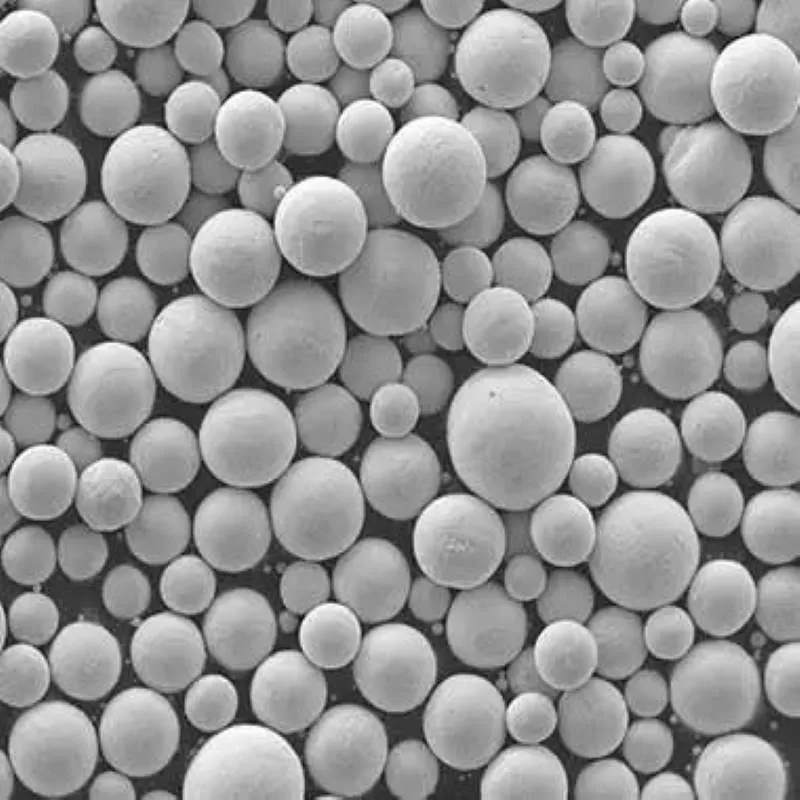
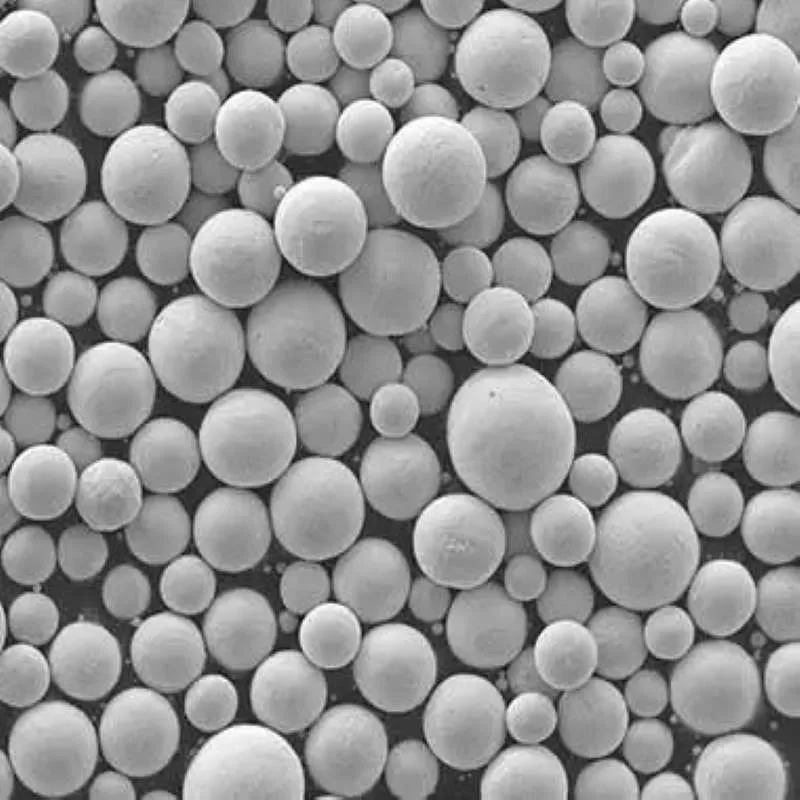
Spherical Latrobe LSS™ S7 Shock-Resisting Tool Steel Powder (ASTM S7)
Product Code : SP-GSTI-503-CU
We provide Spherical Latrobe LSS™ S7 Shock-Resisting Tool Steel Powder (ASTM S7),Spherical Latrobe LSS™ S7 Shock-Resisting Tool Steel Powder (ASTM S7) is suitable for laser/electron beam augmentation, hot isostatic pressing, laser cladding, hot/cold spraying, and so on. The particles can be irregular and spherical. The particle distribution can reach the nanometer scale.,Spherical Particle Size,0-15μm,,15-45um,15-53μm, 20-63um,45-105um,45-150μm , 50-150um,75-150μm,or customized,Product purity and oxygen content can be customized according to requirements.
Please contact us if you need customized services. We will contact you with the price and availability in 24 hours.
Latrobe LSS™ S7 Shock-Resisting Tool Steel Spherical Powder (ASTM S7) Product Information
-:-
For detailed product information, please contact sales.
-:
Latrobe LSS™ S7 Shock-Resisting Tool Steel Spherical Powder (ASTM S7) Synonyms
-:-
For detailed product information, please contact sales.
-:
-:-
For detailed product information, please contact sales.
-:
Spherical Latrobe LSS™ S7 Shock-Resisting Tool Steel Powder (ASTM S7) characteristics
-:-
For detailed product information, please contact sales.
-:
Spherical Latrobe LSS™ S7 Shock-Resisting Tool Steel Powder (ASTM S7) Particle Size
-:-
For detailed product information, please contact sales.
-:
-:-
-:-
0-15μm ,5-25μm, 15-45μm, 15-53μm,20-63um, 45-75μm, 45-105μm, 45-150μm ,75-150μm.
(Various granularities can be customized according to customer requirements)
-:-
For detailed product information, please contact sales.
-:
Spherical Latrobe LSS™ S7 Shock-Resisting Tool Steel Powder (ASTM S7) Applicable processes
-:-
For detailed product information, please contact sales.
-:
Laser/electron beam additive manufacturing (SLM/EBM, 3D printing)
Direct laser deposition (DLD)
Used in thermal spray (TSA)
Powder hot isostatic pressing (HIP)
Metal injection molding (MIM)
Powder metallurgy (PM)
Laser cladding (LC), etc.
-:-
For detailed product information, please contact sales.
-:
Spherical Latrobe LSS™ S7 Shock-Resisting Tool Steel Powder (ASTM S7) Chemical Composition
-:-
For detailed product information, please contact sales.
-:
-:-
For detailed product information, please contact sales.
-:
Latrobe LSS™ S7 Shock-Resisting Tool Steel (ASTM S7) Product Information
-:-
For detailed product information, please contact sales.
-:
# **Product Introduction: Latrobe LSS™ S7 Shock-Resisting Tool Steel (ASTM A681)**
**Latrobe LSS™ S7** is a premium-grade, **air-hardening, silicon-chromium shock-resisting tool steel** widely recognized as the industry benchmark for applications demanding the highest combination of impact toughness and dimensional stability. Classified under ASTM A681 Grade S7, this specialized steel offers exceptional resistance to shock loading, chipping, and cracking while maintaining good wear resistance at elevated hardness levels. Its air-hardening characteristic provides minimal distortion during heat treatment, making it ideal for complex tool geometries subjected to severe dynamic stresses.
The defining advantage of LSS™ S7 lies in its **unmatched balance of high toughness (typically 55-58 HRC) and excellent dimensional stability**, achieved through a carefully optimized silicon-chromium alloy system. This combination makes S7 particularly valuable for tools that must withstand heavy impact while maintaining precise dimensional tolerances.
---
## **1. Chemical Composition**
Latrobe LSS™ S7 features a specialized silicon-chromium composition optimized for maximum toughness and stability:
| Element | Content (%) | Function |
| :--- | :--- | :--- |
| Carbon (C) | 0.45 - 0.55 | Provides core strength while maintaining toughness |
| Silicon (Si) | 0.20 - 1.00 | Enhances toughness and fatigue strength |
| Chromium (Cr) | 3.00 - 3.50 | Provides hardenability and moderate wear resistance |
| Molybdenum (Mo)| 1.30 - 1.80 | Enhances hardenability and toughness |
| Manganese (Mn)| 0.20 - 0.90 | Improves hardenability and strength |
| **Balance** | Iron (Fe) | |
*(Composition conforms to ASTM A681 Grade S7 specifications)*
---
## **2. Physical & Mechanical Properties**
### **Annealed Condition Properties:**
- **Hardness:** 192 - 229 HB (Brinell)
- **Machinability:** Fair (rated 40% of 1% carbon steel standard)
- **Density:** 7.83 g/cm³ (0.283 lb/in³)
- **Modulus of Elasticity:** 203 GPa (29.4 × 10⁶ psi)
- **Thermal Conductivity:** 37.5 W/m·K at 20°C
- **Coefficient of Thermal Expansion:** 11.5 × 10⁻⁶/°C (20-100°C)
### **Heat Treatment Characteristics:**
- **Hardening Method:** Air hardening
- **Austenitizing Temperature:** 925°C - 955°C (1700°F - 1750°F)
- **Preheating:** 650°C (1200°F) and 845°C (1550°F) recommended
- **Quenching:** Still air or forced air circulation
- **Tempering Range:** 175°C - 540°C (350°F - 1000°F)
### **Hardened & Tempered Properties:**
- **Optimal Hardness Range:** **55 - 58 HRC** (for best toughness/strength balance)
- **Charpy Impact Value (unnotched):** **75 - 110 J** (at 55-57 HRC) - **Excellent**
- **Transverse Rupture Strength:** 3,800 - 4,400 MPa
- **Compressive Strength:** 2,200 - 2,600 MPa
- **Fatigue Strength:** 1,050 - 1,250 MPa (rotating bending, 10⁷ cycles)
- **Key Characteristics:**
- **Exceptional Impact Toughness:** Among highest of all tool steels
- **Superior Dimensional Stability:** Minimal distortion during air hardening
- **Good Wear Resistance:** Adequate for most impact applications
- **Deep Hardening:** Full hardness to 150mm (6") diameter in air
- **Consistent Performance:** Predictable heat treatment response
---
## **3. International Standards & Cross-Reference**
| Country/Region | Standard | Designation |
| :--- | :--- | :--- |
| **United States** | ASTM A681 | Grade S7 |
| | AISI | S7 |
| | UNS | T41907 |
| **Germany** | DIN 17350 | 1.2542 |
| **Japan** | JIS G4404 | - |
| **United Kingdom** | BS 4659 | BS7 |
| **Sweden** | SS 14 2720 | - |
| **France** | AFNOR | 55SiCrMoV6 |
| **International** | ISO 4957 | 55SiCrMoV6 |
---
## **4. Product Applications**
### **Primary Impact Applications:**
- **Heavy-Duty Punching Tools:** For thick plates and high-strength materials
- **Cold Chisels and Cutting Tools:** For metalworking and demolition
- **Bolt Headers and Cold Forging Dies:** Subjected to extreme impact loads
- **Shear Blades:** For structural steel, railroad rails, and heavy plate
- **Pneumatic Tool Components:** Jackhammer bits, rock drill steels
### **Precision Tooling:**
- **Thread Rolling Dies:** Particularly for high-strength alloys
- **Forming Tools and Dies:** Subjected to intermittent heavy loading
- **Die Inserts for Stamping:** Where dimensional stability is critical
- **Gauges and Fixtures:** In high-vibration environments
### **Industrial & Safety Tools:**
- **Crusher Parts:** Hammers, breaker bars in mining and aggregate
- **Woodworking Tools:** Chipper knives, log splitter wedges
- **Construction Equipment:** Pile driver components, breaker tools
- **Safety-Critical Components:** Where tool failure would be hazardous
### **Specialized Applications:**
- **Plastic Injection Molds:** For abrasive filled materials
- **Hot Work Tools:** Up to 425°C (800°F) intermittent service
- **Knives for Tough Materials:** Cutting composites and hard plastics
---
## **5. Processing Guidelines**
### **Machining (Annealed State):**
- **Turning Speed:** 18-28 m/min (60-90 ft/min)
- **Feed Rate:** 0.10-0.20 mm/rev (0.004-0.008 in/rev)
- **Tool Material:** Premium carbide tools with positive rake angles
- **Chip Control:** Produces continuous chips - use chip breakers
- **Coolant:** Essential for heat control and surface finish
### **Heat Treatment Procedure:**
1. **Stress Relieving:** 650°C (1200°F) after rough machining, slow cool
2. **Preheating:** 650°C (1200°F) for 30 min/inch, then 845°C (1550°F) for 20 min/inch
3. **Austenitizing:** 940°C (1725°F) for 20-30 minutes per inch of thickness
4. **Quenching:** Air cool in still air (for complex shapes) or forced air
5. **Tempering:** Begin when tool reaches hand-warm temperature
- For optimal toughness (55-57 HRC): 205°C - 315°C (400°F - 600°F) for 2+2 hours
- For higher hardness (57-59 HRC): 175°C - 205°C (350°F - 400°F) for 2+2 hours
### **Special Heat Treatment Notes:**
- **Deep Freezing:** Optional at -75°C (-100°F) for maximum dimensional stability
- **Multiple Tempering:** Double tempering minimum, triple recommended
- **Temperature Uniformity:** Critical during austenitizing for consistent results
### **Grinding:**
- **Wheel Selection:** Aluminum oxide, medium hardness (I-K grade)
- **Wheel Speed:** 25-28 m/s (5000-5500 SFPM)
- **Coolant:** Flood coolant essential to prevent overheating
- **Technique:** Light, frequent passes with consistent feed rates
- **Surface Finish:** Can achieve excellent finishes with proper technique
---
## **6. Performance Comparison**
### **vs. S5 (Silicon-Molybdenum Shock Steel):**
- **S7:** Better dimensional stability, deeper hardening, more consistent
- **S5:** Higher toughness at equivalent hardness, better fatigue resistance
- **Applications:** S7 preferred for complex shapes, S5 for extreme impact
### **vs. H13 (Hot Work Steel):**
- **S7:** Superior room temperature impact strength, better toughness
- **H13:** Better hot hardness above 425°C (800°F), superior thermal fatigue
- **Temperature:** S7 optimal for <425°C, H13 for higher temperatures
### **vs. D2 (High-Carbon High-Chromium):**
- **S7:** 3-4 times higher impact strength, better dimensional stability
- **D2:** 5-8 times better wear resistance, higher maximum hardness
- **Applications:** S7 for impact, D2 for wear-dominated applications
---
## **7. Technical Advantages**
### **Unique Properties:**
1. **Optimal Toughness-Hardness Balance:** Best combination in commercial tool steels
2. **Exceptional Stability:** Minimal distortion (±0.05% typical)
3. **Deep Hardening Capacity:** Suitable for very large sections
4. **Consistent Performance:** Predictable behavior in heat treatment and service
### **Economic & Safety Benefits:**
- **Extended Tool Life:** 3-5 times longer than conventional steels in impact service
- **Reduced Scrap:** Minimal distortion reduces finishing requirements
- **Safety Enhancement:** Low risk of catastrophic failure
- **Versatility:** Single material solution for many demanding applications
---
## **8. Special Applications & Considerations**
### **High-Precision Impact Tools:**
- **Progressive Dies:** Where dimensional accuracy must be maintained under impact
- **Precision Punches:** For high-tolerance hole punching
- **Forming Tools:** Requiring maintained geometry under heavy loading
### **Large Section Applications:**
- **Die Blocks:** Up to 150mm (6") thick with uniform properties
- **Hammer Tools:** Large cross-sections with through-hardening
- **Machine Components:** Heavy sections requiring impact resistance
### **Design Optimization:**
- **Section Transitions:** Gradual changes to minimize stress concentrations
- **Corner Radii:** Minimum 0.8mm (0.030") recommended
- **Support Design:** Proper mounting and support extends service life
- **Maintenance Access:** Design for easy inspection and maintenance
---
## **9. Availability & Specifications**
### **Standard Forms:**
- **Round Bars:** 10mm to 400mm diameter (0.375" to 16")
- **Flat Stock:** 6mm to 300mm thickness (0.25" to 12")
- **Square Bars:** 10mm to 300mm (0.375" to 12")
- **Forged Blocks:** Custom sizes available
- **Plate:** Up to 400mm thick
### **Quality Standards:**
- **Microcleanliness:** Stringently controlled for maximum toughness
- **Homogeneity:** Excellent uniformity throughout cross-section
- **Decarburization:** Controlled per ASTM A681 requirements
- **Surface Quality:** Suitable for precision applications
### **Certifications:**
- Complete mill test reports
- Hardness certification throughout material
- Ultrasonic testing available (ASTM A388)
- Full traceability with heat/lot numbers
---
## **10. Maintenance & Service Life Extension**
### **Preventive Maintenance:**
- **Regular Inspection:** Visual and magnetic particle inspection recommended
- **Edge Maintenance:** Proper sharpening techniques to prevent stress risers
- **Corrosion Protection:** Important in humid or corrosive environments
- **Usage Logging:** Track cycles, impacts, and maintenance history
### **Reconditioning Options:**
- **Welding:** Possible with proper preheat (315°C/600°F) and procedure
- **Rehardening:** Can be successfully re-heat treated multiple times
- **Surface Enhancement:** Nitriding for increased wear resistance
### **Failure Prevention:**
- **Common Issues:** Fatigue cracking, abrasive wear, edge deformation
- **Prevention:** Proper hardness selection, design optimization, correct application
- **Technical Support:** Available for troubleshooting and optimization
---
**Technical Summary:** Latrobe LSS™ S7 represents the **gold standard for shock-resisting tool steels**, offering an unparalleled combination of toughness, dimensional stability, and practical hardness. Its air-hardening nature and consistent performance have made it the preferred choice for demanding applications where tools must withstand severe impact while maintaining precision. While not offering the extreme wear resistance of high-carbon grades or the hot hardness of true hot-work steels, S7 provides the optimal balance for the majority of impact applications encountered in industry.
**Industry Status:** S7 is widely regarded as the most versatile and reliable shock-resistant tool steel available, with decades of proven performance across multiple industries. Its predictable behavior and excellent balance of properties have established it as a benchmark material.
**Safety Note:** For impact tools, regular inspection and adherence to manufacturer specifications are essential. Always follow industry safety standards and best practices.
**Disclaimer:** Performance data represents typical values. For critical applications, conduct testing under actual service conditions. Always consult Latrobe's current technical documentation and processing recommendations for specific requirements. Material properties may vary based on processing and service history.
-:-
For detailed product information, please contact sales.
-:
Latrobe LSS™ S7 Shock-Resisting Tool Steel (ASTM S7) Specification
Dimensions
Size:
Diameter 20-1000 mm Length <7204 mm
Size:We can customized as required
Standard:
Per your request or drawing
We can customized as required
Properties(Theoretical)
Chemical Composition
-:-
For detailed product information, please contact sales.
-:
Latrobe LSS™ S7 Shock-Resisting Tool Steel (ASTM S7) Properties
-:-
For detailed product information, please contact sales.
-:
Spherical Latrobe LSS™ S7 Shock-Resisting Tool Steel Powder (ASTM S7) Particle Size Description
-:-
For detailed product information, please contact sales.
-:
Applications of Spherical Latrobe LSS™ S7 Shock-Resisting Tool Steel Powder (ASTM S7)
-:-
For detailed product information, please contact sales.
-:
-:-
For detailed product information, please contact sales.
-:
Applications of Latrobe LSS™ S7 Shock-Resisting Tool Steel Spherical Powder (ASTM S7)
-:-
For detailed product information, please contact sales.
-:
Chemical Identifiers Latrobe LSS™ S7 Shock-Resisting Tool Steel Spherical Powder (ASTM S7)
-:-
For detailed product information, please contact sales.
-:
Packing of Latrobe LSS™ S7 Shock-Resisting Tool Steel Spherical Powder (ASTM S7)
-:-
For detailed product information, please contact sales.
-:
Standard Packing:
-:-
For detailed product information, please contact sales.
-:
Typical bulk packaging includes palletized plastic 5 gallon/25 kg. pails, fiber and Steel Spherical Powder drums to 1 ton super sacks in full container (FCL) or truck load (T/L) quantities. Research and sample quantities and hygroscopic, oxidizing or other air sensitive materials may be packaged under argon or vacuum. Solutions are packaged in polypropylene, plastic or glass jars up to palletized 3675 gallon liquid totes Special package is available on request. E FORUs’ is carefully handled to minimize damage during storage and transportation and to preserve the quality of our products in their original condition