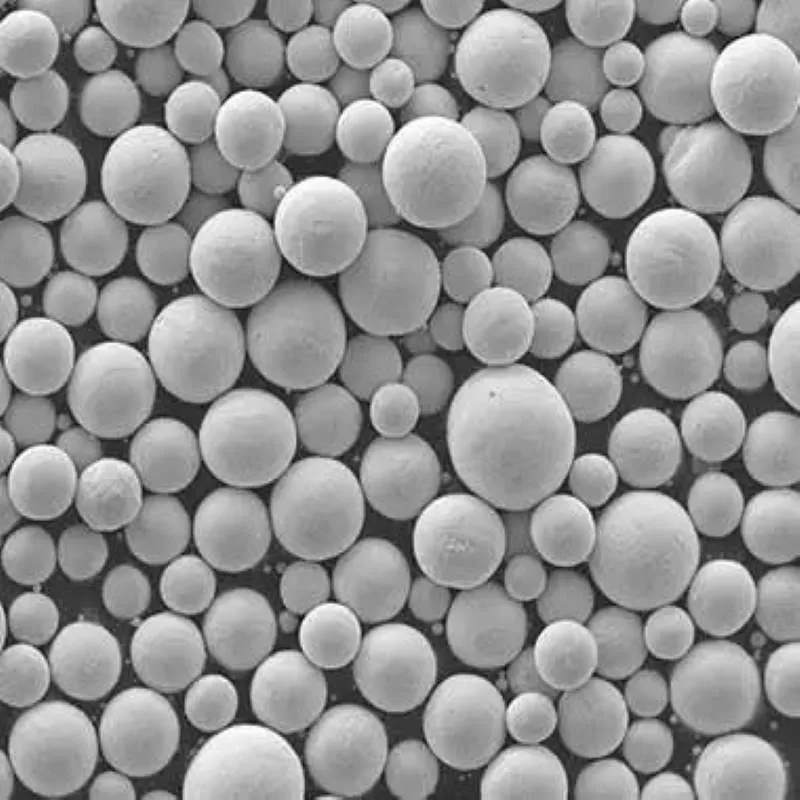
Spherical ASTM A573 Steel Powder, grade 58
Product Code : SP-CSTI-555-CU
We provide Spherical ASTM A573 Steel Powder, grade 58,Spherical ASTM A573 Steel Powder, grade 58 is suitable for laser/electron beam augmentation, hot isostatic pressing, laser cladding, hot/cold spraying, and so on. The particles can be irregular and spherical. The particle distribution can reach the nanometer scale.,Spherical Particle Size,0-15μm,,15-45um,15-53μm, 20-63um,45-105um,45-150μm , 50-150um,75-150μm,or customized,Product purity and oxygen content can be customized according to requirements.
Please contact us if you need customized services. We will contact you with the price and availability in 24 hours.
ASTM A573 Steel Spherical Powder, grade 58 Product Information
-:-
For detailed product information, please contact sales.
-:
ASTM A573 Steel Spherical Powder, grade 58 Synonyms
-:-
For detailed product information, please contact sales.
-:
-:-
For detailed product information, please contact sales.
-:
Spherical ASTM A573 Steel Powder, grade 58 characteristics
-:-
For detailed product information, please contact sales.
-:
Spherical ASTM A573 Steel Powder, grade 58 Particle Size
-:-
For detailed product information, please contact sales.
-:
-:-
-:-
0-15μm ,5-25μm, 15-45μm, 15-53μm,20-63um, 45-75μm, 45-105μm, 45-150μm ,75-150μm.
(Various granularities can be customized according to customer requirements)
-:-
For detailed product information, please contact sales.
-:
Spherical ASTM A573 Steel Powder, grade 58 Applicable processes
-:-
For detailed product information, please contact sales.
-:
Laser/electron beam additive manufacturing (SLM/EBM, 3D printing)
Direct laser deposition (DLD)
Used in thermal spray (TSA)
Powder hot isostatic pressing (HIP)
Metal injection molding (MIM)
Powder metallurgy (PM)
Laser cladding (LC), etc.
-:-
For detailed product information, please contact sales.
-:
Spherical ASTM A573 Steel Powder, grade 58 Chemical Composition
-:-
For detailed product information, please contact sales.
-:
-:-
For detailed product information, please contact sales.
-:
ASTM A573 Steel, grade 58 Product Information
-:-
For detailed product information, please contact sales.
-:
# **Technical Data Sheet: ASTM A573 Steel, Grade 58**
## **1. Product Overview**
ASTM A573 Grade 58 is a structural carbon steel plate material that offers enhanced toughness properties compared to conventional carbon steels. This specification, which includes three toughness grades (58, 65, and 70), features Grade 58 as the entry-level toughness grade with a minimum yield strength of **32 ksi (220 MPa)**. The distinguishing characteristic of A573 steels is their improved notch toughness, achieved through controlled chemistry and processing rather than increased strength levels. Grade 58 is particularly valuable for applications where resistance to brittle fracture is important, such as in low-temperature service, dynamically loaded structures, or applications with stress concentrations, making it a preferred choice for bridges, buildings, and other structural applications where reliability under adverse conditions is paramount.
## **2. International Standards & Specifications**
- **Primary Standard:** ASTM A573/A573M - *Standard Specification for Structural Carbon Steel Plates of Improved Toughness*
- **Dimensional Standard:** ASTM A6/A6M - *General Requirements for Rolled Structural Steel Bars, Plates, Shapes, and Sheet Piling*
- **Related Standards:**
- ASTM A673/A673M: *Sampling Procedure for Impact Testing of Structural Steel*
- ASTM A370: *Standard Test Methods and Definitions for Mechanical Testing of Steel Products*
- **International Equivalents:**
- **EN Standard:** EN 10025-2 Grade **S235J0/J2** (similar strength with toughness requirements)
- **JIS Standard:** JIS G3106 **SM400A/B** (structural steel with guaranteed impact properties)
- **ISO Standard:** ISO 630-2 Grade **E235B/C** (structural steels with specified impact energy)
- **GB/T Standard:** GB/T 700 **Q235C/D** (carbon structural steel with impact requirements)
- **Canadian Standard:** CSA G40.21 **260T** (toughness grade structural steel)
- **Australian Standard:** AS/NZS 3678 **Grade 250** (structural steel with toughness)
- **German Standard:** DIN 17100 **St37-3U** (structural steel with improved toughness)
## **3. Chemical Composition (Heat Analysis, % by Weight)**
| Element | Maximum (%) | Typical Range (%) | Metallurgical Function |
|---------|-------------|------------------|------------------------|
| Carbon (C) | 0.23 | 0.15 - 0.21 | Controlled for optimal toughness-weldability balance |
| Manganese (Mn) | 0.90 | 0.60 - 0.80 | Enhances toughness, improves hardenability without excessive strength |
| Phosphorus (P) | 0.035 | 0.008 - 0.020 | Strictly controlled to prevent embrittlement |
| Sulfur (S) | 0.040 | 0.015 - 0.025 | Controlled for improved through-thickness properties |
| Silicon (Si) | 0.40 | 0.15 - 0.30 | Deoxidizer, contributes to toughness improvement |
| Copper (Cu)* | 0.20 min (when specified) | 0.20 - 0.35 | Optional for atmospheric corrosion resistance |
*Note: Copper requirement applies only when specified for enhanced atmospheric corrosion resistance. When not specified, copper is not required.
**Key Chemical Characteristics:**
- **Carbon Equivalent (CE):** 0.25 - 0.35 (calculated per IIW formula: C + Mn/6)
- **Deoxidation Practice:** Typically fully killed with silicon or silicon-aluminum for improved internal soundness
- **Toughness Optimization:** Chemistry balanced to maximize Charpy impact energy
- **Cleanness Requirements:** Higher than standard carbon steels for improved fracture resistance
- **Phosphorus Control:** Tight limits to minimize temper embrittlement susceptibility
## **4. Mechanical Properties**
### **Minimum Required Properties (Per ASTM A573)**
| Property | Requirement | Test Standard | Notes |
|----------|-------------|---------------|-------|
| **Tensile Strength** | **58 - 71 ksi (400 - 490 MPa)** | ASTM A370 | Range specified rather than minimum only |
| **Yield Strength (0.5% extension), min** | **32 ksi (220 MPa)** | ASTM A370 | For all thicknesses up to 4 inches |
| **Elongation in 8 in. (200 mm), min** | **23%** | ASTM A370 | Minimum elongation requirement |
| **Elongation in 2 in. (50 mm), min** | **27%** | ASTM A370 | Alternative elongation measurement |
### **Charpy V-Notch Impact Requirements (Key Differentiating Feature)**
| Test Temperature | Minimum Average Energy | Minimum Single Value | Test Standard |
|------------------|-----------------------|---------------------|---------------|
| **70°F (21°C)** | **15 ft-lb (20 J)** | **12 ft-lb (16 J)** | ASTM A673 |
| **40°F (4°C)** | **15 ft-lb (20 J)** | **12 ft-lb (16 J)** | ASTM A673 |
| **0°F (-18°C)** | **15 ft-lb (20 J)** | **12 ft-lb (16 J)** | ASTM A673 |
**Testing Requirements:**
- Impact testing required on all material
- Frequency: H, P, or L frequency per ASTM A673 as specified
- Test orientation: Longitudinal preferred, transverse when specified
- Test location: Mid-thickness for plates > 0.75 inch thick
### **Typical Achieved Properties**
| Property | Typical Range | Comments |
|----------|---------------|----------|
| **Tensile Strength** | 60 - 68 ksi (415 - 470 MPa) | Well within specified range |
| **Yield Strength** | 34 - 40 ksi (235 - 275 MPa) | Typically exceeds minimum |
| **Yield-to-Tensile Ratio** | 0.55 - 0.65 | Lower ratio indicates good ductility |
| **Elongation (8")** | 26% - 32% | Excellent ductility characteristics |
| **Charpy V-Notch @ 0°F** | 25 - 50 ft-lb | Typically exceeds minimum significantly |
| **Hardness** | 120 - 150 HB | Brinell hardness range |
## **5. Physical Properties**
| Property | Value | Unit | Notes |
|----------|-------|------|-------|
| **Density** | 0.283 | lb/in³ (7.85 g/cm³) | At room temperature |
| **Modulus of Elasticity** | 29,000 | ksi (200 GPa) | In tension |
| **Shear Modulus** | 11,200 | ksi (77 GPa) | Standard value for steel |
| **Poisson's Ratio** | 0.29 | - | Standard for steel |
| **Thermal Conductivity** | 51.9 | W/m·K | At 100°C |
| **Coefficient of Thermal Expansion** | 6.5 × 10⁻⁶ | /°F (11.7 × 10⁻⁶/°C) | Linear expansion, 68-212°F range |
| **Specific Heat** | 0.46 | kJ/kg·K | At 20°C |
| **Electrical Resistivity** | 0.17 | μΩ·m | At 20°C |
| **Magnetic Properties** | Ferromagnetic | - | Strongly magnetic |
| **Ductile-to-Brittle Transition Temperature** | < -20°F (-29°C) | - | Typically very low due to toughness optimization |
## **6. Material Forms & Availability**
### **Standard Product Forms**
- **Plates:** Primary product form
- **Thickness Range:** Up to 4 inches (100 mm) typically available
- **Widths:** Up to 150 inches (3810 mm) depending on mill capability
- **Lengths:** Typically up to 480 inches (12,200 mm) or as required
- **Weight:** Plates typically supplied as single pieces or multiple-piece orders
### **Surface Conditions**
- **As-Rolled:** Most common supply condition
- **Normalized:** Available when specified for improved properties
- **Stress Relieved:** When required for specific applications
- **Surface Finish:** Standard mill finish, may be blast cleaned when specified
### **Processing Options**
- **Shearing:** Available to required dimensions
- **Flame Cutting:** CNC cutting to complex shapes
- **Machining:** Edge preparation and hole drilling available
- **Heat Treatment:** Normalizing or stress relieving when specified
## **7. Heat Treatment & Microstructural Characteristics**
### **Standard Conditions**
- **As-Rolled:** Typically supplied in the as-rolled condition
- **Normalized:** Optional for improved toughness and more uniform properties
- **Microstructure:** Fine-grained ferrite-pearlite structure
- **Grain Size:** ASTM 7 or finer (fine grain size for improved toughness)
- **Inclusion Control:** Stringent control of sulfide and oxide inclusions
### **Heat Treatment Effects**
- **Normalizing Temperature:** 1650-1700°F (899-927°C)
- **Normalizing Benefits:** Refined grain structure, improved toughness homogeneity
- **Stress Relieving:** 1100-1200°F (593-649°C) for 1 hour per inch
- **Annealing:** Generally not required due to good as-rolled properties
## **8. Key Product Characteristics**
1. **Enhanced Toughness:** Primary distinguishing feature with guaranteed Charpy impact values
2. **Excellent Low-Temperature Performance:** Maintains ductility and toughness at sub-zero temperatures
3. **Good Weldability:** Moderate carbon equivalent allows most welding processes
4. **Reliable Performance:** Consistent properties with tight controls
5. **Good Formability:** Adequate ductility for most fabrication operations
6. **Improved Fracture Resistance:** Superior resistance to brittle fracture initiation
7. **Predictable Behavior:** Consistent response to fabrication and service conditions
8. **Cost-Effective Toughness:** Provides improved toughness without alloy steel costs
## **9. Primary Applications**
### **Bridge Construction**
- **Fracture-Critical Members:** Components where brittle fracture could be catastrophic
- **Bridge Decks and Floor Systems:** Particularly in cold climate regions
- **Suspension Bridge Components:** Where dynamic loading occurs
- **Movable Bridge Parts:** Machinery supports and structural components
- **Bridge Repair and Rehabilitation:** Replacement parts for existing structures
### **Building Construction**
- **Seismic-Resistant Structures:** Moment frames and braced frames in seismic zones
- **High-Rise Buildings:** Structural components subject to wind and dynamic loads
- **Industrial Buildings:** Structures housing vibrating equipment
- **Stadiums and Arenas:** Long-span roof structures and seating supports
- **Parking Garages:** Structural members exposed to deicing salts and temperature cycles
### **Industrial Structures**
- **Crane Runway Beams:** For heavy-duty material handling equipment
- **Process Plant Structures:** Supporting vibrating machinery or impact loads
- **Mining Structures:** Components exposed to dynamic loading conditions
- **Power Plant Structures:** Supports for turbines and heavy equipment
- **Material Handling Systems:** Conveyor supports and transfer station structures
### **Transportation Infrastructure**
- **Railroad Bridges:** Particularly in cold climate regions
- **Tunnel Linings:** Structural supports in transportation tunnels
- **Port Facilities:** Wharf structures and cargo handling equipment supports
- **Airport Structures:** Hangar buildings and terminal structures
### **Special Applications**
- **Wind Turbine Towers:** Base sections and tower components
- **Transmission Towers:** In regions subject to ice loading or seismic activity
- **Offshore Structures:** Non-primary structural components
- **Cryogenic Storage Facilities:** Secondary structural supports
- **Military Structures:** Where reliability under adverse conditions is critical
## **10. Fabrication Guidelines**
### **Welding Processes**
| Process | Suitability | Recommended Electrode/Filler | Notes |
|---------|-------------|-------------------------------|-------|
| **SMAW (Stick)** | Excellent | E7018, E7016, E6010 | All-position capability |
| **GMAW (MIG)** | Excellent | ER70S-6, ER70S-3 | Most common for fabrication |
| **FCAW (Flux-Cored)** | Excellent | E71T-1, E71T-11 | High deposition rates |
| **GTAW (TIG)** | Excellent | ER70S-2 | For critical, high-quality welds |
| **SAW (Submerged Arc)** | Excellent | EM12K, F7A2-EM12K | High productivity for long seams |
| **Electroslag Welding** | Good | Appropriate consumables | For very thick sections |
**Welding Parameters:**
- **Preheat:** Generally not required for thicknesses < 1 inch
- **Interpass Temperature:** Maximum 400°F (204°C)
- **Heat Input:** 25-45 kJ/inch recommended
- **Post-Weld Heat Treatment:** Usually not required, but stress relieving may be beneficial for thick sections
- **Weld Procedure Qualification:** Required per AWS D1.1 or applicable code
### **Cutting Operations**
| Method | Thickness Range | Edge Quality | Notes |
|--------|----------------|--------------|-------|
| **Shearing** | Up to 1 inch | Clean, square | Most economical for straight cuts |
| **Plasma Cutting** | All thicknesses | Good, slight bevel | Suitable for complex shapes |
| **Oxy-Fuel Cutting** | > 0.5 inch | Good with grinding | Most common for plate fabrication |
| **Waterjet Cutting** | All thicknesses | Excellent, no HAZ | For precision cutting |
| **Laser Cutting** | Up to 1 inch | Excellent | For precision, complex shapes |
| **Machining** | All thicknesses | Excellent | For high-precision edges |
### **Forming Operations**
| Operation | Minimum Radius | Springback | Notes |
|-----------|----------------|------------|-------|
| **Cold Bending** | 1× thickness | 1-2° | For moderate bends |
| **Hot Bending** | 0.5× thickness | Minimal | For tight radius bends |
| **Roll Forming** | Varies by machine | Controlled | For cylindrical sections |
| **Press Brake Forming** | As per tooling | Compensated | For precise bends |
| **Flanging** | 0.75× thickness | Moderate | For edge stiffening |
**Forming Guidelines:**
- **Cold Forming Limits:** Generally good for most fabrication
- **Hot Forming Temperature:** 1650-1750°F (899-954°C)
- **Springback Compensation:** Standard practices apply
- **Strain Aging:** Minimal concern due to controlled chemistry
### **Machining Operations**
| Operation | Speed (SFM) | Feed (ipr/ipt) | Tool Material | Notes |
|-----------|-------------|----------------|---------------|-------|
| **Turning** | 300-500 | 0.008-0.015 | HSS or carbide | Good machinability |
| **Face Milling** | 250-400 | 0.004-0.008 | Carbide inserts | Standard practices |
| **Drilling** | 60-100 | 0.005-0.010 | HSS drills | Peck drilling for deep holes |
| **Tapping** | 30-50 | - | HSS taps | Standard practice |
| **Sawing** | 200-300 FPM | - | Bi-metal blades | 3-5 TPI for thick sections |
## **11. Quality Assurance & Testing**
### **Mandatory Testing Requirements**
- **Chemical Analysis:** For each heat of steel
- **Tensile Testing:** One test per heat and thickness range
- **Charpy Impact Testing:** Required for all material at specified frequency
- **Bend Testing:** When specified by purchaser
- **Ultrasonic Testing:** When specified for quality verification
### **Charpy Testing Requirements (ASTM A673)**
- **Frequency H:** One test per 50 tons or fraction from each heat
- **Frequency P:** One test per 25 tons or fraction from each heat
- **Frequency L:** One test per 10 tons or fraction from each heat
- **Test Orientation:** Longitudinal unless transverse specified
- **Test Temperature:** As specified (70°F, 40°F, or 0°F)
- **Reporting:** Average and individual values for each set
### **Certification Requirements**
- **Mill Test Reports:** Required for all material
- **Heat Traceability:** Complete from melt to final product
- **Test Results:** All required tests documented
- **Third-Party Inspection:** Available when specified
## **12. Comparison with Similar Steels**
| Characteristic | A573 Grade 58 | A36 | A283 Grade C | A572 Grade 50 |
|----------------|---------------|-----|--------------|---------------|
| **Yield Strength** | 32 ksi (220 MPa) | 36 ksi (250 MPa) | 30 ksi (205 MPa) | 50 ksi (345 MPa) |
| **Tensile Strength** | 58-71 ksi (400-490 MPa) | 58-80 ksi (400-550 MPa) | 55-75 ksi (380-515 MPa) | 65 ksi min (450 MPa) |
| **Key Feature** | **Improved Toughness** | General Purpose | General Purpose | High Strength |
| **Charpy Requirements** | **Mandatory** | Optional | Optional | Optional |
| **Cost Factor** | 1.1 - 1.3 | 1.0 | 0.9 - 1.0 | 1.2 - 1.4 |
| **Typical Applications** | Toughness-critical structures | General structures | General plate work | High-strength structures |
## **13. Design Considerations**
### **Structural Design Parameters**
- **Allowable Stresses (ASD):**
- Tension: 0.60 × Fy = 19.2 ksi (132 MPa)
- Shear: 0.40 × Fy = 12.8 ksi (88 MPa)
- Bearing: 0.90 × Fy = 28.8 ksi (198 MPa)
- Compression: Based on slenderness ratio
- **Load and Resistance Factor Design (LRFD):**
- φ = 0.90 for tension, flexure
- φ = 0.75 for shear
- **Fatigue Considerations:**
- Category A: 24 ksi at 2×10⁶ cycles
- Appropriate for moderate cyclic loading
### **Fracture Control Design**
- **Fracture Mechanics Approach:** May be used for critical applications
- **Crack Arrest Design:** Suitable for applications requiring crack arrest capability
- **NDT Requirements:** Enhanced inspection may be specified for critical welds
- **Redundancy:** Often used in redundant structural systems
## **14. Economic Considerations**
### **Cost Factors**
- **Material Cost:** Moderate premium over standard carbon steels
- **Fabrication Cost:** Similar to other structural steels
- **Testing Cost:** Additional for mandatory impact testing
- **Life Cycle Cost:** Potentially lower due to improved reliability
- **Insurance Implications:** May be favorable for critical structures
### **Value Proposition**
- **Reliability:** Reduced risk of brittle fracture
- **Safety:** Enhanced performance in adverse conditions
- **Versatility:** Suitable for wide temperature range service
- **Code Compliance:** Meets stringent requirements for toughness-critical applications
## **15. Industry Codes & Standards**
### **Design Codes**
- **AASHTO LRFD:** Bridge Design Specifications
- **AISC 360:** Specification for Structural Steel Buildings
- **AWS D1.1/D1.5:** Structural Welding Code
- **ASCE 7:** Minimum Design Loads
- **API RP 2A:** Planning, Designing and Constructing Fixed Offshore Platforms
### **Material Standards**
- **ASTM A673:** Sampling Procedure for Impact Testing
- **ASTM A370:** Mechanical Testing Methods
- **ASTM A6:** General Requirements for Structural Steel
- **ASTM A435:** Straight Beam Ultrasonic Examination
## **16. Limitations & Special Considerations**
### **Application Limitations**
1. **Not Recommended For:**
- Primary structural components in corrosive environments without protection
- Pressure vessel applications (use pressure vessel grades instead)
- Applications requiring yield strength > 32 ksi
- Continuous service above 800°F (427°C)
2. **Thickness Limitations:**
- Standard properties apply up to 4 inches thick
- Properties for thicker sections should be verified with mill
### **Environmental Considerations**
- **Temperature Range:** Excellent performance down to 0°F, good to lower temperatures
- **Corrosion Resistance:** Standard carbon steel resistance, requires protection
- **Atmospheric Exposure:** Copper-bearing grade available for improved resistance
## **17. Project Specification Guidelines**
### **Essential Specification Elements**
```plaintext
MATERIAL: ASTM A573 GRADE 58
1. SPECIFICATION
- ASTM A573/A573M, Grade 58
2. IMPACT TESTING REQUIREMENTS
- Test Temperature: [Specify: 70°F, 40°F, or 0°F]
- Frequency: [Specify: H, P, or L per ASTM A673]
- Orientation: [Longitudinal or Transverse]
3. DIMENSIONAL REQUIREMENTS
- Thickness: [Specify with tolerance]
- Width and Length: [As required]
- Flatness: [Specify if critical]
4. SUPPLEMENTARY REQUIREMENTS
- [S1: Ultrasonic Examination if required]
- [S2: Maximum Carbon Equivalent if specified]
- [S3: Fine Austenitic Grain Size if required]
5. CERTIFICATION
- Mill test reports required
- Third-party inspection [if specified]
```
### **Sample Specification Language**
"Structural steel plates shall conform to ASTM A573, Grade 58. Charpy V-notch impact testing shall be conducted at 0°F in accordance with ASTM A673, Frequency H. Minimum average absorbed energy shall be 15 ft-lb with no single value less than 12 ft-lb. Mill test reports shall be provided documenting chemical analysis, tensile properties, and impact test results."
## **18. Future Developments**
### **Technical Trends**
- **Enhanced Toughness:** Continuing development of even higher toughness grades
- **Processing Improvements:** Advanced rolling and cooling techniques
- **Quality Control:** Digital and automated inspection methods
- **Sustainability:** Reduced carbon footprint production methods
### **Market Trends**
- **Increased Demand:** Growing requirements for fracture-critical structures
- **Code Evolution:** More stringent toughness requirements in building codes
- **Global Standards:** Harmonization of international toughness specifications
- **Specialized Applications:** Expansion into new structural applications
## **19. Technical Support & Resources**
### **Manufacturer Support**
- **Technical Data:** Complete mechanical and physical properties
- **Fabrication Guidelines:** Recommended practices for cutting, welding, forming
- **Application Engineering:** Assistance with material selection and specification
- **Quality Documentation:** Complete traceability and certification
### **Industry Resources**
- **AISC:** Design guides and technical resources
- **AWS:** Welding procedure recommendations
- **ASTM:** Complete specification details and interpretation
- **NIST:** Material property databases and research
## **20. Disclaimer & Notes**
### **Important Considerations**
1. **Design Responsibility:** Engineer of record must verify suitability for specific application
2. **Fabrication Quality:** Properties depend on proper fabrication practices
3. **Environmental Factors:** Service conditions must be considered in material selection
4. **Code Compliance:** Must meet all applicable local and national codes
### **Limitations**
- Properties guaranteed as tested per ASTM A573 requirements
- Performance in service depends on proper design, fabrication, and maintenance
- No warranty of fitness for particular application without specific evaluation
---
*ASTM A573 Grade 58 provides a reliable, toughness-enhanced structural steel solution for applications where resistance to brittle fracture is important. Its guaranteed Charpy impact properties, combined with good fabricability and consistent performance, make it suitable for a wide range of structural applications requiring enhanced reliability, particularly in challenging environmental conditions or for fracture-critical components.*
-:-
For detailed product information, please contact sales.
-:
ASTM A573 Steel, grade 58 Specification
Dimensions
Size:
Diameter 20-1000 mm Length <5940 mm
Size:We can customized as required
Standard:
Per your request or drawing
We can customized as required
Properties(Theoretical)
Chemical Composition
-:-
For detailed product information, please contact sales.
-:
ASTM A573 Steel, grade 58 Properties
-:-
For detailed product information, please contact sales.
-:
Spherical ASTM A573 Steel Powder, grade 58 Particle Size Description
-:-
For detailed product information, please contact sales.
-:
Applications of Spherical ASTM A573 Steel Powder, grade 58
-:-
For detailed product information, please contact sales.
-:
-:-
For detailed product information, please contact sales.
-:
Applications of ASTM A573 Steel Spherical Powder, grade 58
-:-
For detailed product information, please contact sales.
-:
Chemical Identifiers ASTM A573 Steel Spherical Powder, grade 58
-:-
For detailed product information, please contact sales.
-:
Packing of ASTM A573 Steel Spherical Powder, grade 58
-:-
For detailed product information, please contact sales.
-:
Standard Packing:
-:-
For detailed product information, please contact sales.
-:
Typical bulk packaging includes palletized plastic 5 gallon/25 kg. pails, fiber and Steel Spherical Powder drums to 1 ton super sacks in full container (FCL) or truck load (T/L) quantities. Research and sample quantities and hygroscopic, oxidizing or other air sensitive materials may be packaged under argon or vacuum. Solutions are packaged in polypropylene, plastic or glass jars up to palletized 2411 gallon liquid totes Special package is available on request. E FORUs’ is carefully handled to minimize damage during storage and transportation and to preserve the quality of our products in their original condition