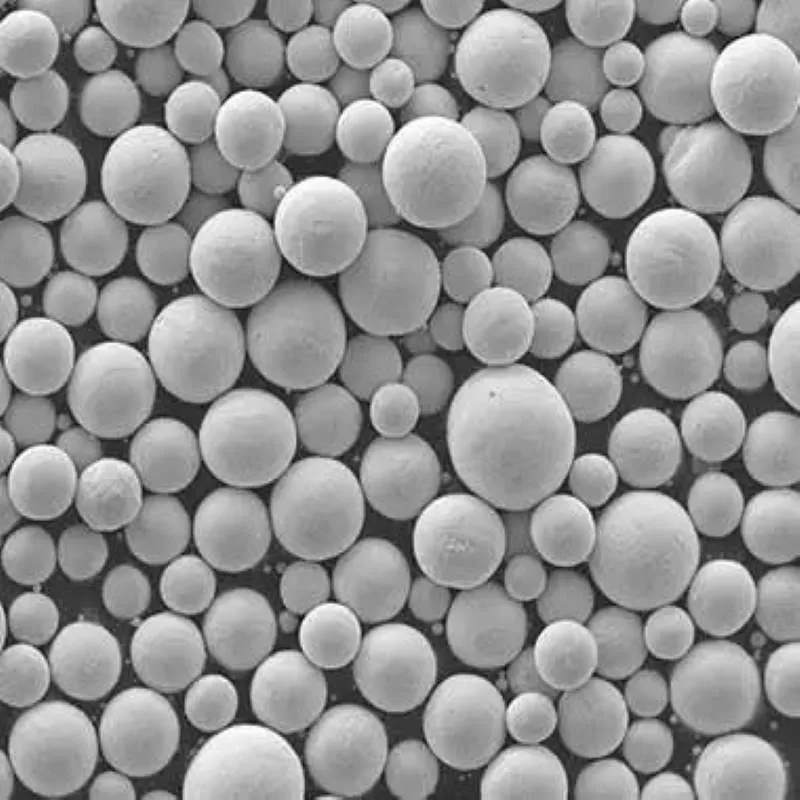
Spherical ASTM A299 Carbon Steel Powder, Manganese Silicon Alloy
Product Code : SP-CSTI-591-CU
We provide Spherical ASTM A299 Carbon Steel Powder, Manganese Silicon Alloy,Spherical ASTM A299 Carbon Steel Powder, Manganese Silicon Alloy is suitable for laser/electron beam augmentation, hot isostatic pressing, laser cladding, hot/cold spraying, and so on. The particles can be irregular and spherical. The particle distribution can reach the nanometer scale.,Spherical Particle Size,0-15μm,,15-45um,15-53μm, 20-63um,45-105um,45-150μm , 50-150um,75-150μm,or customized,Product purity and oxygen content can be customized according to requirements.
Please contact us if you need customized services. We will contact you with the price and availability in 24 hours.
ASTM A299 Carbon Steel Spherical Powder, Manganese Silicon Alloy Product Information
-:-
For detailed product information, please contact sales.
-:
ASTM A299 Carbon Steel Spherical Powder, Manganese Silicon Alloy Synonyms
-:-
For detailed product information, please contact sales.
-:
-:-
For detailed product information, please contact sales.
-:
Spherical ASTM A299 Carbon Steel Powder, Manganese Silicon Alloy characteristics
-:-
For detailed product information, please contact sales.
-:
Spherical ASTM A299 Carbon Steel Powder, Manganese Silicon Alloy Particle Size
-:-
For detailed product information, please contact sales.
-:
-:-
-:-
0-15μm ,5-25μm, 15-45μm, 15-53μm,20-63um, 45-75μm, 45-105μm, 45-150μm ,75-150μm.
(Various granularities can be customized according to customer requirements)
-:-
For detailed product information, please contact sales.
-:
Spherical ASTM A299 Carbon Steel Powder, Manganese Silicon Alloy Applicable processes
-:-
For detailed product information, please contact sales.
-:
Laser/electron beam additive manufacturing (SLM/EBM, 3D printing)
Direct laser deposition (DLD)
Used in thermal spray (TSA)
Powder hot isostatic pressing (HIP)
Metal injection molding (MIM)
Powder metallurgy (PM)
Laser cladding (LC), etc.
-:-
For detailed product information, please contact sales.
-:
Spherical ASTM A299 Carbon Steel Powder, Manganese Silicon Alloy Chemical Composition
-:-
For detailed product information, please contact sales.
-:
-:-
For detailed product information, please contact sales.
-:
ASTM A299 Carbon Steel, Manganese Silicon Alloy Product Information
-:-
For detailed product information, please contact sales.
-:
## **ASTM A299 Manganese-Silicon Carbon Steel for High-Pressure Boiler and Pressure Vessel Applications**
### **1. Product Overview**
**ASTM A299** is a **carbon-manganese-silicon steel plate** specifically designed for **fusion-welded boilers and other pressure vessels requiring superior strength and toughness in intermediate-thickness sections**. This specification covers **steel plates of improved transition temperature properties** through enhanced manganese and silicon contents, making it particularly suitable for applications where notch toughness and resistance to brittle fracture are critical.
Unlike standard carbon steels, ASTM A299 employs a **balanced manganese-silicon alloying approach** that provides higher strength levels while maintaining good weldability and fabricability. The material is universally supplied in the **normalized condition** to ensure uniform grain structure and optimal mechanical properties throughout the plate thickness, typically ranging from 0.5 to 8 inches (12 to 200 mm).
### **2. Key International Standards & Specifications**
| Standard System | Equivalent Designation | Notes |
|-----------------|------------------------|-------|
| **ASTM/ASME** | **ASTM A299/A299M** / **SA-299** | Primary specification for ASME Boiler & Pressure Vessel Code Section I & VIII |
| **European (EN)** | **EN 10028-2: P355GH** | Similar pressure vessel steel for elevated temperature service |
| **Japanese (JIS)** | **JIS G3108 SBV 1/2/3** | Boiler and pressure vessel quality steels |
| **German (DIN)** | **HII** | Historical designation for similar pressure vessel steels |
| **ISO** | **ISO 9328-2** | Steel plates for pressure purposes |
| **Chinese** | **GB 713 Q345R** | Similar pressure vessel steel plate |
| **Classification Societies:** Widely accepted with supplementary requirements from ABS, DNV, LR, and BV for marine applications. |
### **3. Chemical Composition (% by Weight)**
ASTM A299 features a distinctive chemistry optimized for pressure vessel applications, with no explicit grade divisions but controlled chemistry ranges for different thicknesses.
| Element | Composition Requirements | Metallurgical Purpose |
|---------|--------------------------|------------------------|
| **Carbon (C)** | ≤ 0.28% (max varies with thickness) | Provides strength while controlling weldability and toughness |
| **Manganese (Mn)** | **0.85-1.50%** (range varies with thickness) | **Primary strengthening element** - enhances hardenability, strength, and toughness |
| **Phosphorus (P)** | ≤ 0.035% | Harmful impurity strictly controlled |
| **Sulfur (S)** | ≤ 0.040% | Controlled to improve transverse properties and weldability |
| **Silicon (Si)** | **0.15-0.40%** | **Essential alloying element** - deoxidizer, strengthens ferrite, improves toughness |
| **Copper (Cu)** | ≤ 0.35% (when specified for corrosion resistance) | Optional for enhanced atmospheric corrosion resistance |
| **Chromium (Cr)** | ≤ 0.25% (residual) | May be present |
| **Nickel (Ni)** | ≤ 0.25% (residual) | May be present |
| **Molybdenum (Mo)** | ≤ 0.08% (residual) | May be present |
**Key Metallurgical Features:**
- **Manganese-Silicon Synergy:** Mn improves hardenability and strength; Si enhances strength and toughness through solid solution strengthening
- **Normalized Microstructure:** Fine ferrite-pearlite structure with enhanced toughness
- **Transition Temperature:** Specifically designed for improved low-temperature properties
- **Thickness-Dependent Chemistry:** Higher Mn allowed for thicker sections to maintain through-thickness properties
### **4. Mechanical & Physical Properties**
#### **4.1 Tensile Properties (Normalized Condition)**
| Property | Minimum Requirements (Typical for ≤ 2" thickness) | Typical Range | Test Standard |
|----------|---------------------------------------------------|---------------|---------------|
| **Yield Strength (0.2% offset)** | **45 ksi (310 MPa)** | 47-55 ksi (325-380 MPa) | ASTM A370 |
| **Tensile Strength** | **75-95 ksi (515-655 MPa)** | 78-88 ksi (540-605 MPa) | ASTM A370 |
| **Elongation (in 8" gauge)** | **19%** minimum | 20-25% | ASTM A370 |
| **Reduction of Area** | Not specified | Typically 50-60% | ASTM A370 |
**Thickness Considerations:**
- For plates > 2 inches: Minimum tensile strength reduces to 70 ksi (485 MPa)
- Thicker sections (> 4 inches) may show reduced yield and elongation values
#### **4.2 Impact Properties (Critical Feature)**
| Test Condition | Minimum Charpy V-Notch Energy | Typical Values | Notes |
|----------------|--------------------------------|----------------|-------|
| **Room Temperature** | Not always specified | 40-70 ft-lb (54-95 J) | Good inherent toughness |
| **Low Temperature** | Often specified by purchaser | 25-40 ft-lb (34-54 J) at -20°F (-29°C) | Improved transition temperature properties |
| **Orientation** | Longitudinal specimens | Transverse typically 70-80% of longitudinal | - |
#### **4.3 Physical Properties**
| Property | Value | Conditions |
|----------|-------|------------|
| **Density** | 7.85 g/cm³ (0.284 lb/in³) | Room temperature |
| **Modulus of Elasticity** | 29,000 ksi (200 GPa) | 20°C (68°F) |
| **Shear Modulus** | 11,200 ksi (77 GPa) | 20°C (68°F) |
| **Poisson's Ratio** | 0.29 | - |
| **Thermal Conductivity** | 47 W/m·K | 20°C (68°F) |
| **Specific Heat Capacity** | 475 J/kg·K | 20°C (68°F) |
| **Coefficient of Thermal Expansion** | 11.8 × 10⁻⁶/°C | 20-100°C (68-212°F) |
| **Thermal Expansion (Elevated)** | 12.5 × 10⁻⁶/°C | 20-500°C (68-932°F) |
#### **4.4 Hardness Characteristics**
- **Typical Brinell Hardness:** 170-210 HB
- **Through-Thickness Variation:** ≤ 30 HB points in normalized condition
- **Maximum Recommended:** 225 HB for weldability considerations
### **5. Heat Treatment Requirements**
**Mandatory Condition:** **Normalized**
- **Normalizing Temperature:** 1600-1700°F (870-925°C)
- **Soaking Time:** Minimum 1 hour per inch of thickness
- **Cooling:** Still air to room temperature
- **Optional Stress Relieving:** May be specified for fabricated components
**Microstructural Requirements:**
- **Grain Size:** ASTM No. 5 or finer (typically 6-8)
- **Microstructure:** Uniform fine ferrite-pearlite
- **Inclusion Control:** ASTM E45 Method A, maximum severity 2.0
### **6. Product Applications**
#### **6.1 Primary Industries & Applications**
| Industry | Specific Applications | Typical Thickness | Service Conditions |
|----------|----------------------|-------------------|---------------------|
| **Power Generation** | - Boiler drums and shells
- Steam headers and piping
- Feedwater heater shells | 1-4 inches (25-100 mm) | Up to 800°F (425°C), high pressure |
| **Petrochemical** | - Reactor vessels
- High-pressure separators
- Fractionation columns | 0.75-3 inches (19-75 mm) | 500-700°F (260-370°C), moderate corrosion |
| **Chemical Processing** | - High-pressure reactors
- Process vessels
- Storage tanks | 0.5-2.5 inches (12-65 mm) | 400-650°F (205-345°C), various media |
| **Oil & Gas** | - Refinery equipment
- Gas processing vessels
- High-pressure storage | 0.75-2 inches (19-50 mm) | 450-750°F (230-400°C), hydrocarbon service |
| **Marine** | - Boilers for marine vessels
- High-pressure shipboard systems | 0.5-1.5 inches (12-38 mm) | Marine environments, cyclic loading |
#### **6.2 Special Application Advantages**
- **Improved Toughness:** Superior to standard carbon steels at intermediate temperatures
- **Weldability:** Good despite higher strength levels
- **Code Compliance:** ASME Section I and VIII approved
- **Versatility:** Suitable for both boiler and pressure vessel applications
### **7. Fabrication Characteristics**
#### **7.1 Weldability**
**Weldability Rating:** **Very Good** (for its strength level)
| Parameter | Requirements/Recommendations |
|-----------|------------------------------|
| **Carbon Equivalent (CE)** | 0.45-0.55% (IIW formula) |
| **Preheat Temperature** | 200-300°F (95-150°C) for thickness > 0.75 inch |
| **Recommended Processes** | SMAW (E7018), SAW, GMAW, FCAW |
| **Interpass Temperature** | ≤ 400°F (205°C) |
| **Post-Weld Heat Treatment** | Recommended for thickness > 1.5 inches
Temperature: 1100-1250°F (595-675°C) |
#### **7.2 Welding Consumables**
- **AWS Classification:** AWS A5.1 E7018 or AWS A5.5 E7018
- **Strength Matching:** Consumables with 70+ ksi tensile strength
- **Special Considerations:** Standard low hydrogen practices
#### **7.3 Forming & Machining**
| Operation | Requirements |
|-----------|--------------|
| **Hot Forming** | 1650-1800°F (900-980°C)
Re-normalization recommended if heated above 1700°F |
| **Cold Forming** | Good for moderate deformation
Minimum bend radius: 3× thickness |
| **Machinability** | 65-70% of free-cutting steel
Requires adequate lubrication |
| **Cutting** | All standard methods suitable |
### **8. Comparative Analysis**
#### **8.1 Versus Similar Pressure Vessel Steels**
| Aspect | ASTM A299 | ASTM A515 Grade 70 | ASTM A516 Grade 70 |
|--------|-----------|--------------------|--------------------|
| **Alloy System** | **Mn-Si enhanced** | C-Si | C-Mn |
| **Min Yield Strength** | 45 ksi | 38 ksi | 38 ksi |
| **Tensile Range** | 75-95 ksi | 70-90 ksi | 70-90 ksi |
| **Typical Toughness** | **Superior** | Standard | Standard |
| **Cost Factor** | 1.1-1.2x | 1.0x | 1.0x |
| **Primary Use** | **High-pressure boilers** | Moderate pressure | Low temperature |
#### **8.2 Versus Higher Alloy Steels**
| Property | ASTM A299 | ASTM A204 Grade A | ASTM A387 Grade 2 |
|----------|-----------|-------------------|------------------|
| **Alloy Content** | Mn-Si | Mo | Cr-Mo |
| **Max Service Temperature** | 800°F (425°C) | 900°F (480°C) | 1000°F (540°C) |
| **Weldability** | **Excellent** | Very Good | Good |
| **Cost Factor** | 1.0x | 1.3-1.4x | 1.5-1.7x |
| **Creep Resistance** | Moderate | Good | Very Good |
### **9. Technical Advantages**
#### **9.1 Key Benefits**
1. **Enhanced Toughness:** Improved transition temperature properties compared to standard carbon steels
2. **Higher Strength:** 45 ksi minimum yield vs. 38 ksi for typical carbon pressure vessel steels
3. **Good Weldability:** Favorable carbon equivalent for pressure vessel fabrication
4. **Code Recognition:** Long-established ASME approval for critical applications
5. **Economic Balance:** Cost-effective for applications requiring better-than-carbon-steel properties
#### **9.2 Special Metallurgical Features**
- **Manganese Benefit:** Improves hardenability without excessive carbon
- **Silicon Contribution:** Strengthens ferrite matrix, improving overall toughness
- **Normalized Structure:** Ensures uniform properties through thickness
- **Transition Temperature:** Specifically engineered for improved low-temperature performance
### **10. Design Considerations**
#### **10.1 Optimal Application Areas**
- **High-pressure boiler components** requiring notch toughness
- **Pressure vessels** operating at intermediate temperatures (400-800°F)
- **Applications** where improved low-temperature properties are needed
- **Components** subject to thermal cycling or shock
#### **10.2 Design Limitations**
- **Temperature Limit:** Not recommended for continuous service above 800°F (425°C)
- **Corrosion Resistance:** Standard carbon steel resistance - requires protection in aggressive environments
- **Availability:** Less common than A516/A515 grades in some regions
- **Thickness Limits:** Properties optimized for intermediate thicknesses (0.5-4 inches)
### **11. Quality Assurance**
#### **11.1 Standard Testing Requirements**
1. **Chemical Analysis:** Heat and product analysis
2. **Tensile Testing:** One test per plate or 50 tons
3. **Bend Testing:** When specified for ductility verification
#### **11.2 Optional Supplementary Tests**
- **Charpy Impact Testing:** When low-temperature service required
- **Ultrasonic Testing:** Per ASTM A578 for critical applications
- **Hardness Testing:** For fabrication procedure qualification
### **12. Procurement & Specification**
#### **12.1 Ordering Information**
When ordering ASTM A299, specify:
- Full designation: ASTM A299/A299M
- Plate thickness (important for chemistry and properties)
- Any supplementary requirements
- Impact test requirements if needed
- Certification requirements
#### **12.2 Availability**
- **Lead Time:** 6-10 weeks typical
- **Thickness Range:** 0.5 to 8 inches (12 to 200 mm) commonly available
- **Width/Length:** Standard mill sizes
- **Quantity:** Suitable for project-specific orders
### **13. Case Studies**
#### **13.1 Power Plant Boiler Drum**
**Application:** 150 MW coal-fired power plant boiler
**Requirements:** 3-inch thick shell, 1200 psi at 750°F
**Why A299 Selected:**
- Met ASME Section I requirements for power boilers
- Provided improved toughness over A515/A516
- Good weldability for longitudinal and circumferential seams
- Successful 30+ year service history
#### **13.2 Petrochemical Reactor**
**Industry:** Chemical processing
**Conditions:** 2-inch wall, 600 psi at 650°F, cyclic service
**Results:**
- Withstood thermal cycling without issues
- Good resistance to hydrogen attack at operating conditions
- Fabricated with standard procedures
- Met all code requirements for pressure vessels
### **14. Industry Trends**
#### **14.1 Current Applications**
- **Conventional Power:** Still used in boiler applications
- **Industrial Boilers:** Package and field-erected units
- **Pressure Vessels:** Where notch toughness is a concern
- **Retrofit Projects:** Replacement of aging components
#### **14.2 Technical Developments**
- **Improved Processing:** Better normalizing controls
- **Welding Technology:** Advanced procedures for higher productivity
- **Testing Methods:** Enhanced NDT for quality assurance
- **Design Optimization:** Better utilization of material properties
### **15. Conclusion**
**ASTM A299** represents a **specialized carbon-manganese-silicon steel** that fills an **important niche between standard carbon steels and low-alloy steels** for pressure vessel applications. Its technical attributes provide:
**Primary Advantages:**
1. **Superior Toughness:** Improved transition temperature properties for safer operation
2. **Enhanced Strength:** Higher yield strength than typical carbon pressure vessel steels
3. **Good Fabricability:** Excellent weldability and forming characteristics
4. **Code Compliance:** Long-standing ASME approval for critical applications
5. **Economic Value:** Cost-effective for applications requiring enhanced properties
**Ideal Application Scenarios:**
- High-pressure boiler drums and headers
- Pressure vessels requiring improved notch toughness
- Components operating at intermediate temperatures (400-800°F)
- Applications where thermal cycling or shock is a concern
**Selection Considerations:**
- Evaluate actual service conditions including temperature and pressure
- Consider toughness requirements for the specific application
- Compare total cost including fabrication with alternative materials
- Verify availability and lead times for project scheduling
ASTM A299 continues to serve as a **reliable, proven material** for demanding pressure vessel applications where **enhanced toughness and strength** are required without the cost of alloy steels. Its balanced composition and normalized condition provide **consistent, predictable performance** that has been demonstrated through decades of successful service in power generation and process industries.
For engineers designing **pressure equipment that requires better toughness than standard carbon steels** but doesn't need the elevated temperature capabilities of alloy steels, A299 offers a **technically sound, code-approved solution** that represents an optimal balance of performance, fabricability, and cost.
-:-
For detailed product information, please contact sales.
-:
ASTM A299 Carbon Steel, Manganese Silicon Alloy Specification
Dimensions
Size:
Diameter 20-1000 mm Length <5982 mm
Size:We can customized as required
Standard:
Per your request or drawing
We can customized as required
Properties(Theoretical)
Chemical Composition
-:-
For detailed product information, please contact sales.
-:
ASTM A299 Carbon Steel, Manganese Silicon Alloy Properties
-:-
For detailed product information, please contact sales.
-:
Spherical ASTM A299 Carbon Steel Powder, Manganese Silicon Alloy Particle Size Description
-:-
For detailed product information, please contact sales.
-:
Applications of Spherical ASTM A299 Carbon Steel Powder, Manganese Silicon Alloy
-:-
For detailed product information, please contact sales.
-:
-:-
For detailed product information, please contact sales.
-:
Applications of ASTM A299 Carbon Steel Spherical Powder, Manganese Silicon Alloy
-:-
For detailed product information, please contact sales.
-:
Chemical Identifiers ASTM A299 Carbon Steel Spherical Powder, Manganese Silicon Alloy
-:-
For detailed product information, please contact sales.
-:
Packing of ASTM A299 Carbon Steel Spherical Powder, Manganese Silicon Alloy
-:-
For detailed product information, please contact sales.
-:
Standard Packing:
-:-
For detailed product information, please contact sales.
-:
Typical bulk packaging includes palletized plastic 5 gallon/25 kg. pails, fiber and Steel Spherical Powder drums to 1 ton super sacks in full container (FCL) or truck load (T/L) quantities. Research and sample quantities and hygroscopic, oxidizing or other air sensitive materials may be packaged under argon or vacuum. Solutions are packaged in polypropylene, plastic or glass jars up to palletized 2453 gallon liquid totes Special package is available on request. E FORUs’ is carefully handled to minimize damage during storage and transportation and to preserve the quality of our products in their original condition