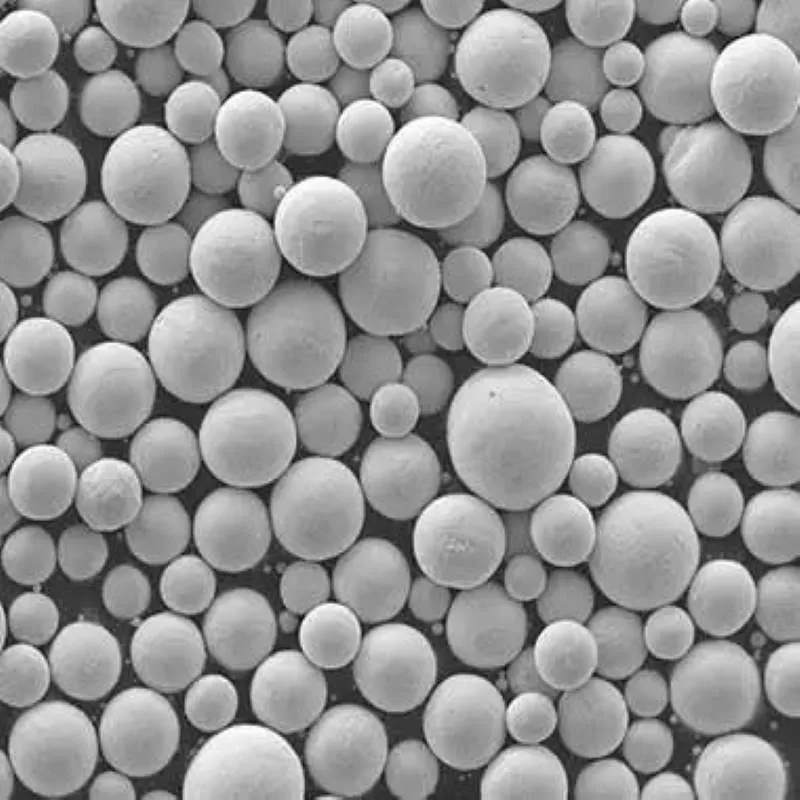
Spherical ASTM A387 Alloy Steel Powder, Grade 2, Class 1
Product Code : SP-CSTI-606-CU
We provide Spherical ASTM A387 Alloy Steel Powder, Grade 2, Class 1,Spherical ASTM A387 Alloy Steel Powder, Grade 2, Class 1 is suitable for laser/electron beam augmentation, hot isostatic pressing, laser cladding, hot/cold spraying, and so on. The particles can be irregular and spherical. The particle distribution can reach the nanometer scale.,Spherical Particle Size,0-15μm,,15-45um,15-53μm, 20-63um,45-105um,45-150μm , 50-150um,75-150μm,or customized,Product purity and oxygen content can be customized according to requirements.
Please contact us if you need customized services. We will contact you with the price and availability in 24 hours.
ASTM A387 Alloy Steel Spherical Powder, Grade 2, Class 1 Product Information
-:-
For detailed product information, please contact sales.
-:
ASTM A387 Alloy Steel Spherical Powder, Grade 2, Class 1 Synonyms
-:-
For detailed product information, please contact sales.
-:
-:-
For detailed product information, please contact sales.
-:
Spherical ASTM A387 Alloy Steel Powder, Grade 2, Class 1 characteristics
-:-
For detailed product information, please contact sales.
-:
Spherical ASTM A387 Alloy Steel Powder, Grade 2, Class 1 Particle Size
-:-
For detailed product information, please contact sales.
-:
-:-
-:-
0-15μm ,5-25μm, 15-45μm, 15-53μm,20-63um, 45-75μm, 45-105μm, 45-150μm ,75-150μm.
(Various granularities can be customized according to customer requirements)
-:-
For detailed product information, please contact sales.
-:
Spherical ASTM A387 Alloy Steel Powder, Grade 2, Class 1 Applicable processes
-:-
For detailed product information, please contact sales.
-:
Laser/electron beam additive manufacturing (SLM/EBM, 3D printing)
Direct laser deposition (DLD)
Used in thermal spray (TSA)
Powder hot isostatic pressing (HIP)
Metal injection molding (MIM)
Powder metallurgy (PM)
Laser cladding (LC), etc.
-:-
For detailed product information, please contact sales.
-:
Spherical ASTM A387 Alloy Steel Powder, Grade 2, Class 1 Chemical Composition
-:-
For detailed product information, please contact sales.
-:
-:-
For detailed product information, please contact sales.
-:
ASTM A387 Alloy Steel, Grade 2, Class 1 Product Information
-:-
For detailed product information, please contact sales.
-:
# **ASTM A387 Grade 2 Class 1 - 0.5% Chromium-0.5% Molybdenum Alloy Steel Plate (Annealed Condition)**
## **1. Product Overview**
**ASTM A387 Grade 2 Class 1** is an **annealed 0.5% chromium-0.5% molybdenum alloy steel plate** designed for **pressure vessel applications operating at moderate elevated temperatures up to 900°F (480°C)**. As the lowest alloy content grade within the ASTM A387 chromium-molybdenum series, Grade 2 provides enhanced high-temperature properties compared to plain carbon steels while maintaining excellent weldability and fabricability. The Class 1 designation indicates the material is supplied in a fully softened, annealed condition, optimized for extensive forming and fabrication operations with final normalizing and tempering performed after component manufacturing.
This entry-level chromium-molybdenum steel represents a cost-effective solution for applications requiring improved creep strength and oxidation resistance beyond carbon steels but where higher chromium grades would be economically unjustified. Its balanced combination of 0.5% chromium (for basic oxidation resistance) and 0.5% molybdenum (for creep strength enhancement) makes it suitable for a wide range of industrial applications in power generation, chemical processing, and general industrial equipment.
## **2. Key International Standards & Specifications**
| Standard System | Equivalent Designation | Notes |
|-----------------|------------------------|-------|
| **ASTM/ASME** | **ASTM A387/A387M Grade 2 Class 1** / **SA-387 Grade 2 Class 1** | Primary specification, ASME Boiler & Pressure Vessel Code Section I & VIII approved |
| **European (EN)** | **EN 10028-2: 13CrMo4-5** (similar but higher Cr) | European equivalent for moderate temperature service |
| **Japanese (JIS)** | **JIS G4109 SCMV 1** | Japanese Cr-Mo steel designation for similar applications |
| **German (DIN)** | **1.7335** (13CrMo4-5) | Similar application grade |
| **ISO** | **ISO 9328-2** | Steel plates for pressure purposes |
| **Chinese** | **GB 713 15CrMoR** | Similar chromium-molybdenum pressure vessel steel |
| **Unified Numbering System** | **UNS K12143** | Standard material designation |
**Classification Society Approvals:** Available with supplementary requirements from ABS, DNV, LR, BV, and other major societies for specific applications.
## **3. Chemical Composition (% by Weight)**
| Element | ASTM A387 Grade 2 Class 1 Requirements | Metallurgical Purpose |
|---------|------------------------------------------|------------------------|
| **Carbon (C)** | **0.05-0.21%** | Balanced for strength and weldability; higher than Grades 11-22 |
| **Manganese (Mn)** | **0.55-0.80%** | Enhances hardenability and strength through solid solution |
| **Phosphorus (P)** | **0.035% maximum** | Controlled to prevent brittlement |
| **Sulfur (S)** | **0.040% maximum** | Controlled for improved hot workability |
| **Silicon (Si)** | **0.50-0.80%** | Deoxidizer; contributes to oxidation resistance |
| **Chromium (Cr)** | **0.50-0.80%** | **Primary alloying element** - provides basic oxidation resistance |
| **Molybdenum (Mo)** | **0.45-0.65%** | **Key alloying element** - enhances creep strength and tempering resistance |
| **Nickel (Ni)** | **0.40% maximum** (residual) | Kept low to control cost |
| **Copper (Cu)** | **0.20% maximum** (residual) | Residual element control |
| **Vanadium (V)** | **0.03% maximum** (residual) | Kept minimal |
**Key Metallurgical Features:**
- **Carbon Equivalent (CE):** Typically 0.40-0.50% (IIW formula)
- **Alloy Balance:** Minimum chromium-molybdenum for cost-effective enhancement
- **Annealed Microstructure:** Fully soft ferrite-pearlite
- **Hardenability:** Moderate; suitable for medium thickness sections
## **4. Mechanical & Physical Properties**
### **4.1 Tensile Properties (Annealed Condition - As Supplied)**
| Property | Minimum Requirement | Typical Range | Test Standard |
|----------|---------------------|---------------|---------------|
| **Yield Strength (0.2% offset)** | **25 ksi (170 MPa)** | 26-35 ksi (180-240 MPa) | ASTM A370 |
| **Tensile Strength** | **55-80 ksi (380-550 MPa)** | 60-75 ksi (415-515 MPa) | ASTM A370 |
| **Elongation (in 2" / 50mm gauge)** | **30%** minimum | 32-38% | ASTM A370 |
| **Reduction of Area** | Not specified | Typically 60-70% | ASTM A370 |
**Note:** These are properties in the annealed, as-supplied condition. Final properties are achieved after fabrication and heat treatment.
### **4.2 Properties After Final Heat Treatment (Typical)**
| Property | After Normalizing & Tempering |
|----------|-------------------------------|
| **Yield Strength** | 40-50 ksi (275-345 MPa) |
| **Tensile Strength** | 70-85 ksi (485-585 MPa) |
| **Elongation** | 22-28% |
| **Hardness** | 160-200 HB |
### **4.3 Elevated Temperature Properties**
| Temperature | Yield Strength Retention | Tensile Strength Retention | Maximum Recommended Service |
|-------------|--------------------------|----------------------------|-----------------------------|
| **700°F (370°C)** | ~85% of RT value | ~90% of RT value | Good for continuous service |
| **800°F (425°C)** | ~75% of RT value | ~80% of RT value | Suitable for extended service |
| **900°F (480°C)** | ~65% of RT value | ~70% of RT value | Upper limit for design |
### **4.4 Physical Properties**
| Property | Value | Conditions |
|----------|-------|------------|
| **Density** | 7.85 g/cm³ (0.284 lb/in³) | Room temperature |
| **Modulus of Elasticity** | 29,000 ksi (200 GPa) | 20°C (68°F) |
| **Coefficient of Thermal Expansion** | 11.8 × 10⁻⁶/°C | 20-100°C |
| **Thermal Conductivity** | 46 W/m·K | 20°C (68°F) |
| **Specific Heat Capacity** | 470 J/kg·K | 20°C (68°F) |
| **Electrical Resistivity** | 0.22 μΩ·m | 20°C (68°F) |
### **4.5 Hardness Characteristics (Annealed Condition)**
- **Typical Brinell Hardness:** 130-170 HB
- **Maximum Recommended:** 180 HB for formability
- **After Final Heat Treatment:** Typically 170-210 HB
## **5. Heat Treatment Requirements**
### **5.1 As-Supplied Condition: Annealed**
- **Annealing Temperature:** 1550-1650°F (845-900°C)
- **Cooling:** Furnace cool or air cool
- **Purpose:** Provide soft condition for fabrication
### **5.2 Final Heat Treatment (After Fabrication)**
1. **Normalizing:**
- Temperature: 1600-1700°F (870-925°C)
- Soak: 1 hour per inch minimum
2. **Tempering:**
- Temperature: 1150-1300°F (620-705°C)
- Soak: 1-2 hours per inch
- Cooling: Air cool
### **5.3 Post-Weld Heat Treatment (PWHT)**
- **Generally Required** for welded constructions
- **Temperature:** 1150-1300°F (620-705°C)
- **Time:** 1 hour per inch minimum
- **Purpose:** Stress relief and tempering
## **6. Product Applications**
### **6.1 Primary Industries & Applications**
| Industry | Specific Applications | Service Conditions |
|----------|----------------------|---------------------|
| **Power Generation** | - Moderate pressure boilers
- Steam piping and headers | 700-850°F (370-455°C) |
| **Chemical Processing** | - Process heaters
- Moderate temperature reactors | 600-800°F (315-425°C) |
| **Industrial Equipment** | - Heat exchangers
- Process vessels | 500-750°F (260-400°C) |
| **General Manufacturing** | - High-temperature equipment
- Industrial furnaces | 600-850°F (315-455°C) |
### **6.2 Application Advantages**
- **Cost-Effective:** Lowest cost in A387 series
- **Improved Properties:** Better than carbon steels at elevated temperatures
- **Good Fabricability:** Annealed condition enables complex forming
- **Code Compliance:** ASME approved for pressure vessel use
## **7. Fabrication Characteristics**
### **7.1 Weldability**
**Weldability Rating:** **Excellent** (for a low-alloy steel)
| Parameter | Requirements |
|-----------|--------------|
| **Carbon Equivalent** | 0.35-0.45% |
| **Preheat Temperature** | 200-300°F (95-150°C) |
| **Interpass Temperature** | 400-600°F (205-315°C) |
| **Recommended Processes** | SMAW, GTAW, SAW |
| **Consumables** | AWS A5.5 E7018 or equivalent |
### **7.2 Forming & Machining (Annealed Condition)**
- **Cold Forming:** Excellent due to soft condition
- **Hot Forming:** Performed at 1650-1800°F (900-980°C)
- **Machining:** Good in annealed condition
- **Cutting:** All standard methods suitable
## **8. Comparative Analysis**
### **8.1 vs. Other A387 Grades**
| Aspect | Grade 2 Class 1 | Grade 11 Class 1 | Grade 22 Class 1 |
|--------|-----------------|------------------|------------------|
| **Chromium Content** | 0.50-0.80% | 1.00-1.50% | 2.00-2.50% |
| **Temperature Capability** | Up to 900°F | Up to 1000°F | Up to 1200°F |
| **Cost** | **Most economical** | Moderate | Higher |
| **Primary Use** | **Moderate temperature** | General high-temp | Higher temperature |
### **8.2 vs. Carbon-Molybdenum Steels**
| Property | A387 Gr 2 Cl 1 | A204 Grade A |
|----------|----------------|--------------|
| **Alloy System** | 0.5Cr-0.5Mo | 0.5Mo only |
| **Oxidation Resistance** | **Slightly better** | Standard |
| **Creep Strength** | **Slightly better** | Good |
| **Cost** | Higher | Lower |
| **Max Temperature** | **900°F** | 900°F |
## **9. Technical Advantages**
### **9.1 Key Benefits**
1. **Cost-Effective Enhancement:** Improved properties over carbon steels
2. **Excellent Fabricability:** Annealed condition ideal for forming
3. **Good Weldability:** Lower carbon equivalent than higher alloys
4. **Code Compliance:** ASME approved for pressure vessels
5. **Versatility:** Suitable for various moderate temperature applications
### **9.2 Performance Improvements over Carbon Steel**
- **Creep Strength:** Approximately 20-30% improvement at 800°F
- **Oxidation Resistance:** Slight improvement at elevated temperatures
- **Temper Resistance:** Better property retention during PWHT
## **10. Design Considerations**
### **10.1 Temperature Limits**
- **Maximum Continuous Service:** 900°F (480°C)
- **Hydrogen Service:** Limited capability
- **Cyclic Service:** Requires proper analysis
- **Minimum Temperature:** -20°F (-29°C) without impact testing
### **10.2 Corrosion Considerations**
- **Oxidation Resistance:** Slight improvement over carbon steel
- **Sulfidation:** Limited resistance
- **General Corrosion:** Similar to carbon steel
## **11. Quality Assurance**
### **11.1 Standard Testing**
1. **Chemical Analysis:** Heat and product verification
2. **Tensile Testing:** One test per plate or 50 tons
3. **Hardness Testing:** For quality verification
### **11.2 Optional Tests**
- **Charpy Impact:** When specified
- **Ultrasonic Testing:** For critical applications
- **Bend Tests:** For ductility verification
## **12. Procurement & Specification**
### **12.1 Ordering Information**
When ordering ASTM A387 Grade 2 Class 1:
- Full designation: ASTM A387/A387M Grade 2 Class 1
- Plate dimensions and tolerances
- Testing requirements
- Certification requirements
### **12.2 Availability**
- **Lead Time:** 6-10 weeks typical
- **Thickness Range:** 0.25 to 4 inches (6 to 100 mm)
- **Standard Sizes:** Available from major mills
## **13. Case Studies**
### **13.1 Industrial Boiler Application**
**Industry:** Chemical processing plant
**Application:** Process steam boiler drums
**Conditions:** 800°F (425°C), 600 psi
**Results:** Adequate performance at lower cost than Grade 11, successful 10-year service
### **13.2 Heat Exchanger Application**
**Application:** Process heat exchanger shells
**Conditions:** 750°F (400°C), 300 psi
**Performance:** Met all design requirements, cost-effective solution
## **14. Industry Trends**
### **14.1 Current Applications**
- **Moderate Temperature** process equipment
- **Cost-Sensitive** applications requiring enhanced properties
- **Replacement Parts** for existing equipment
- **Industrial Heating** systems
### **14.2 Market Position**
- **Entry-Level Grade:** In chromium-molybdenum series
- **Cost-Driven Selection:** When carbon steels are inadequate but higher alloys over-specified
- **Niche Applications:** Specific moderate temperature requirements
## **15. Conclusion**
**ASTM A387 Grade 2 Class 1** provides an **entry-level chromium-molybdenum steel option** for **moderate high-temperature pressure vessel applications** where enhanced properties over carbon steels are required but higher chromium grades are economically unjustified. Its technical attributes offer:
**Key Advantages:**
1. **Economic Efficiency:** Lowest cost in A387 chromium-molybdenum series
2. **Enhanced Properties:** Moderate improvement over carbon steels
3. **Excellent Fabricability:** Annealed condition enables complex forming
4. **Code Compliance:** ASME approved for pressure vessel construction
**Optimal Application Scenarios:**
- Moderate temperature process equipment (700-900°F)
- Cost-sensitive applications requiring better-than-carbon-steel properties
- Components requiring extensive forming operations
- Replacements for existing Grade 2 equipment
**Selection Considerations:**
- Evaluate temperature requirements carefully
- Consider total cost including fabrication and heat treatment
- Compare with carbon-molybdenum steels for similar applications
- Verify code compliance for specific service conditions
**Material Selection Guidelines:**
- **Choose Grade 2 when:** Temperatures ≤900°F, slight property enhancement needed, cost sensitivity high
- **Consider carbon steels when:** Temperatures <700°F, no enhanced properties required
- **Consider higher alloys when:** Temperatures >900°F, hydrogen service, enhanced oxidation resistance needed
While **less commonly specified than Grades 11 and 22**, ASTM A387 Grade 2 Class 1 serves an **important economic niche** for applications where minimal alloy additions provide adequate property enhancement. Its **balanced approach to cost and performance** makes it a **practical choice** for engineers designing moderate temperature pressure equipment where both technical requirements and economic considerations must be addressed.
For applications operating reliably in the **700-900°F range** without severe environmental challenges, **Grade 2 Class 1 offers a technically adequate, economically advantageous solution** that provides measurable benefits over carbon steels while maintaining reasonable fabricability and cost.
-:-
For detailed product information, please contact sales.
-:
ASTM A387 Alloy Steel, Grade 2, Class 1 Specification
Dimensions
Size:
Diameter 20-1000 mm Length <5999 mm
Size:We can customized as required
Standard:
Per your request or drawing
We can customized as required
Properties(Theoretical)
Chemical Composition
-:-
For detailed product information, please contact sales.
-:
ASTM A387 Alloy Steel, Grade 2, Class 1 Properties
-:-
For detailed product information, please contact sales.
-:
Spherical ASTM A387 Alloy Steel Powder, Grade 2, Class 1 Particle Size Description
-:-
For detailed product information, please contact sales.
-:
Applications of Spherical ASTM A387 Alloy Steel Powder, Grade 2, Class 1
-:-
For detailed product information, please contact sales.
-:
-:-
For detailed product information, please contact sales.
-:
Applications of ASTM A387 Alloy Steel Spherical Powder, Grade 2, Class 1
-:-
For detailed product information, please contact sales.
-:
Chemical Identifiers ASTM A387 Alloy Steel Spherical Powder, Grade 2, Class 1
-:-
For detailed product information, please contact sales.
-:
Packing of ASTM A387 Alloy Steel Spherical Powder, Grade 2, Class 1
-:-
For detailed product information, please contact sales.
-:
Standard Packing:
-:-
For detailed product information, please contact sales.
-:
Typical bulk packaging includes palletized plastic 5 gallon/25 kg. pails, fiber and Steel Spherical Powder drums to 1 ton super sacks in full container (FCL) or truck load (T/L) quantities. Research and sample quantities and hygroscopic, oxidizing or other air sensitive materials may be packaged under argon or vacuum. Solutions are packaged in polypropylene, plastic or glass jars up to palletized 2470 gallon liquid totes Special package is available on request. E FORUs’ is carefully handled to minimize damage during storage and transportation and to preserve the quality of our products in their original condition