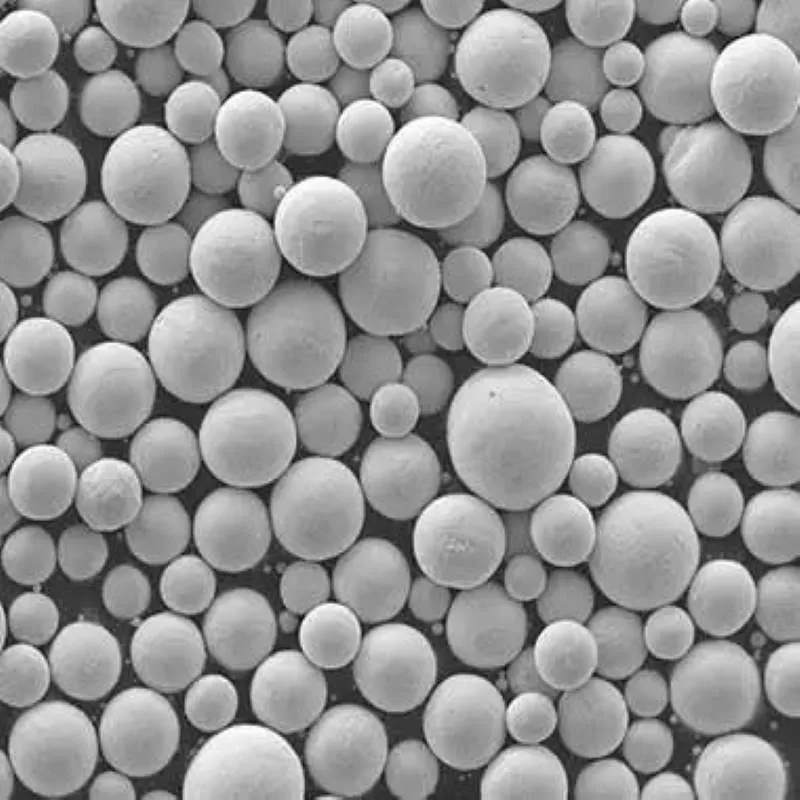
Spherical ASTM A463 Aluminum-Coated Steel Powder, Type I
Product Code : SP-CSTI-620-CU
We provide Spherical ASTM A463 Aluminum-Coated Steel Powder, Type I,Spherical ASTM A463 Aluminum-Coated Steel Powder, Type I is suitable for laser/electron beam augmentation, hot isostatic pressing, laser cladding, hot/cold spraying, and so on. The particles can be irregular and spherical. The particle distribution can reach the nanometer scale.,Spherical Particle Size,0-15μm,,15-45um,15-53μm, 20-63um,45-105um,45-150μm , 50-150um,75-150μm,or customized,Product purity and oxygen content can be customized according to requirements.
Please contact us if you need customized services. We will contact you with the price and availability in 24 hours.
ASTM A463 Aluminum-Coated Steel Spherical Powder, Type I, Commercial Quality Product Information
-:-
For detailed product information, please contact sales.
-:
ASTM A463 Aluminum-Coated Steel Spherical Powder, Type I, Commercial Quality Synonyms
-:-
For detailed product information, please contact sales.
-:
-:-
For detailed product information, please contact sales.
-:
Spherical ASTM A463 Aluminum-Coated Steel Powder, Type I characteristics
-:-
For detailed product information, please contact sales.
-:
Spherical ASTM A463 Aluminum-Coated Steel Powder, Type I Particle Size
-:-
For detailed product information, please contact sales.
-:
-:-
-:-
0-15μm ,5-25μm, 15-45μm, 15-53μm,20-63um, 45-75μm, 45-105μm, 45-150μm ,75-150μm.
(Various granularities can be customized according to customer requirements)
-:-
For detailed product information, please contact sales.
-:
Spherical ASTM A463 Aluminum-Coated Steel Powder, Type I Applicable processes
-:-
For detailed product information, please contact sales.
-:
Laser/electron beam additive manufacturing (SLM/EBM, 3D printing)
Direct laser deposition (DLD)
Used in thermal spray (TSA)
Powder hot isostatic pressing (HIP)
Metal injection molding (MIM)
Powder metallurgy (PM)
Laser cladding (LC), etc.
-:-
For detailed product information, please contact sales.
-:
Spherical ASTM A463 Aluminum-Coated Steel Powder, Type I Chemical Composition
-:-
For detailed product information, please contact sales.
-:
-:-
For detailed product information, please contact sales.
-:
ASTM A463 Aluminum-Coated Steel, Type I, Commercial Quality Product Information
-:-
For detailed product information, please contact sales.
-:
# **Product Introduction: ASTM A463 Aluminum-Coated Steel, Type I, Commercial Quality**
**ASTM A463 Type I, Commercial Quality** is a **hot-dip aluminum-coated (aluminized) steel sheet** specification designed for applications requiring **excellent heat and corrosion resistance** at an economical cost. The product consists of a commercial quality steel sheet substrate (with its inherent formability) coated on both sides with a protective aluminum or aluminum-silicon alloy layer applied via the continuous hot-dip process. This creates a material that combines the strength and economy of steel with the superior high-temperature oxidation resistance and atmospheric corrosion protection of aluminum.
**Type I** coating is characterized by a **pure aluminum or aluminum-silicon alloy coating**, offering optimal performance for high-temperature service and general atmospheric corrosion resistance.
---
## **1. Key International Standards**
* **Primary Material Standard:** **ASTM A463/A463M** - Standard Specification for Steel Sheet, Aluminum-Coated, by the Hot-Dip Process
* **Coating Classification:** **Type I** - Aluminum-Silicon Alloy Coating (typically 5-11% silicon balance aluminum)
* **Quality Designation:** **Commercial Quality** - Designed for forming applications requiring moderate ductility
* **Related Standards:**
* **ASTM A924/A924M:** General Requirements for Steel Sheet, Metallic-Coated by the Hot-Dip Process
* **ASME SA463:** ASME Boiler and Pressure Vessel Code adoption
* **ISO 5000:** Hot-dip aluminium-silicon coated cold rolled carbon steel sheet (Europe)
* **JIS G3314:** Hot-dip aluminium-coated steel sheets and coils (Japan)
* **EN 10215:** Continuously hot-dip aluminium-silicon (AS) coated steel strip and sheet
---
## **2. Chemical Composition & Structure**
### **Steel Substrate (Commercial Quality):**
| Element | Typical Composition (%) | Function/Requirement |
|---------|------------------------|----------------------|
| Carbon (C) | 0.10 max | Ensures good formability and weldability |
| Manganese (Mn) | 0.60 max | Strength and hardenability control |
| Phosphorus (P) | 0.04 max | Impurity control for formability |
| Sulfur (S) | 0.05 max | Impurity control for formability |
| Silicon (Si) | Residual | Deoxidation, typically low |
| **Note:** Commercial Quality steel is not specified by chemical composition but by mechanical properties and formability characteristics. |
### **Coating Composition (Type I):**
| Component | Composition Range | Characteristics |
|-----------|------------------|-----------------|
| Aluminum (Al) | 89-95% | Primary protective element |
| Silicon (Si) | 5-11% | Reduces coating brittleness, prevents excessive Fe-Al intermetallic formation |
| Iron (Fe) | ≤3% | Dissolved from substrate during coating process |
| **Coating Designation:** Typically expressed as coating mass (e.g., **A40** = 40 g/m² total both sides) |
### **Coating Structure:**
1. **Surface Layer:** Pure aluminum-rich zone (provides corrosion protection)
2. **Intermediate Layer:** Al-Si-Fe intermetallic alloy (bonding layer)
3. **Interface:** Thin Fe-Al intermetallic layer (metallurgical bond to steel)
4. **Steel Substrate:** Commercial quality low-carbon steel
---
## **3. Mechanical & Physical Properties**
### **Mechanical Properties (Steel Substrate - Commercial Quality):**
| Property | Typical Range | Notes |
|----------|---------------|-------|
| Tensile Strength | 310-450 MPa (45-65 ksi) | Depends on substrate thickness and processing |
| Yield Strength | 230-310 MPa (33-45 ksi) | Minimum typically 230 MPa (33 ksi) |
| Elongation (50mm) | 20-30% | Minimum typically 20% |
| Hardness (HRB) | 50-75 | Rockwell B scale |
| **Bend Test Performance:** | **Good** | Can be bent 180° flat on itself without coating fracture |
### **Coating Properties:**
| Property | Characteristics | Test Methods |
|----------|----------------|--------------|
| Coating Mass | **20-250 g/m² total both sides** (common: 40-120 g/m²) | ASTM A90 (weigh-strip-weigh) |
| Coating Adherence | Excellent - withstands standard bending tests | ASTM A463 bending test |
| Coating Uniformity | Good - continuous hot-dip process ensures consistency | Visual and microscopic |
| Surface Finish | Characteristic spangled appearance (can be minimized) | Commercial Bright, minimized spangle |
### **Physical Properties:**
| Property | Value/Description | Conditions/Notes |
|----------|------------------|------------------|
| Density (composite) | ~3.0 g/cm³ (coating) / 7.85 g/cm³ (steel) | Two-material composite |
| Thermal Conductivity | 25-30 W/m·K (coating contributes) | At 100°C |
| Maximum Service Temperature | **Up to 675°C (1250°F)** continuously | Significantly higher than galvanized |
| Thermal Expansion Coefficient | ~12×10⁻⁶/°C (steel dominates) | 20-100°C range |
| Electrical Resistivity | Higher than bare steel due to aluminum coating | Affects welding and grounding |
| Reflectivity | High (55-65% total solar reflectance) | Excellent for heat reflection |
---
## **4. Key Characteristics & Advantages**
### **Superior High-Temperature Performance:**
- **Excellent Oxidation Resistance:** Aluminum forms protective Al₂O₃ layer stable to 675°C (1250°F)
- **Heat Reflectivity:** Reflects up to 80% of radiant heat (vs. 25% for galvanized)
- **No "Peeling" at High Temperature:** Unlike zinc coatings which can flake off
### **Corrosion Resistance:**
- **Atmospheric Corrosion:** 3-5 times better than galvanized steel in industrial/marine environments
- **High-Temperature Corrosion:** Resists scaling and oxidation far better than carbon steel
- **Sulfur Resistance:** Excellent resistance to sulfur compounds at elevated temperatures
### **Formability & Fabrication:**
- **Good Formability:** Commercial quality substrate allows moderate forming
- **Coating Flexibility:** Withstands bending and forming without flaking
- **Weldability:** Can be welded with proper techniques (special considerations needed)
### **Economic Advantages:**
- **Cost-Effective Alternative:** To stainless steel for high-temperature applications
- **Long Service Life:** Reduces maintenance and replacement frequency
- **Weight Savings Potential:** Can use thinner gauges than carbon steel in some applications
### **Limitations & Considerations:**
- **Cut Edge Protection:** Requires special attention as exposed steel edges will corrode
- **Weldability Challenges:** Aluminum coating interferes with conventional welding
- **Compatibility Issues:** Potential for galvanic corrosion when in contact with dissimilar metals
- **Forming Considerations:** Softer coating can be damaged by abrasive tooling
---
## **5. Product Applications**
### **High-Temperature Applications (Primary Market):**
- **Heat Exchanger Components:**
- Automotive exhaust systems (manifolds, heat shields, mufflers)
- Industrial heat recuperators
- Oven and furnace liners
- Heat reflector panels
- **Appliance Industry:**
- Oven cavities and liners
- Toaster and broiler components
- Dryer drums and heating elements
- Water heater fireboxes and flues
- **HVAC Systems:**
- Furnace heat exchangers
- Ductwork for high-temperature air
- Chimney liners and vent pipes
### **Architectural & Building:**
- **Roofing and Siding:** For industrial buildings requiring heat reflection
- **Industrial Chimneys and Stacks:** Liner plates and external jacketing
- **Solar Energy Components:** Solar collector panels and backing
### **Agricultural & Processing Equipment:**
- **Grain Dryers and Storage:** Heat-resistant components
- **Food Processing Equipment:** Ovens, dryers, conveyors
- **Incinerator Components:** Chutes, baffles, heat shields
### **Automotive & Transportation:**
- **Exhaust System Components:** Heat shields, resonators
- **Engine Compartment Heat Management:** Shields and baffles
- **Commercial Vehicle Components:** Near-engine and exhaust areas
### **Special Applications:**
- **Barbecue Grills and Components:** Burner boxes, heat plates
- **Fireplace Inserts and Components:** Heat reflectors, liners
- **Lighting Fixtures:** High-temperature reflectors
---
## **6. Fabrication Guidelines**
### **Cutting Operations:**
- **Shearing:** Produces clean edges but exposes bare steel
- **Sawing:** Appropriate for thicker gauges
- **Plasma/Laser Cutting:** Effective but creates aluminum oxide residue
- **Edge Protection:** Critical - recommend sealing or painting cut edges
### **Forming Operations:**
- **Bending:** Minimum bend radius = 1× thickness (t) for 90° bends
- **Roll Forming:** Excellent suitability for continuous profiles
- **Stamping:** Possible with proper die design and lubrication
- **Tooling Considerations:** Use polished surfaces, adequate clearances
### **Joining Methods:**
#### **Mechanical Fastening:**
- **Self-drilling Screws:** Most common method
- **Rivets:** Provide good electrical contact
- **Bolts/Nuts:** With proper washers to prevent galvanic corrosion
#### **Welding (Special Techniques Required):**
- **Spot Welding:** Most successful method - use higher current and shorter time
- **MIG Welding:** Requires silicon-bronze filler (e.g., ERCuSi-A) or special aluminum wires
- **Arc Welding:** Generally not recommended
- **Preparation:** Remove coating from weld area (1-2 cm each side)
- **Post-Weld:** Clean and treat weld area for corrosion protection
#### **Adhesive Bonding:**
- Excellent option for non-structural joints
- Surface preparation critical (degrease, light abrasion)
- Epoxy and acrylic adhesives work well
### **Surface Treatment & Finishing:**
- **Chemical Treatment:** Chromate or non-chromate conversion coatings
- **Painting:** Requires special aluminum-compatible primers (wash primers, epoxy)
- **Cleaning:** Avoid alkaline cleaners (attack aluminum)
- **Storage:** Keep dry to prevent white rust (aluminum corrosion products)
---
## **7. Coating Designations & Ordering Information**
### **Coating Mass Designations:**
| Coating Designation | Total Coating Mass (g/m²) | Coating Thickness (per side) | Typical Applications |
|---------------------|---------------------------|------------------------------|----------------------|
| **A20** | 20 min | ~7.5 μm | Light-duty interior applications |
| **A40** | 40 min | ~15 μm | General purpose, automotive |
| **A60** | 60 min | ~22.5 μm | Appliance, moderate corrosion |
| **A100** | 100 min | ~37.5 μm | Severe service, high temperature |
| **A150** | 150 min | ~56 μm | Maximum protection, extreme conditions |
### **Surface Finish Options:**
1. **Commercial Bright:** Standard spangled appearance
2. **Minimized Spangle:** Treated to reduce visible spangle pattern
3. **Patterned/Embossed:** For additional stiffness and appearance
4. **Painted/Coil Coated:** Factory-applied organic coatings
### **Ordering Specifications Example:**
```
ASTM A463 Type I, Commercial Quality
Coating Designation: A60
Thickness: 0.8 mm (20 gauge)
Width: 1219 mm (48 inches)
Surface Finish: Minimized Spangle
```
---
## **8. Quality Control & Testing**
### **Coating Quality Tests:**
| Test | Method | Requirements |
|------|--------|--------------|
| Coating Mass | ASTM A90/A90M | Meet minimum for designation |
| Coating Adherence | ASTM A463 bend test | No flaking off beyond specified radius |
| Coating Uniformity | Visual inspection | Continuous, reasonably uniform |
| Surface Condition | Visual | Free from defects affecting serviceability |
### **Steel Substrate Tests (Commercial Quality):**
- **Bend Test:** 180° flat on itself without cracking
- **Tensile Test:** As agreed between producer and purchaser
- **Hardness Test:** Optional, as specified
### **Certification & Documentation:**
- **Mill Test Certificate:** Including coating mass verification
- **Heat Number Traceability:** For steel substrate
- **Coating Bath Analysis:** For Type I coating composition
- **Dimensional Reports:** Thickness, width, length verification
---
## **9. Comparison with Other Metallic Coatings**
### **Type I vs. Galvanized (Zinc-Coated):**
| Property | Type I Aluminized | Hot-Dip Galvanized | Advantage |
|----------|-------------------|-------------------|-----------|
| **Max Service Temp** | 675°C (1250°F) | 200°C (390°F) | Aluminized for high heat |
| **Atmospheric Life** | 3-5× longer | Baseline | Aluminized superior |
| **Heat Reflectivity** | 80% | 25% | Aluminized much better |
| **Initial Cost** | Higher | Lower | Galvanized cheaper |
| **Weldability** | Difficult | Fairly easy | Galvanized better |
| **Cut Edge Protection** | None (sacrificial) | Excellent (cathodic) | Galvanized superior |
### **Type I vs. Type II (Pure Aluminum Coated):**
| Aspect | Type I (Al-Si) | Type II (Pure Al) | Application Guide |
|--------|----------------|-------------------|-------------------|
| **Coating Composition** | 5-11% Si, bal. Al | 99%+ Aluminum | Different properties |
| **Intermetallic Layer** | Thinner, more ductile | Thicker, brittle | Type I better for forming |
| **High-Temp Oxidation** | Very good | Excellent | Type II slightly better |
| **Atmospheric Corrosion** | Excellent | Excellent | Both very good |
| **Formability** | Better | Poorer | Type I preferred for forming |
| **Typical Applications** | Formed parts, automotive | Flat sheets, heat reflectors | Choose based on forming needs |
### **Aluminized vs. Stainless Steel:**
| Consideration | Type I Aluminized | 409 Stainless | 304 Stainless |
|---------------|-------------------|---------------|---------------|
| **Cost per unit area** | Lowest | Moderate | Highest |
| **High-Temp Oxidation** | Excellent | Good | Excellent |
| **Formability** | Good | Fair | Good |
| **Weldability** | Poor | Good | Excellent |
| **Weight** | Same as carbon steel | Same | Same |
| **Best Application** | Heat reflectors, non-welded | Welded exhaust systems | Corrosive environments |
---
## **10. Environmental & Sustainability Considerations**
### **Environmental Advantages:**
- **Long Service Life:** Reduces material consumption over time
- **Recyclability:** Both steel and aluminum are highly recyclable
- **Heat Reflection:** Can reduce cooling energy requirements in buildings
- **Reduced Maintenance:** Lower frequency of replacement
### **Health & Safety:**
- **No Lead or Cadmium:** Coating contains no hazardous heavy metals
- **Welding Fumes:** Requires ventilation (aluminum oxide fumes)
- **Sharp Edges:** Cut edges can be sharp - handle with care
### **Life Cycle Considerations:**
1. **Manufacturing:** Higher energy than galvanizing but less than stainless
2. **Transportation:** Same as equivalent gauge steel
3. **Installation:** Similar to other coated steels
4. **Service Life:** Extended compared to most carbon steels
5. **End-of-Life:** Fully recyclable in steelmaking stream
---
**Technical Summary:** ASTM A463 Type I, Commercial Quality aluminized steel offers an exceptional balance of high-temperature performance, corrosion resistance, and moderate formability at a reasonable cost. Its aluminum-silicon alloy coating provides superior oxidation resistance up to 675°C (1250°F) while maintaining better coating ductility than pure aluminum coatings. While presenting some fabrication challenges (particularly in welding and edge protection), its advantages for heat-resistant applications make it a preferred choice over galvanized steel for high-temperature service and over stainless steel for cost-sensitive applications. The Commercial Quality substrate ensures adequate formability for most manufacturing processes, making it suitable for a wide range of industrial, automotive, appliance, and architectural applications where heat and corrosion resistance are primary concerns.
-:-
For detailed product information, please contact sales.
-:
ASTM A463 Aluminum-Coated Steel, Type I, Commercial Quality Specification
Dimensions
Size:
Diameter 20-1000 mm Length <6013 mm
Size:We can customized as required
Standard:
Per your request or drawing
We can customized as required
Properties(Theoretical)
Chemical Composition
-:-
For detailed product information, please contact sales.
-:
ASTM A463 Aluminum-Coated Steel, Type I, Commercial Quality Properties
-:-
For detailed product information, please contact sales.
-:
Spherical ASTM A463 Aluminum-Coated Steel Powder, Type I Particle Size Description
-:-
For detailed product information, please contact sales.
-:
Applications of Spherical ASTM A463 Aluminum-Coated Steel Powder, Type I
-:-
For detailed product information, please contact sales.
-:
-:-
For detailed product information, please contact sales.
-:
Applications of ASTM A463 Aluminum-Coated Steel Spherical Powder, Type I, Commercial Quality
-:-
For detailed product information, please contact sales.
-:
Chemical Identifiers ASTM A463 Aluminum-Coated Steel Spherical Powder, Type I, Commercial Quality
-:-
For detailed product information, please contact sales.
-:
Packing of ASTM A463 Aluminum-Coated Steel Spherical Powder, Type I, Commercial Quality
-:-
For detailed product information, please contact sales.
-:
Standard Packing:
-:-
For detailed product information, please contact sales.
-:
Typical bulk packaging includes palletized plastic 5 gallon/25 kg. pails, fiber and Steel Spherical Powder drums to 1 ton super sacks in full container (FCL) or truck load (T/L) quantities. Research and sample quantities and hygroscopic, oxidizing or other air sensitive materials may be packaged under argon or vacuum. Solutions are packaged in polypropylene, plastic or glass jars up to palletized 2484 gallon liquid totes Special package is available on request. E FORUs’ is carefully handled to minimize damage during storage and transportation and to preserve the quality of our products in their original condition