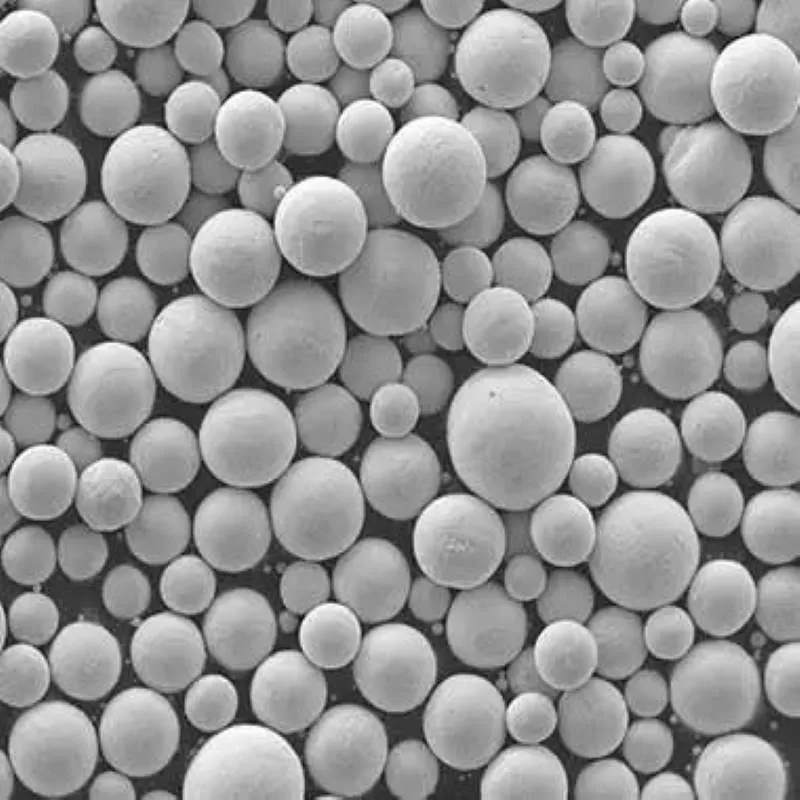
Spherical ASTM A387 Alloy Steel Powder, Grade 7, Class 1
Product Code : SP-CSTI-610-CU
We provide Spherical ASTM A387 Alloy Steel Powder, Grade 7, Class 1,Spherical ASTM A387 Alloy Steel Powder, Grade 7, Class 1 is suitable for laser/electron beam augmentation, hot isostatic pressing, laser cladding, hot/cold spraying, and so on. The particles can be irregular and spherical. The particle distribution can reach the nanometer scale.,Spherical Particle Size,0-15μm,,15-45um,15-53μm, 20-63um,45-105um,45-150μm , 50-150um,75-150μm,or customized,Product purity and oxygen content can be customized according to requirements.
Please contact us if you need customized services. We will contact you with the price and availability in 24 hours.
ASTM A387 Alloy Steel Spherical Powder, Grade 7, Class 1 Product Information
-:-
For detailed product information, please contact sales.
-:
ASTM A387 Alloy Steel Spherical Powder, Grade 7, Class 1 Synonyms
-:-
For detailed product information, please contact sales.
-:
-:-
For detailed product information, please contact sales.
-:
Spherical ASTM A387 Alloy Steel Powder, Grade 7, Class 1 characteristics
-:-
For detailed product information, please contact sales.
-:
Spherical ASTM A387 Alloy Steel Powder, Grade 7, Class 1 Particle Size
-:-
For detailed product information, please contact sales.
-:
-:-
-:-
0-15μm ,5-25μm, 15-45μm, 15-53μm,20-63um, 45-75μm, 45-105μm, 45-150μm ,75-150μm.
(Various granularities can be customized according to customer requirements)
-:-
For detailed product information, please contact sales.
-:
Spherical ASTM A387 Alloy Steel Powder, Grade 7, Class 1 Applicable processes
-:-
For detailed product information, please contact sales.
-:
Laser/electron beam additive manufacturing (SLM/EBM, 3D printing)
Direct laser deposition (DLD)
Used in thermal spray (TSA)
Powder hot isostatic pressing (HIP)
Metal injection molding (MIM)
Powder metallurgy (PM)
Laser cladding (LC), etc.
-:-
For detailed product information, please contact sales.
-:
Spherical ASTM A387 Alloy Steel Powder, Grade 7, Class 1 Chemical Composition
-:-
For detailed product information, please contact sales.
-:
-:-
For detailed product information, please contact sales.
-:
ASTM A387 Alloy Steel, Grade 7, Class 1 Product Information
-:-
For detailed product information, please contact sales.
-:
# **Product Introduction: ASTM A387 Grade 7 Class 1 Alloy Steel Plate**
**ASTM A387 Grade 7 Class 1** is a medium-high chromium-molybdenum alloy steel plate designed specifically for **elevated temperature and high-pressure service** in welded pressure vessel applications. The "Grade 7" designation refers to its alloy composition containing **7-9% Chromium and 0.9-1.1% Molybdenum**, while "Class 1" indicates the material is supplied in the **as-rolled or as-supplied condition** without mandatory final heat treatment from the mill (though fabrication typically requires post-weld heat treatment).
This grade offers **significantly enhanced oxidation resistance and high-temperature strength** compared to lower chromium grades (Grade 2, Grade 5), making it suitable for more severe service environments where corrosion resistance and creep strength are critical design factors.
---
## **1. Key International Standards**
* **Primary Material Standard:** **ASTM A387/A387M** - Standard Specification for Pressure Vessel Plates, Alloy Steel, Chromium-Molybdenum
* **Common Supplementary Standards:**
* **ASTM A20/A20M:** General Requirements for Steel Plates for Pressure Vessels
* **ASME Section II, Part A:** Adopted as **SA-387 Grade 7 Class 1** in the ASME Boiler and Pressure Vessel Code
* **EN 10028-2:** Comparable European standard is **P7** (approximately 1.7317)
* **ISO 9328-2:** International equivalent specification
---
## **2. Chemical Composition (Weight %, ASTM A387)**
| Element | Composition (%) | Key Characteristics |
|---------|----------------|----------------------|
| Carbon (C) | 0.15 max | Controlled for weldability and toughness |
| Manganese (Mn) | 0.30-0.60 | Deoxidizer and strength enhancer |
| Phosphorus (P) | 0.035 max | Impurity control |
| Sulfur (S) | 0.035 max | Impurity control |
| Silicon (Si) | 0.50-1.00 | Deoxidizer, improves high-temperature strength |
| Chromium (Cr) | 7.00-9.00 | **Primary alloy:** Provides oxidation and corrosion resistance |
| Molybdenum (Mo) | 0.90-1.10 | **Key alloy:** Enhances high-temperature strength and creep resistance |
*Note: The balanced chromium-molybdenum ratio optimizes both corrosion resistance and mechanical properties at elevated temperatures.*
---
## **3. Mechanical & Physical Properties (Class 1, As-Rolled Condition)**
### **Mechanical Properties:**
- **Tensile Strength:** **415-585 MPa** (60,000-85,000 psi)
- **Yield Strength (min):** **205 MPa** (30,000 psi)
- **Elongation in 2 in. (50 mm):** 18% minimum
- **Reduction of Area:** Typically 45-55%
- **Hardness Range:** 170-230 HB (Brinell)
### **Physical Properties:**
| Property | Value | Conditions |
|----------|-------|------------|
| Density | 7.80 g/cm³ (0.282 lb/in³) | Room temperature |
| Modulus of Elasticity | 200 GPa (29×10⁶ psi) | Room temperature |
| Thermal Conductivity | 34-38 W/m·K | 100°C (212°F) |
| Specific Heat | 460-480 J/kg·K | 100°C (212°F) |
| Thermal Expansion Coefficient | 11.2×10⁻⁶/K | 20-100°C (68-212°F) |
| Electrical Resistivity | 0.55-0.60 μΩ·m | Room temperature |
---
## **4. Key Characteristics & Advantages**
### **High-Temperature Performance:**
- **Oxidation Resistance:** Excellent resistance to scaling and oxidation up to **650°C (1200°F)** due to the 7-9% chromium content, which forms a stable protective oxide layer
- **Creep Strength:** Superior creep rupture strength compared to lower-grade Cr-Mo steels, maintaining structural integrity under long-term stress at elevated temperatures
- **Thermal Fatigue Resistance:** Good resistance to cracking under cyclic thermal stress conditions
### **Corrosion Resistance:**
- **Sulfidation Resistance:** Enhanced resistance to sulfur attack in refining environments
- **Hydrogen Resistance:** Suitable for hydrogen service at elevated temperatures and pressures
- **General Corrosion:** Better general corrosion resistance than carbon and low-alloy steels in many chemical environments
### **Fabrication Characteristics:**
- **Formability:** Can be hot formed with proper procedures; cold forming possible with appropriate techniques
- **Machinability:** Moderate machinability rating (approximately 60% of 1212 steel)
- **Weldability:** Requires careful procedure but can be welded successfully with appropriate preheat and post-weld heat treatment
---
## **5. Product Applications**
### **Petrochemical & Refining Industry:**
- **Hydrocracking Units:** Reactor vessels, hot separators, and transfer lines
- **Catalytic Reforming:** Reactor shells and associated high-temperature piping
- **Sulfur Recovery Units:** Process equipment exposed to corrosive gases
- **Delayed Coking Units:** Drums and critical piping systems
- **Hydrotreating Reactors:** For services beyond the capability of lower-alloy steels
### **Power Generation:**
- **High-Temperature Steam Piping:** Headers and main steam lines in conventional power plants
- **Heat Recovery Steam Generators (HRSGs):** High-temperature sections and superheater components
- **Fossil Fuel Boilers:** Pressure parts operating at elevated temperatures
### **Chemical Processing:**
- **High-Temperature Reactors:** For processes involving corrosive media
- **Heat Exchangers:** Shells and tube sheets in severe service
- **Process Vessels:** Operating at temperatures beyond the capability of Grade 5 materials
---
## **6. Heat Treatment & Fabrication Considerations**
### **Manufacturer's Condition (Class 1):**
- Supplied in as-rolled condition
- No mandatory heat treatment from mill
- Fabricator responsible for final heat treatment
### **Recommended Fabrication Heat Treatments:**
1. **Normalizing:** 925-1000°C (1700-1830°F) followed by air cooling
2. **Tempering:** 650-750°C (1200-1380°F) for 1-2 hours per inch of thickness
3. **Stress Relieving:** 650-700°C (1200-1290°F) for welded assemblies
### **Welding Requirements:**
- **Preheat Temperature:** 200-300°C (400-570°F) minimum
- **Interpass Temperature:** 250-350°C (480-660°F)
- **Post-Weld Heat Treatment (PWHT):** **Mandatory** at 680-750°C (1250-1380°F) for sufficient time (typically 1 hour per inch of thickness)
- **Filler Metals:** AWS A5.5 E90XX-B9 or equivalent chromium-molybdenum electrodes
### **Important Fabrication Notes:**
- Slow cooling after welding to prevent hardening
- Avoid thermal shocks during heating and cooling cycles
- Strict control of heat treatment temperatures to prevent excessive grain growth or inadequate tempering
- Non-destructive testing recommended after welding and heat treatment
---
## **7. Comparison with Other Grades**
| Property | Grade 7 vs. Grade 5 | Grade 7 vs. Grade 9 |
|----------|---------------------|---------------------|
| Chromium Content | Higher (7-9% vs. 4-6%) | Lower (7-9% vs. 8-10%) |
| Oxidation Resistance | Superior to Grade 5 | Slightly inferior to Grade 9 |
| Cost | Higher than Grade 5 | Lower than Grade 9 |
| Temperature Limit | ~650°C vs. ~600°C for Grade 5 | ~650°C vs. ~700°C for Grade 9 |
| Weldability | More challenging than Grade 5 | Similar to Grade 9 |
---
**Technical Summary:** ASTM A387 Grade 7 Class 1 represents an intermediate chromium-molybdenum alloy steel that bridges the performance gap between conventional low-alloy steels (Grade 2, 5) and higher alloy grades (Grade 9, 91). Its balanced composition provides an optimal combination of elevated temperature strength, oxidation resistance, and fabricability for demanding pressure vessel applications in the energy and chemical processing industries. Proper fabrication techniques, including mandatory post-weld heat treatment, are essential to achieve the desired service performance and safety margins.
-:-
For detailed product information, please contact sales.
-:
ASTM A387 Alloy Steel, Grade 7, Class 1 Specification
Dimensions
Size:
Diameter 20-1000 mm Length <6003 mm
Size:We can customized as required
Standard:
Per your request or drawing
We can customized as required
Properties(Theoretical)
Chemical Composition
-:-
For detailed product information, please contact sales.
-:
ASTM A387 Alloy Steel, Grade 7, Class 1 Properties
-:-
For detailed product information, please contact sales.
-:
Spherical ASTM A387 Alloy Steel Powder, Grade 7, Class 1 Particle Size Description
-:-
For detailed product information, please contact sales.
-:
Applications of Spherical ASTM A387 Alloy Steel Powder, Grade 7, Class 1
-:-
For detailed product information, please contact sales.
-:
-:-
For detailed product information, please contact sales.
-:
Applications of ASTM A387 Alloy Steel Spherical Powder, Grade 7, Class 1
-:-
For detailed product information, please contact sales.
-:
Chemical Identifiers ASTM A387 Alloy Steel Spherical Powder, Grade 7, Class 1
-:-
For detailed product information, please contact sales.
-:
Packing of ASTM A387 Alloy Steel Spherical Powder, Grade 7, Class 1
-:-
For detailed product information, please contact sales.
-:
Standard Packing:
-:-
For detailed product information, please contact sales.
-:
Typical bulk packaging includes palletized plastic 5 gallon/25 kg. pails, fiber and Steel Spherical Powder drums to 1 ton super sacks in full container (FCL) or truck load (T/L) quantities. Research and sample quantities and hygroscopic, oxidizing or other air sensitive materials may be packaged under argon or vacuum. Solutions are packaged in polypropylene, plastic or glass jars up to palletized 2474 gallon liquid totes Special package is available on request. E FORUs’ is carefully handled to minimize damage during storage and transportation and to preserve the quality of our products in their original condition