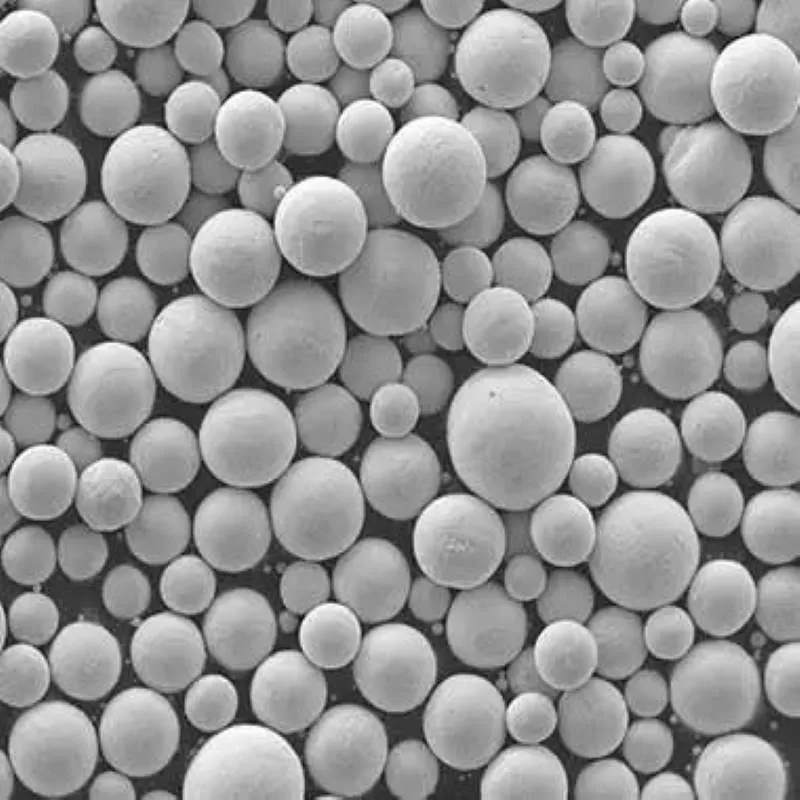
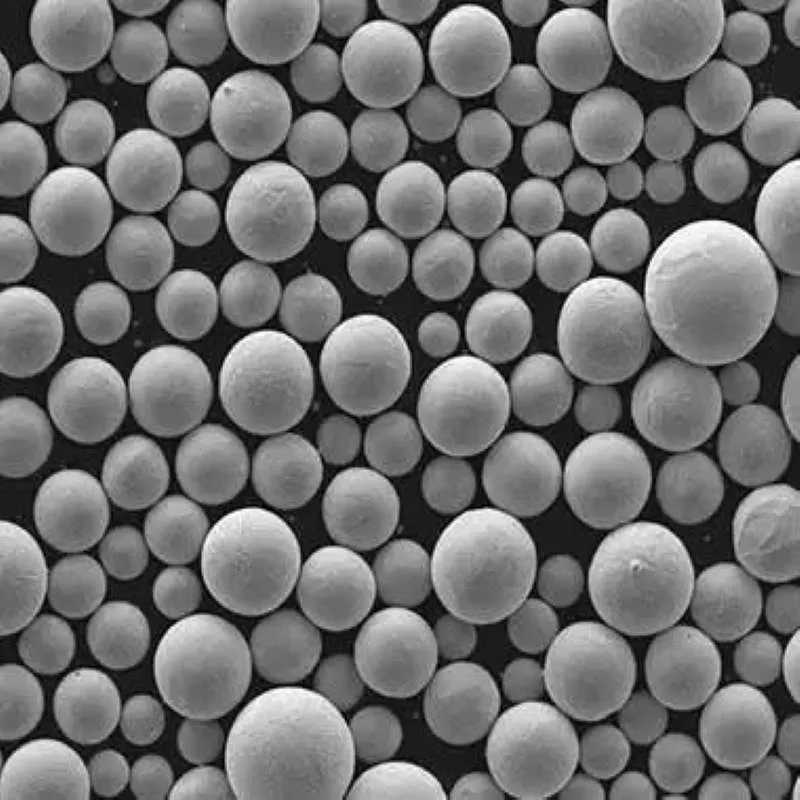
Spherical ASTM A387 Alloy Steel Powder, Grade 9, Class 2
Product Code : SP-CSTI-614-CU
We provide Spherical ASTM A387 Alloy Steel Powder, Grade 9, Class 2,Spherical ASTM A387 Alloy Steel Powder, Grade 9, Class 2 is suitable for laser/electron beam augmentation, hot isostatic pressing, laser cladding, hot/cold spraying, and so on. The particles can be irregular and spherical. The particle distribution can reach the nanometer scale.,Spherical Particle Size,0-15μm,,15-45um,15-53μm, 20-63um,45-105um,45-150μm , 50-150um,75-150μm,or customized,Product purity and oxygen content can be customized according to requirements.
Please contact us if you need customized services. We will contact you with the price and availability in 24 hours.
ASTM A387 Alloy Steel Spherical Powder, Grade 9, Class 2 Product Information
-:-
For detailed product information, please contact sales.
-:
ASTM A387 Alloy Steel Spherical Powder, Grade 9, Class 2 Synonyms
-:-
For detailed product information, please contact sales.
-:
-:-
For detailed product information, please contact sales.
-:
Spherical ASTM A387 Alloy Steel Powder, Grade 9, Class 2 characteristics
-:-
For detailed product information, please contact sales.
-:
Spherical ASTM A387 Alloy Steel Powder, Grade 9, Class 2 Particle Size
-:-
For detailed product information, please contact sales.
-:
-:-
-:-
0-15μm ,5-25μm, 15-45μm, 15-53μm,20-63um, 45-75μm, 45-105μm, 45-150μm ,75-150μm.
(Various granularities can be customized according to customer requirements)
-:-
For detailed product information, please contact sales.
-:
Spherical ASTM A387 Alloy Steel Powder, Grade 9, Class 2 Applicable processes
-:-
For detailed product information, please contact sales.
-:
Laser/electron beam additive manufacturing (SLM/EBM, 3D printing)
Direct laser deposition (DLD)
Used in thermal spray (TSA)
Powder hot isostatic pressing (HIP)
Metal injection molding (MIM)
Powder metallurgy (PM)
Laser cladding (LC), etc.
-:-
For detailed product information, please contact sales.
-:
Spherical ASTM A387 Alloy Steel Powder, Grade 9, Class 2 Chemical Composition
-:-
For detailed product information, please contact sales.
-:
-:-
For detailed product information, please contact sales.
-:
ASTM A387 Alloy Steel, Grade 9, Class 2 Product Information
-:-
For detailed product information, please contact sales.
-:
# **Product Introduction: ASTM A387 Grade 9 Class 2 Alloy Steel Plate**
**ASTM A387 Grade 9 Class 2** is a premium-grade chromium-molybdenum alloy steel plate supplied in the **normalized and tempered (N&T) heat treatment condition** for high-temperature pressure vessel applications. The material maintains the identical chemical composition as Grade 9 Class 1 (8-10% Chromium, 0.9-1.1% Molybdenum) but with the critical distinction of mill-applied heat treatment that ensures superior mechanical properties, enhanced toughness, and optimal microstructural uniformity.
This material represents the highest quality supply condition for conventional 9Cr-1Mo steel, offering designers guaranteed minimum properties and fabricators a consistent, predictable base material for critical elevated temperature components where reliability and performance consistency are paramount.
---
## **1. Key International Standards**
* **Primary Material Standard:** **ASTM A387/A387M** - Standard Specification for Pressure Vessel Plates, Alloy Steel, Chromium-Molybdenum
* **Common Supplementary Standards:**
* **ASTM A20/A20M:** General Requirements for Steel Plates for Pressure Vessels
* **ASME Section II, Part A:** Adopted as **SA-387 Grade 9 Class 2** in the ASME Boiler and Pressure Vessel Code
* **EN 10028-2:** Comparable European standard is **P9** (1.7380) typically supplied normalized and tempered
* **ISO 9328-2:** International specification for pressure vessel steels
---
## **2. Chemical Composition (Weight %, ASTM A387)**
| Element | Composition (%) | Metallurgical Significance |
|---------|----------------|----------------------------|
| Carbon (C) | 0.15 max | Controls strength; lower than Grade 91 for better weldability |
| Manganese (Mn) | 0.30-0.60 | Enhances hardenability and deoxidation |
| Phosphorus (P) | 0.030 max | Strict control for improved toughness |
| Sulfur (S) | 0.030 max | Controlled for reduced inclusions |
| Silicon (Si) | 0.25-1.00 | Deoxidizer and ferrite strengthener |
| **Chromium (Cr)** | **8.00-10.00** | **Provides oxidation resistance via protective Cr₂O₃ layer formation** |
| **Molybdenum (Mo)** | **0.90-1.10** | **Enhances elevated temperature strength and reduces temper embrittlement** |
| Nickel (Ni) | Not specified (typically ≤0.40) | May be present as residual |
*Critical Note: The absence of vanadium (V) and niobium (Nb) distinguishes Grade 9 from the advanced Grade 91, resulting in different strengthening mechanisms and heat treatment responses.*
---
## **3. Mechanical & Physical Properties (Class 2, N&T Condition)**
### **Room Temperature Mechanical Properties (Guaranteed Minimum):**
- **Tensile Strength:** **415-585 MPa** (60,000-85,000 psi)
- **Yield Strength (0.2% offset, min):** **240 MPa** (35,000 psi) *[Higher than Class 1 minimum of 205 MPa]*
- **Elongation in 2 in. (50 mm):** 18% minimum
- **Reduction of Area:** Typically 50-65% (improved over Class 1)
- **Hardness Range:** 180-230 HB (Brinell)
- **Charpy V-Notch Impact Toughness:** Typically **40-75 J (30-55 ft-lb)** at 21°C - **significantly enhanced over Class 1**
### **Elevated Temperature Performance:**
- **Maximum Recommended Service Temperature:** **650°C (1200°F)**
- **Creep Strength:** Adequate for design stresses up to ~575°C (1067°F)
- **Oxidation Resistance:** Good protection up to 650°C due to chromium content
- **Thermal Fatigue Resistance:** Improved over Class 1 due to refined microstructure
### **Physical Properties:**
| Property | Value | Conditions/Notes |
|----------|-------|------------------|
| Density | 7.78 g/cm³ (0.281 lb/in³) | Room temperature |
| Modulus of Elasticity | 202 GPa (29.3×10⁶ psi) | 21°C (70°F) |
| Thermal Conductivity | 29-33 W/m·K | 500°C (932°F) |
| Specific Heat Capacity | 580-600 J/kg·K | 500°C (932°F) |
| Mean Coefficient of Thermal Expansion | 11.5×10⁻⁶/K | 20-600°C (68-1112°F) |
| Thermal Diffusivity | 8.0-8.5 mm²/s | 500°C (932°F) |
---
## **4. Microstructure & Heat Treatment**
### **Mill Heat Treatment (Class 2 Condition):**
1. **Normalizing:** **925-980°C (1697-1796°F)** - Austenitizing to dissolve carbides and homogenize
2. **Tempering:** **700-750°C (1292-1382°F)** - Typically 1-2 hours per inch of thickness
3. **Cooling:** Air cooling after both treatments
### **Resulting Microstructure:**
- **Tempered Martensite/Bainite** (depending on cooling rate from normalizing)
- Fine dispersion of M₂₃C₆ chromium carbides
- Absence of vanadium/niobium carbides (differentiating from Grade 91)
- Uniform grain structure with ASTM grain size typically 5-7
### **Transformation Characteristics:**
- **Ac₁:** ~800-830°C (1472-1526°F)
- **Ac₃:** ~890-920°C (1634-1688°F)
- **Martensite Start (Mₛ):** ~380-420°C (716-788°F)
---
## **5. Key Advantages of Class 2 vs. Class 1**
### **Enhanced Mechanical Properties:**
- **Higher Guaranteed Yield Strength:** 240 MPa vs. 205 MPa minimum
- **Superior Toughness:** Consistently higher impact values due to tempered microstructure
- **Property Uniformity:** Consistent through-thickness properties in thick sections
- **Improved Ductility:** Better elongation and reduction of area values
### **Fabrication Benefits:**
- **Reduced Fabricator Heat Treatment:** May require only PWHT rather than full re-normalizing
- **Predictable Welding Response:** More consistent HAZ properties
- **Better Formability:** More uniform response to bending and shaping operations
- **Reduced Risk of Cracking:** Lower residual stresses from mill heat treatment
### **Design & Reliability Advantages:**
- **Higher Design Allowables:** Can utilize higher yield strength in calculations
- **Improved Fracture Resistance:** Essential for cyclic service and low-temperature startups
- **Consistent Performance:** Reduced property scatter across plates and heats
---
## **6. Product Applications**
### **Power Generation (Primary Sector):**
- **High-Temperature Steam Piping:** Main and reheat steam lines up to 600°C
- **Steam Headers & Manifolds:** For subcritical and some supercritical boilers
- **Heat Recovery Steam Generators (HRSGs):** High-pressure evaporators and superheaters
- **Steam Drums:** For high-temperature, high-pressure service
- **Attemperator Stations:** Desuperheater piping and components
### **Petrochemical & Refining:**
- **Hydrocracker Units:** Hot high-pressure separators, reactor effluent lines
- **Catalytic Cracking:** Regenerator cyclones, reactor vapor lines
- **Reformer Units:** Process piping and heat exchanger shells
- **Sulfur Recovery Plants:** Claus process reactors and associated piping
- **Hydrotreater Reactors:** For severe service conditions
### **Chemical Processing:**
- **High-Temperature Reactors:** Ammonia, methanol, and ethylene production
- **Process Heaters:** Convection and radiant section tubing
- **Waste Heat Boilers:** High-temperature sections
### **Oil & Gas:**
- **Production Separators:** For high-temperature, high-pressure wells
- **Gas Compression Systems:** Discharge coolers and piping
- **LNG Heat Exchangers:** Warm sections of heat exchange systems
---
## **7. Fabrication Guidelines**
### **Welding Procedures:**
- **Preheat Temperature:** **150-250°C (300-480°F)** mandatory
- **Interpass Temperature:** **200-300°C (392-572°F)** maximum
- **Filler Metals:** AWS A5.5 E80XX-B8 or AWS A5.28 ER80S-B8
- Common: E8018-B8, E8015-B8
- Matching composition for optimal properties
- **Post-Weld Heat Treatment (PWHT):** **Mandatory**
- Temperature: **700-750°C (1292-1382°F)**
- Time: Minimum 1 hour per inch (25 mm) thickness
- Critical: PWHT temperature must NOT exceed the original tempering temperature
### **Forming Operations:**
- **Cold Forming:** Possible with radius ≥3t (t = thickness)
- **Hot Forming:** Recommended above 850°C (1562°F)
- If heated above 925°C (1697°F), re-normalizing and tempering required
- If heated between Ac₁ and 925°C, tempering only may suffice
- **Machining:** Use positive rake tools, adequate cooling/lubrication
### **Critical Fabrication Controls:**
1. **Temperature Monitoring:** Continuous during all thermal operations
2. **Heating/Cooling Rates:** Typically ≤200°C/h (360°F/h) to prevent distortion
3. **Avoid Contamination:** Particularly from copper, zinc, and low-melting-point metals
4. **Cleaning:** Remove all scale, oil, and contaminants before heating
---
## **8. Comparison with Related Grades**
| Parameter | Grade 9 Class 2 vs. Grade 9 Class 1 | Grade 9 Class 2 vs. Grade 91 | Grade 9 Class 2 vs. Grade 7 Class 2 |
|-----------|--------------------------------------|------------------------------|-------------------------------------|
| **Yield Strength** | Higher (240 vs. 205 MPa min) | Lower (240 vs. 415 MPa min) | Higher (240 vs. 240 MPa min) |
| **Toughness** | Superior | Generally comparable | Superior (higher Cr content) |
| **Creep Strength** | Similar | Significantly lower | Better (higher Mo content) |
| **Maximum Temperature** | Similar (650°C) | Similar (625°C) | Similar (650°C) |
| **Oxidation Resistance** | Similar | Similar | Better (8-10% vs. 7-9% Cr) |
| **Fabrication Complexity** | Lower (N&T from mill) | Higher (strict HT controls) | Similar |
| **Cost Premium** | 10-20% over Class 1 | 20-40% over Grade 9 | 15-25% over Grade 7 |
---
## **9. Quality Assurance & Testing**
### **Mandatory Testing (per ASTM A387/A20):**
- Chemical analysis (ladle and product)
- Tensile testing (longitudinal and transverse)
- Hardness testing (Brinell typically)
- Charpy V-notch impact testing (often specified)
- Dimensional verification
### **Additional Testing (Commonly Specified):**
- Ultrasonic examination (UT) to ASTM A435/A577
- Macroetch examination
- Grain size determination
- Elevated temperature tensile tests
- Creep/stress rupture tests (for qualification)
### **Certification & Documentation:**
- Mill Test Certificate to EN 10204 3.1 or equivalent
- Heat treatment charts with complete time-temperature records
- Non-destructive testing reports
- Full traceability to original heat number
---
## **10. Design & Selection Considerations**
### **When to Specify Grade 9 Class 2:**
1. **Thick-Section Components:** Where through-thickness properties are critical
2. **Cyclic Service:** Applications with frequent thermal/pressure cycles
3. **Low-Temperature Exposure:** Components subject to low-temperature startup
4. **Critical Pressure Parts:** Where maximum reliability is required
5. **Fabrication Efficiency:** When minimizing post-forming heat treatment is beneficial
### **Economic Considerations:**
- **Higher Initial Cost** than Class 1 but potential **lower total installed cost**
- **Reduced Fabrication Risk:** More predictable material behavior
- **Lifecycle Benefits:** Extended service life in demanding applications
- **Insurance Advantages:** Often preferred for critical equipment
### **Limitations & Constraints:**
- **Not for Ultra-High Temperature:** Where Grade 91 performance is required
- **Thickness Limitations:** Typically available up to 150mm (6 inches)
- **Specialized Fabrication:** Requires experienced fabricators
- **Heat Treatment Sensitivity:** Must avoid overtempering during PWHT
---
## **11. Maintenance & In-Service Considerations**
### **Operational Monitoring:**
- Regular visual inspection for oxidation/scaling
- Hardness testing during outages to detect overtempering
- Dimensional checks for creep deformation
- Non-destructive testing of critical welds
### **Repair & Maintenance Welding:**
- Follow original welding procedures
- Local PWHT may be required for repairs
- Consider dissimilar welding if repair materials differ
### **End-of-Life Considerations:**
- Potential for embrittlement after very long-term service
- Possible microstructural degradation (graphitization) above 450°C
- Environmental cracking susceptibility in certain media
---
**Technical Summary:** ASTM A387 Grade 9 Class 2 represents the optimal supply condition for conventional 9Cr-1Mo steel, delivering guaranteed enhanced mechanical properties through mill-applied normalizing and tempering. It provides a balanced combination of elevated temperature strength, oxidation resistance, and fabricability for demanding pressure vessel applications up to approximately 650°C. While lacking the advanced precipitation strengthening of Grade 91, it offers simpler fabrication requirements and excellent performance for a wide range of high-temperature applications in power generation, petrochemical, and process industries. The Class 2 condition provides designers with higher design allowables and fabricators with a more consistent, predictable material, ultimately contributing to safer, more reliable pressure equipment with potentially lower total lifecycle costs.
-:-
For detailed product information, please contact sales.
-:
ASTM A387 Alloy Steel, Grade 9, Class 2 Specification
Dimensions
Size:
Diameter 20-1000 mm Length <6007 mm
Size:We can customized as required
Standard:
Per your request or drawing
We can customized as required
Properties(Theoretical)
Chemical Composition
-:-
For detailed product information, please contact sales.
-:
ASTM A387 Alloy Steel, Grade 9, Class 2 Properties
-:-
For detailed product information, please contact sales.
-:
Spherical ASTM A387 Alloy Steel Powder, Grade 9, Class 2 Particle Size Description
-:-
For detailed product information, please contact sales.
-:
Applications of Spherical ASTM A387 Alloy Steel Powder, Grade 9, Class 2
-:-
For detailed product information, please contact sales.
-:
-:-
For detailed product information, please contact sales.
-:
Applications of ASTM A387 Alloy Steel Spherical Powder, Grade 9, Class 2
-:-
For detailed product information, please contact sales.
-:
Chemical Identifiers ASTM A387 Alloy Steel Spherical Powder, Grade 9, Class 2
-:-
For detailed product information, please contact sales.
-:
Packing of ASTM A387 Alloy Steel Spherical Powder, Grade 9, Class 2
-:-
For detailed product information, please contact sales.
-:
Standard Packing:
-:-
For detailed product information, please contact sales.
-:
Typical bulk packaging includes palletized plastic 5 gallon/25 kg. pails, fiber and Steel Spherical Powder drums to 1 ton super sacks in full container (FCL) or truck load (T/L) quantities. Research and sample quantities and hygroscopic, oxidizing or other air sensitive materials may be packaged under argon or vacuum. Solutions are packaged in polypropylene, plastic or glass jars up to palletized 2478 gallon liquid totes Special package is available on request. E FORUs’ is carefully handled to minimize damage during storage and transportation and to preserve the quality of our products in their original condition